Showing posts with label globalisation. Show all posts

Monday, July 29, 2013

Capability building in China

All too often in the UK we hear senior business leaders and politicians bemoaning the lack of skilled labour.  But China 30 or so years ago had very few skilled staff.  So how did they progress to be the world's leading manufacturer and exporter?


Article|McKinsey Quarterly

Capability building in China

Skill building must be rewards-based, rooted in real work, and tailored to local conditions.


July 2013 | byKarel Eloot, Gernot Strube, and Arthur Wang
Capability building—leadership, managerial, and team-based skills rather than technical ones—has become an urgent imperative for many companies in China. As the country loses its extreme low-cost-labor advantage, businesses must look for ways to increase productivity and internal collaboration, to better understand consumers, and to develop a more sophisticated appetite for risk.
Companies in China face many of the same challenges—a lack of up-front planning and inadequate resources—that bedevil capability-building exercises everywhere. But certain “China factors” stand out. For starters, the demand for managers with strong leadership skills and international experience is growing significantly faster than the supply of qualified candidates. That imbalance makes it more difficult to pull off successful skill-building efforts, even for multinationals that typically invest more in training than Chinese companies do. (Indeed, one implication of China’s white-hot war for talent is that outside trainers brought in by multinational companies to set up and run new programs often move on before relevant tools and internal processes are in place.) Another perennial challenge for multinationals: the Chinese context and culture, which may require local tailoring of global approaches.
Then, of course, there are China’s state-owned enterprises. Many of them only recently converted from government departments into commercial entities and are still working to adapt to a competitive environment and adopt a true business mind-set. These companies generally lack a systematic approach to nurturing employees moving up the organizational ladder. They misconstrue capability building as a classroom activity, missing the impact of linking it to actual business. And they are too inflexible either to fire underperformers or to reward and promote employees, including managers, who change their behavior and adopt the necessary mind-sets.
While the challenges facing multinationals and state-owned enterprises differ, our experience with leaders at both kinds of organizations (as well as with private-sector Chinese companies) has highlighted the importance of some common, broadly applicable principles. In this article, we describe three that should help companies overcome many of the obstacles that have frustrated capability-building efforts in the past.

1. Relate capability building to real activities

...

2. Instill incentives and create opportunities for promotion

...

3. Don’t forget China’s unique culture

...
The solutions may sound obvious: developing Chinese teaching materials to help solve problems, building day-to-day business problems around products that participants would find in the Chinese market, and localizing global training materials through culturally appropriate metaphors and examples. But we know from experience how easy it is to overlook these issues. In our own work, we routinely use a case involving a coffee machine to teach managers about the seven types of waste and how a “lean” perspective can address them. When we recently used this case at a Chinese state-owned enterprise, however, the managers couldn’t make sense of the story, because they had never used a coffee machine. We have now adapted the context to tea making.
About the authors
Karel Eloot is a director in McKinsey’s Shanghai office; Gernot Strube is a director in the Hong Kong office, where Arthur Wang is a principal.

Tuesday, May 21, 2013

Apple 'among largest tax avoiders in US' - Senate committee

A few days ago Google claimed that the reason it seems to be paying low taxes outside of its home country is because the buklk of its taxes are paid in the US.  Apple obviously does not have the same excuse.

From - http://www.bbc.co.uk/news/business-22600984

Apple has been accused of being "among America's largest tax avoiders".
Apple chief executive Tim Cook


A Senate committee said Apple had used "a complex web of offshore entities" to avoid paying billions of dollars in US income taxes. But it said there was no indication the firm acted illegally.
Apple chief Tim Cook will go before the panel on Tuesday. In prepared testimony Apple said it did not use tax gimmicks.
The Irish Republic, home to three Apple subsidiaries, says it is not to blame for the firm's low tax payments.
The US Senate had said that Apple paid little or nothing on billions of dollars in profits placed in Irish subsidiaries.
"They are not issues that arise from the Irish taxation system," Deputy Prime Minister Eamon Gilmore told national broadcaster RTE when asked about the Senate committee report.
"They are issues that arise from the taxation systems in other jurisdictions and that is an issue that has to be addressed first of all in those jurisdictions."
Apple has a cash stockpile of $145bn (£95bn), but the Senate committee said $102bn of this was held offshore.
The company says it is one of the largest taxpayers in the US, having paid $6bn in federal corporate income tax in the 2012 fiscal year.
The Senate Permanent Subcommittee on Investigations has been examining "methods employed by multinational corporations to shift profits offshore".
Some large firms in the US have come under fire for their reluctance to repatriate their foreign earnings as they could face a top tax rate of 35%.
US corporation tax is one of the highest in the world at 35%. However, companies typically pay far less, thanks to numerous deductions and exemptions.


Sunday, May 19, 2013

'Google is cheating British taxpayers out of millions... what they are doing is just immoral': Web giant accused of running 'scandalous' tax avoidance scheme by whistleblower Read more: http://www.dailymail.co.uk/news/article-2326897/Google-tax-avoidance-row-Internet-giant-accused-scandalous-tax-avoidance-scheme-whistleblower.html#ixzz2TkN0odzA Follow us: @MailOnline on Twitter | DailyMail on Facebook

From - http://www.dailymail.co.uk/news/article-2326897/Google-tax-avoidance-row-Internet-giant-accused-scandalous-tax-avoidance-scheme-whistleblower.html

* Barney Jones said Google diverts British profits through Ireland to Bermuda 
* Former executive said company 'pulled the wool over the eyes' of HMRC
* Adds to mounting pressure on Google over its tax affairs 
* Company says all sales contracts go through its low-tax Ireland office 
* Last year, paid just £7.3million in corporation tax on UK turnover of £3billion

A former Google executive turned whistleblower says he has 100,000 emails that expose the 'immoral' tax avoidance scheme used by his former employer.
Barney Jones said the company has 'pulled the wool over the eyes of HMRC and the British population'
Barney Jones, who worked for Google from 2002 until 2006, said the company has 'pulled the wool over the eyes of HMRC and the British population'.

He claims Google has a system in place which diverts British profits through Ireland to the Bermuda tax haven and accused the company of 'cheating' the British taxpayer. 

The internet giant has been under increasing pressure about allegations of tax avoidance.
Prime Minister David Cameron will lead efforts at next month's G8 summit of world leaders to find ways of preventing multinational firms from exploiting tax loopholes.

He is due to meet Google's executive chairman Eric Schmidt tomorrow at the quarterly meeting of the prime minister's Business Advisory Group. 

Last week, Matt Brittin, a vice-president of Google, was aggressively questioned by MPs, who accused the company of 'doing evil' by using 'devious, calculated and unethical' tricks to minimise its liabilities.

It paid just £7.3million in corporation tax last year despite having a UK turnover of £3billion.

Yet, Google assert that all its sales are made in low-tax Ireland, rather than the UK, where corporation tax is just 12.5 per cent compared to 23 per cent in Britain. 

Mr Jones's earlier testimony to the PAC gave MPs such as chair Margaret Hodge further ammunition for the questioning of Mr Brittin last week.

Fury at corporate tax avoidance leads to call for a global response

From - http://www.guardian.co.uk/business/2013/may/18/corporate-tax-avoidance

Anger over the financial affairs of multinationals such as Google, Amazon and Starbucks is gathering momentum in Westminster. Now the UK is poised to lead the debate about international tax reform at next month's G8 summit.i

Google I/O developers conference
Google's approach to its taxes has been branded as evil by Margaret Hodge, chair of the public accounts committee. Photograph: John G Mabanglo/EPA
Huge orange and green cranes hover over a vast building site at King's Cross, London. Over the next three years, 2.4 acres of this site will be transformed into a million square feet of an 11-storey headquarters for the internet giant Google, no doubt chock-a-block with colourful Big Brother-house-style sofas and surreal chill-out zones that mark out its other 70 offices in 40 countries.
The property deal is estimated to have cost around £1bn and was heralded by the site's development consortium as the "most significant property transaction of recent years".
"This is a big investment by Google, we're committing further to the UK where computing and the web were invented. It's good news for Google, for London and for the UK," said Matt Brittin, vice-president for northern and central Europe, when the purchase was announced in January.
Like Amazon, Google is seeing increasing success in the UK where one in every $10 of sales is now generated. Yet both firms claim they are merely touching down on UK soil, without a "permanent establishment" and therefore are not paying tax on profits from billions of pounds worth of sales made here.
On Wednesday, Google won the advertiser of the year trophy at the 54th annual Clio Awards – the Oscars for advertising professionals. Accepting the award in New York, Robert Wong, chief creative officer of Google Creative Lab, said: "At the highest order, our job is to remind the world what it is they love about Google."
That popularity has hit a serious snag. The next day the company was branded "evil" by Margaret Hodge, chair of the public accounts committee, while this weekend Ed Miliband called it "irresponsible". "If everyone approached their tax affairs as some of these companies have approached theirs we wouldn't have a health service, we wouldn't have an education system," he said.
Along with Amazon and, before that, Starbucks, Topshop, Boots, Vodafone, Goldman Sachs and Greene King, Google is the latest to have become the target of grassroots hostility towards their aggressivetax avoidance policies. The actions of these corporations are not illegal, nor underhand, but especially when we're all supposed to be in austerity together, jarring horribly with public opinion.
Something "doesn't smell right", as the Guardian's editorial said this weekend, after it ran an account of the extent of Amazon's dealings in the UK, far wider than what its tax lawyers are implying.
The debate is now raging over whether these companies are the happy beneficiaries of a tax system knitted with loopholes, or the malicious purveyors of smoke-and-mirror accounting. HM Revenue and Customs claims the former – public opinion is rolling towards the latter. Lin Homer, chief executive of HMRC, claimed the public don't understand. Asked why she was not taking a tougher line with internet giants, she told the public accounts committee: "We see, but understand more fully, some of the information that might seem to the general public to be surprising."
But campaigners say tax collectors and leading politicians have been caught out; too engrossed in austerity plans, they are scrabbling to keep up with people who point out that there are other ways to balance the books.
"Without a doubt, they are behind the curve," said Richard Murphy, a chartered accountant, economist and founder of Tax Justice Network. "They have all been caught by surprise because this has come from civil society, a campaign that has been going on for almost a decade but has only been picked up by politicians after the banking crisis when they suddenly realised they were desperately short of cash."
He said HMRC had been ducking tax avoidance completely. He said it had powers to tackle any suspect tax returns of foreign-based companies. "If the breach is blatant, then they can act. What we haven't got is politicians who will stand up to this. It's a critical point. If the state will not stand up for its right to tax big corporations then we are in deep trouble."
UK Uncut began campaigning on the issue in 2010 and it was its legal challenge that revealed how HMRC waived a £20m bill for Goldman Sachs, as well as a £6bn bill to Vodafone. Journalists, tax experts and campaigners have been investigating and exposing the tax scams being perpetrated by big businesses for far longer – pointing out glaring loopholes in Britain's tax system.
When Matt Brittin of Google told the public accounts committee in November 2012 that Google did not have a sales presence in the UK, it was the news agency Reuters that quickly uncovered evidence to the contrary, resulting in Brittin being recalled in front of the committee on Thursday, where his company's behaviour was described as "devious, calculated and, in my view, unethical" by Margaret Hodge.
"You are a company that says you 'do no evil'. And I think that you do do evil," said Hodge, referring to Google's motto, "Don't be evil".
Amazon may also be recalled, after numerous whistleblowers from among its employees approached journalists to contest official accounts of its trading practices within Britain.
For the moment the government's line is that this is a global problem that cannot be solved unilaterally. On Monday, Google's executive chairman, Eric Schmidt, will meet David Cameron, a meeting No 10 insists is not about tax, but to do with Schmidt's role on the prime minister's business advisory group.
Labour leader Ed Miliband, who is due to give a speech to Google employees on Wednesday, has backed a "country by country" international scheme on tax declaration but says that he is concerned that no firm proposals have so far been put forward for the G8. "You have to have much greater transparency. Tax offices have to know country by country how much profit people are making, how much tax they are paying. Unless you know that you won't get to the bottom of what is happening. You have to deal with tax avoidance schemes. You have to deal with tax havens.
"We are saying there has to be a big, big push on this. It has to be done internationally and if it is not done internationally, Britain should act on its own."
All eyes will be on what, if anything, can be agreed at next month's G8 meeting in Scotland, where, as host of the event, David Cameron has pledged to put tax avoidance at the top of the agenda as he insists it is an issue for international co-operation rather than unilateral action.
And it would not be just the wealthy who would be watching the progress of the talks, said Melanie Ward, head of advocacy at ActionAid UK.

The art of hiding the loot

From - http://www.chinadaily.com.cn/sunday/2013-05/19/content_16509693.htm


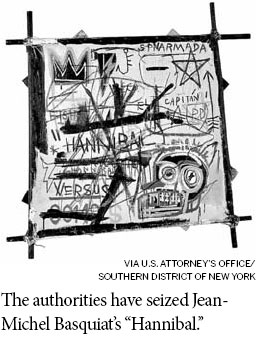
According to the air bill on the crate that arrived at New York's Kennedy International Airportfrom Londonan unnamed painting worth $100 was insideOnly later did investigators discoverthat it was by the American artist Jean-Michel Basquiat and worth $8 million.
This paintingknown as "Hannibal," was brought into the United States in 2007 as part of aBrazilian embezzler's elaborate effort to launder moneythe authorities say.
The painting's seizure was a victory in the economy-rattlingbillion-dollar fraud and money-laundering case of Edemar Cid Ferreiraa former Brazilian banker who converted some of hisloot into a 12,000-piece art collection.
Law enforcement officials in the United States and elsewhere say "Hannibalis just one ofthousands of valuable works of art being used by criminals to hide illicit profits and illegallytransfer assets around the globeAs other traditional money-laundering techniques have comeunder scrutinysmugglersdrug traffickersarms dealers and the like have increasingly turnedto the opaque art marketofficials say.
The Basel Institute on Governancea nonprofit research organization in Switzerlandwarnedlast year of the high volume of illegal and suspicious transactions involving art.
It is hard to imagine a business more custom-made for money launderingwith million-dollarsales conducted in secrecy and with virtually no oversightWhat this means in practical terms isthat "you can have a transaction where the seller is listed as 'private collectionand the buyer islisted as 'private collection,'" said Sharon Cohen Levinchief of the asset forfeiture unit of theUnited States attorney's office in Manhattan. "In any other businessno one would be able toget away with this."
Governments around the world have taken steps to bring illegal activity to lightIn Februaryforinstancethe European Commission passed rules requiring galleries to report anyone whopays for a work with more than 7,500 euros in cashand to file suspicious-transaction reports.
The art of hiding the loot
The United States similarly requires all cashtransactions of $10,000 or more to be reported.
In a forthcoming book, "Money Laundering ThroughArt," the Brazilian judge who presided over theFerreira caseFausto Martin De Sanctisargues formore regulationsaying if businesses like casinos andgem dealers must report suspicious financial activity,so should art dealers and auction houses.
But to dealers and their clientssecrecy is crucial tothe art market's mystique and practiceThe ArtDealers Association of America dismissed the ideathat using art to launder money was even a problem.
In NewarkNew Jerseyfederal prosecutors in a civilcase recently announced the seizure of nearly $16million in fine art photographs as part of a fraud andmoney laundering scheme that prosecutors say wasengineered by Philip Rivkina Texas businessman.
MrRivkinwho has not been charged with any crimes,was last thought to be in Spain and had arranged to have the photos shipped there.
In New Yorkvictims of the scams of the disbarred lawyer Marc Dreier are still in court fightingover art he bought with some of the $700 million stolen from hedge funds and investorsAt themoment 28 works by artists like MatisseWarholRothko and Damien Hirst are being held bythe federal government.
"Hannibalalso sits in storageThat 1982 Basquiat work was part of a spectacular collectionthat MrFerreira assembled while he controlled Banco Santos in Brazil.
In 2004 MrFerreira's financial empirebuilt partly on embezzled fundscollapsedleaving $1billion in debtsA court in Sao Paulo sentenced him in 2006 to 21 years in prison for bankfraudtax evasion and money launderinga conviction he is appealingBefore his arrest,howeverart worth more than $30 millionowned by MrFerreira and his wifeMarciawassmuggled out of BrazilJudge De Sanctis said.
According to court papers, "Hannibalwas bought for $1 million in 2004 by a Panamaniancompany called Broadening-Info Enterpriseswhich later tried to sell the painting for $5 million.It was sent to New York in 2007, passing through the hands of four shipping agents in twocountries before landing at Kennedy International.
Since merchandise valued at less than $200 may enter the United States without customsdocumentationduty or tax, "Hannibal," labeled as worth $100, was cleared for entry before theplane landed.
Philip BylerBroadening's lawyer in New Yorksaid the inaccurate invoices were just ashortsighted attempt by the art dealer that Broadening hired to save importation fees. "It wasnot done with the intention of smuggling," he saidHe also challenged the Brazilian authorities'claimsaying that "Hannibalwas legally purchased from a company owned by MrFerreira'swife.
MrByler said that Broadening intends to appeal the forfeiture.

Thursday, April 25, 2013

We pay £6m tax on £2.6bn UK profits, but that's OK because we help start-ups: Google


Senior MPs called on David Cameron to consider stripping the boss of Google from his role as a government adviser tonight after he suggested that his company’s contribution to the British economy was more important than paying its fair share of tax.

Politicians from all three parties rounded on Google’s executive chairman, Eric Schmidt, after he defended its use of loopholes to minimise its UK tax bill. He insisted that Google would comply only with the letter of the law – despite paying only £6m of taxes on £2.6bn of revenue generated in the  UK in 2011. Google uses anomalies in international law to move profits into low-tax jurisdictions even if they have been generated by business carried out in Britain. Chancellor George Osborne has made tackling the practice a priority for Britain’s chairmanship of the G8.

But in an interview with the BBC, Mr Schmidt defended his company’s practice, suggesting that its contribution to the UK economy was more important than the tax it paid to the Exchequer. “We are investing heavily in Britain,” he said. “We power literally billions of pounds of start-ups through advertising networks and so forth, and we’re a key part of the electronic commerce expansion of Britain, which is driving a lot of economic growth for the country. So from our perspective, I think, you have to look at it in a totality.

“The people we employ in Britain are certainly paying British taxes, and more importantly, they’re British citizens and they’re driving a lot of GDP. I think the most important thing to say about our taxes is that we fully comply with the law, and well, obviously, should the law change we’ll comply with that as well.”
His comments were condemned by MPs, who pointed out that much of the investment in broadband internet infrastructure that had allowed Google to grow had been paid for by taxpayers.

Margaret Hodge, the chairman of the powerful Commons Public Accounts Committee (PAC), which carried out an investigation into the tax practices of multinational companies, said the Government should consider whether Mr Schmidt was an appropriate person to remain on its Business Advisory Group if Google maintained its tax position. “I think we should be careful who we talk to, and I think if people want to have the voice of Government, they have a responsibility to pay their fair share,” she said.

A government source also questioned Mr Schmidt’s position, claiming Google was “not really investing very much in Britain” and that the company had a “disproportionate influence” on Mr Cameron. “It’s a bit like The Wizard of Oz,” the source said. “From the outside, they appear terribly important and powerful but, when you look closely at what they are actually investing in Britain, it is pretty insubstantial.”

Sunday, February 10, 2013

British sugar giant caught in global tax scandal

From The Guardian - http://www.guardian.co.uk/business/2013/feb/09/british-sugar-giant-tax-scandal


One of Britain's biggest multinationals, whose brands include Silver Spoon sugar, Twinings Tea and Kingsmill bread, is avoiding paying millions of pounds of tax in an African state blighted by malnutrition, a year-long investigation revealed on Sunday.
The Zambian sugar-producing subsidiary of Associated British Foods, a FTSE100 company, contributed virtually no corporation tax to the state's exchequer between 2007 and 2012, and none at all for two of those years.
The firm, Zambia Sugar, has recently posted record pre-tax profits and its huge plantation is increasing its capacity to produce more sugar for markets in Europe and Africa. Yet it paid less than 0.5% of its $123m pre-tax profits in corporation tax between 2007 and 2012.
The company benefits from generous capital allowance and tax-relief schemes in Zambia, but the investigation also found that it funnels around a third of its pre-tax profits to sister companies in tax havens, including Ireland, Mauritius and the Netherlands. Tax treaties between Zambia and some of those countries mean the state's revenue authorities are unable to charge their normal tax on money leaving their shores.
The revelations are contained in a report published by ActionAid, which exposes how Zambia Sugar has kept its contribution to the state's exchequer so low, although the company says that globally it actually pays a higher rate of tax on its profits than it otherwise would due to its corporate structure.
It is estimated that the tax haven transactions of this one British headquartered multinational deprived Zambia of a sum 14 times larger than the UK aid provided to the country to combat hunger and food insecurity.
ActionAid's findings will heap more pressure on the chancellor, George Osborne, to make progress in closing gaps in international tax standards and tackling avoidance at the G20 meeting of world leaders this week and the G8 in June.

Sunday, February 3, 2013

Inequality for All – another Inconvenient Truth?

From The Guardian - http://www.guardian.co.uk/film/2013/feb/02/inequality-for-all-us-economy-robert-reich


The powerful documentary Inequality for All was an unexpected hit at the recent Sundance film festival, arguing that US capitalism has fatally abandoned the middle classes while making the super-rich richer. Can its star, economist Robert Reich, do for economics what Al Gore did for the environment?
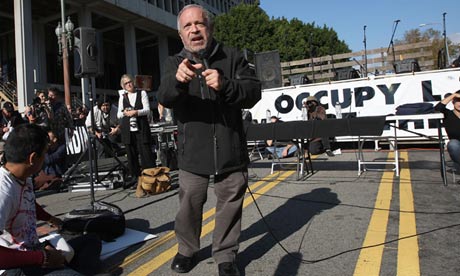
Robert Reich addresses Occupy rally
 Former US labour secretary Robert Reich at an Occupy Los Angeles rally in 2011. Photograph: David Mcnew/Getty Images

In one sense, Inequality for All is absolutely the film of the moment. We are living through tumultuous times. The economy has tanked. Austerity has cut a swath through the country. We're on the verge of a triple-dip recession. And, in another, parallel universe, a small cohort of alien beings – or as we know them, bankers – are currently engaged in trying to figure out what to spend their multimillion-pound bonuses on. Who wouldn't want to know what's going on? Or how it happened? Or why? Or if it is really true that the next generation down is well and truly shafted?

Any synopsis of the film runs the risk of making it seem dry again, but essentially it describes how the middle classes have come to have a smaller and smaller portion of the economic pie. And how, since 70% of the economy is based on the middle classes buying stuff, if they don't have any money to buy this stuff, it cannot grow. Meanwhile, the government has allowed the super-rich, the "one per cent", to take more of the nation's wealth. Half of the US's total assets are now owned by just 400 people – 400! – and, Reich contests that this is not just a threat to the economy, but also to democracy.

And what the film tries to do is thread together evidence that many people know about – the increasing struggle of the middle classes to just get by, the way that the top 1% of society has unshackled itself from the rest of us and has seen its income increase exponentially, and the ever-increasing cost of the traditional avenues of improvement, such as higher education – and weave it into a cohesive and convincing narrative. It is, in some respects, a theory of everything. Reich charts the three decades of increasing median income after the second world war, a period he calls "the great prosperity" and then examines what happened in the late 1970s to put an end to it. The economy didn't falter. It kept on growing. But wages didn't.
The figures that Reich supplies are simply gobsmacking. In 1978, the typical male US worker was making $48,000 a year (adjusted for inflation). Meanwhile the average person in the top 1% was making $390, 000. By 2010, the median wage had plummeted to $33,000, but at the top it had nearly trebled, to $1,100,000.
"Something happened in the late 1970s," we hear him tell his Berkeley class. And much of the rest of the film is working out what happened.
Some inequality is inevitable, he says. Even desirable. It's what makes capitalism tick. But at what point does it become a problem? When the middle classes (in its American sense of the 25% above and below the median wage) have so little of the economic pie that it affects not just their lives but the economy as a whole.
Reich's thesis is that since the 1970s a combination of anti-union legislation and deregulation of the markets contrived to create a situation in which the economy boomed but less of the wealth trickled down. Though for a while, nobody noticed. There were "coping mechanisms". More women entered the workforce, creating dual-income families. Working hours rose. And increasing house prices enabled people to borrow.
And then, in 2007, this all came crashing to a halt. "We have exhausted all the options," he says. There's nowhere else left to go. It's crunch time.
It's crunch time that so many working families understand too well. They may not be familiar with the theory of income inequality but they haven't been able to avoid noticing that they've got less money in their pockets. "I've always thought that kitchen-table economics is the most important topic to most people," says Reich. "Their wages, their jobs, getting by. I've always tried to relate economics to where people live. That's why I was so excited about the film."
… In the UK, Royal Bank of Scotland, having covered itself in glory in the Libor interest-rate fixing scandal, is currently contemplating bonuses for its investment banking division of £250m, according to reports last week. This, to put it another way, is the annual wage bill for at least 12,500 of its call-centre workers. Because this isn't just an American problem. It's a British one too.
"If there was upward mobility it would be OK," says Reich in the film. "But 42% of children born in poverty in the USA will stay there. In Denmark it's 24%. Even in Great Britain, where they still have an aristocracy, it's 30%."
It's probably a shocking statistic for Americans to hear. The problem is that by every index you can measure, inequality is worsening in Britain. There are fewer opportunities to overcome the barriers of your birth in the UK than in any other country in Europe. One of the most chilling moments in Inequality for All for a British audience is that how, faced with the same choices that America had in the 70s, we have, in the last year or so, taken the same path.

One of the key moments for Reich was the underinvestment in education, particularly higher education in the 70s. This was when America introduced tuition fees and its workforce started to fall behind the rest of the world's. When opportunities for those from low- and middle-income backgrounds began shrinking: precisely where the UK is today.
It's not just that wages have remained flat in America – as they have in the UK – it's that the expenses of everyday life have soared, in particular education and healthcare.
Last October, an independent commission in the UK led by the Resolution Foundation predicted that in 2020 wages for low- to middle-income families would be the same as they were in 2000. And yet everything else will have gone up. We too are facing the crunch.
In December, the Office for National Statistics found that richest 10% of people in Britain own 40% of the national wealth. In London and the south-east, one in eight households has almost £1m of assets. The bottom half of the country has no net property wealth and only £4,000 in pensions savings. For them, there is just rising prices. And the ever diminishing possibility of things ever being different for them or their children.