Showing posts with label good news. Show all posts

Monday, July 29, 2013

Capability building in China

All too often in the UK we hear senior business leaders and politicians bemoaning the lack of skilled labour.  But China 30 or so years ago had very few skilled staff.  So how did they progress to be the world's leading manufacturer and exporter?


Article|McKinsey Quarterly

Capability building in China

Skill building must be rewards-based, rooted in real work, and tailored to local conditions.


July 2013 | byKarel Eloot, Gernot Strube, and Arthur Wang
Capability building—leadership, managerial, and team-based skills rather than technical ones—has become an urgent imperative for many companies in China. As the country loses its extreme low-cost-labor advantage, businesses must look for ways to increase productivity and internal collaboration, to better understand consumers, and to develop a more sophisticated appetite for risk.
Companies in China face many of the same challenges—a lack of up-front planning and inadequate resources—that bedevil capability-building exercises everywhere. But certain “China factors” stand out. For starters, the demand for managers with strong leadership skills and international experience is growing significantly faster than the supply of qualified candidates. That imbalance makes it more difficult to pull off successful skill-building efforts, even for multinationals that typically invest more in training than Chinese companies do. (Indeed, one implication of China’s white-hot war for talent is that outside trainers brought in by multinational companies to set up and run new programs often move on before relevant tools and internal processes are in place.) Another perennial challenge for multinationals: the Chinese context and culture, which may require local tailoring of global approaches.
Then, of course, there are China’s state-owned enterprises. Many of them only recently converted from government departments into commercial entities and are still working to adapt to a competitive environment and adopt a true business mind-set. These companies generally lack a systematic approach to nurturing employees moving up the organizational ladder. They misconstrue capability building as a classroom activity, missing the impact of linking it to actual business. And they are too inflexible either to fire underperformers or to reward and promote employees, including managers, who change their behavior and adopt the necessary mind-sets.
While the challenges facing multinationals and state-owned enterprises differ, our experience with leaders at both kinds of organizations (as well as with private-sector Chinese companies) has highlighted the importance of some common, broadly applicable principles. In this article, we describe three that should help companies overcome many of the obstacles that have frustrated capability-building efforts in the past.

1. Relate capability building to real activities

...

2. Instill incentives and create opportunities for promotion

...

3. Don’t forget China’s unique culture

...
The solutions may sound obvious: developing Chinese teaching materials to help solve problems, building day-to-day business problems around products that participants would find in the Chinese market, and localizing global training materials through culturally appropriate metaphors and examples. But we know from experience how easy it is to overlook these issues. In our own work, we routinely use a case involving a coffee machine to teach managers about the seven types of waste and how a “lean” perspective can address them. When we recently used this case at a Chinese state-owned enterprise, however, the managers couldn’t make sense of the story, because they had never used a coffee machine. We have now adapted the context to tea making.
About the authors
Karel Eloot is a director in McKinsey’s Shanghai office; Gernot Strube is a director in the Hong Kong office, where Arthur Wang is a principal.

Monday, June 3, 2013

Why do we have to trawl for the facts about Britain and the EU?

Finally, the absurd fishing quota policy that sometimes results in 50% of the catch being discarded is going to change.
With fishing policy, as with Italy's attempt to ban plastic bags, our government is terrified of appearing to allow the EU to undermine British 'interests'
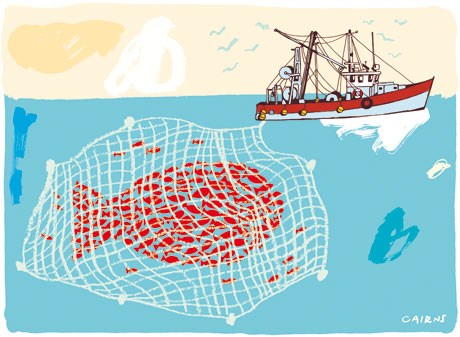
Brian Cairns illustration
For years, campaigners have been fighting against industrial fishing in European waters and last week, at long last, they had something to celebrate. Their target has been the huge factory ships that hoover up everything in their wake, discarding the dead fish they don't want – often half the catch – and returning to port with their quotas met the most profitable way. The result has not just been dwindling fish stocks – the entire marine ecosystem is under assault, including the coastal fishing communities that depend on it for their livelihood.
No one European country can make a difference by itself: fish do not respect borders. In any case, the danger for any one country acting unilaterally to husband fish stocks and ban the practice of discarding dead fish is that if others do not follow suit it will be the sucker. It will have hurt its own fishing interests just to benefit others. This is a problem that can only be solved by European countries acting together.
Last Thursday at 3am, EU members states finally agreed the outlines of a tough Common Fisheries Policy. First, there was a commitment for the first time to set quotas – based on hard scientific advice – that aim to go beyond stabilising fish stocks to achieving growth. Crucially, from 2015, boats will be forbidden from discarding unwanted dead fish, starting with species such as mackerel that live in the upper oceans, and extended to all fish types by 2020. Every country will have to submit a detailed plan for how it intends to meet its quota, but making its own decision about which types of fishing it will favour. But with discards effectively banned – inevitably, under British pressure, boats will still be allowed to discard 5% of their catch after 2020 – there will be an inbuilt bias against industrial fishing. This is a major move to help stocks.
Battle-hardened campaigners could only blink in semi-disbelief. Hugh Fearnley-Whittingstall, the leader of Fish Fight, who has signed up more than 860,000 supporters to work for tougher quotas and a ban on discards, hailed the deal as a "tremendous achievement". Even Greenpeace managed a grudging congratulation: "For all its loopholes and sluggish timelines the policy has the potential to turn Europe's destructive and oversized fishing industry into a sustainable, low-impact sector." The fishing industry acknowledged a corner had been turned.
It was a great example of an increasingly democratic EU beginning to work rather well. For the policy to become law, the European parliament will have to give its assent – and on this question it is very radical. EU fisheries ministers, managed cleverly by EU Commissioner Maria Damanaki, knew they had to come up with something strong, or parliament's endorsement would be impossible. But equally, the deal is only sellable domestically if governments accountable to national parliaments and electorates work out exactly which parts of their domestic fishing industry are going to shoulder the pain. Here is a policy that is democratically legitimate at EU and national levels, respects national sovereignty and solves a problem that no one country could solve itself.
However, this will be news to almost every reader of this column. No national newspaper printed it. It did break at 3am, but apart from the FTthere was not even online coverage and no follow-up the following day. Intriguingly, even the BBC's Today programme felt the story could be ignored; the juicy European news of the day was a BBC scoop that the EU Commission is going to take Britain to court over the government's alleged discriminatory withdrawal of welfare benefits from EU nationals. It was a good story, but listeners might also have been interested in hearing the fishing deal discussed – or even that it had happened. After all, the news was only hours old. Fish Fight does have 860,000 supporters: the effective ending of discards was hardly marginal news.
But the story did not fit the narrative. The British view, hardwired into the political and media class's DNA, is that the EU is a mess about to disintegrate under the weight of its absurd, anti-democratic ambitions to become a superstate, with its even more absurd single currency. It does nothing worthwhile, harms all British interests and we must stay disengaged or, at best, leave altogether. Every editor knows that no positive stories emanate from Brussels, and even if they do, there are no penalties for ignoring them.
It is utterly disabling. The technical reason why Britain fought so hard to continue to allow boats to discard 5% of their catch after 2020 is that allegedly in British waters, shoals of fish are more intertwined than in other waters, so catching fish that have to be discarded is more likely. Really? My hunch is that without the concession officials and ministers were terrified of Nigel Farage and Eurosceptic Tory MPs lining up with some disgruntled fishermen to claim the big bad EU had undermined British "interests".
Certainly, that was why Britain last week blocked Italy from implementing a ban on single-use plastic bags as discriminatory under EU law against British plastic bag manufacturers. Now no EU country can adopt what is clearly a sane environmental move – at one time supported by the prime minister – because of a reflex terror of a complaint by "wealth-creating" business that EU regulation is undermining British interests. (Both Wales and Northern Ireland have introduced a plastic bag levy.)
Nor will anybody have juxtaposed the richly comic spectacle of the British government prosecuting Italy for being discriminatory under EU law even as it protests against the injustice of being called discriminatory itself over welfare. Instead, there is synthetic outrage about Britain being singled out by a mutton-headed and politically insensitive European Commission. Yet the entire EU is based on the principle that there are common European interests, extending from how we fish our seas to how we explore space, that are underpinned by the notion that member states do not discriminate against each other. The rule of European law is universal, as it should be in rule-of-law societies. The Commission has no option but to uphold it.
This is a club worth staying in. It is much better for Britain's fishing industry – along with every other industry – that we are in the EU as it makes its rules. If the British are to make an informed choice about their destiny in any future referendum, then at least they deserve to know the facts. Judging by last week they will not be able to rely on their media for those or on their terrified politicians.

Sunday, May 12, 2013

Philanthropist finds giving is receiving

From: http://www.chinadaily.com.cn/china/2013-05/12/content_16492961.htm


An American philanthropist's desire to shape the minds of the leaders of tomorrow means juniorstudents in China have an opportunity to join an all-inclusive 10-day private safari tour of SouthAfrica.
Students between grades 1 to 9 win a place on the safari by participating in the second annualGlobal Natural History Day competition.
Funded by Kenneth EBehringthe chairman of the Global Health and Education Foundation,a nonprofit organization located in Californiathe GNHD competition aims to help develop thenext generation of world leaders.
Philanthropist finds giving is receiving
Kenneth EBehring (back rowfounded the annual Global Natural History Day competition in 2012 toinspire children to tackle the world's problems. [Provided to China Daily]
"It (GNHDcan stimulate and excite kids about the natural worldso they can take the lessonsof nature and become well-educatedcreative and imaginative leaders who can tackle theworld's problems," Behring tells China Daily at the 2013 GNHD competition Shandong LaunchCeremony held in April.
The 2013 GNHD competitionthemed "Great MigrationsAnimalBotanicalAnthropological",covers China and the United States.
In addition to cash prizeswinners of their respective divisions will be eligible for the "KennethEBehring Discovery Tripin February 2014, which will take winning students and teachers toSouth Africa.
The GNHD competition is only part of Behring's philanthropy effortswhich began in 2000. ThatyearBehring had an epiphany when he lifted a small Vietnamese girl from the ground andplaced her in a wheelchairThe incident turned the entrepreneur into a philanthropist.
"I saw this little girl envision a freedom she had never knownHer face opened into a smile,"Behring recalls.
"For the first time I could rememberI felt joy."
Behring was in business for nearly seven decades and was listed as one of the 400 wealthiestmen in America by Forbes Magazine.
But he wasn't happy.
"After a career filled with outward successI did not even know where to look to find realhappiness," Behring says.
The very same yearhe created the Wheelchair Foundationmarking the start of hisphilanthropic journey.
To dateBehring has given away nearly a million wheelchairs to more than 150 countries.
In 2001, Behring established a partnership with the China Disabled PersonsFederation to helpdistribute wheelchairs in ChinaSince then Behring has distributed more than 325,000wheelchairs in more than 40 cities and towns in China.
Behring is impressed by the tenacity of the physically challenged people in China.
"More often than notI meet physically disabled people in China who are good singerspaintersand craftsman."
Behring understands the huge challenge China faces in terms of physically challenged people.
"Because of its sizeChina most likely has the largest population of physically disabled peopleof any country in the worldThe government is very aware of their challenges."
But his philanthropic work in China goes beyond the GNHD project and wheelchairsBehringhas started a safe drinking water project together with local governments and departments.
The water project aims to help eliminate waterborne diseases and impurities by carrying outfeasibility studiespurchasing water purification systemsoverseeing water station constructionand sanitation quality controlas well as conducting public health and sanitation education inrural areas.
A pilot project has begun in Shanyin countyShanxi provincewhere the water contains highlevels of fluoride and arsenicAccording to Behringthe project serves 215 households of 830people within Yangzhuang villageThey charge the villagers a small fee to keep the operationsustainable.
Behring plans to open water stations in five other villages and wants physically disabled peopleto run them.

Saturday, May 11, 2013

Osborne: G7 agree to target tax evasion and avoidanc

From: http://www.bbc.co.uk/news/business-22476233


The G7 group of industrialised nations have agreed that there must be collective action against tax evasion and avoidance, the UK's finance minister has said.
Chancellor George Osborne said after the talks that it was "incredibly important" that firms and individuals paid the tax they owed.
Chancellor George Osborne at a news conference following the G7 meeting
The members agreed on more policy issues than had been assumed, he added.
The G7 comprises the US, Germany, the UK, Japan, Italy, France and Canada.
In a news conference held jointly with Bank of England governor Sir Mervyn King, Mr Osborne said the finance ministers and central bank governors of the G7, meeting in Aylesbury, Buckinghamshire, had also agreed no bank should be "too big to fail".

Friday, May 10, 2013

The net closes in on super rich tax dodgers: Spies expose how hundreds of Britons are 'hiding billions' in foreign tax havens


Hundreds of ultra-wealthy Britons are being investigated for tax evasion following the exposure of their secret offshore accounts.

International spy agencies are thought to have helped obtain a 'goldmine' of data that names high-profile multi-millionaires and their financial advisers.
The files show how the rich have hidden billions in Singapore, the British Virgin Islands and the Caymans. 
Ultra-wealthy Britons are being investigated over claims they are hiding cash in secret offshore accounts in places like the Cayman Islands (pictured)
More than 100 individuals have been identified so far – and have already been sent warning letters by HM Revenue & Customs.
'You're talking about super-rich people,' said one source, who added that many of the names on the list were well known.
Offenders face paying the tax they have dodged along with massive fines.
Officials are unsure what sums are at stake but pointed out that a crackdown on millionaires who hid money in Liechtenstein is expected to raise £3billion.
Last night George Osborne said: 'The message is simple: if you evade tax we're coming after you. This data is another weapon in HMRC's arsenal.'
The Chancellor has previously expressed shock at the extent to which the wealthy were exploiting tax loopholes.


Read more: http://www.dailymail.co.uk/news/article-2322212/The-net-closes-super-rich-tax-dodgers-Spies-expose-hundreds-Britons-hiding-billions-foreign-tax-havens.html#ixzz2SsdiSVhL
Follow us: @MailOnline on Twitter | DailyMail on Facebook

Wednesday, April 10, 2013

France's President Hollande: Eradicate tax havens

From - http://www.bbc.co.uk/news/world-europe-22094194


French President Francois Hollande has called for "eradication" of the world's tax havens and told French banks they must declare all of their subsidiaries.
French President Francois Hollande, 10 Apr 13
He was speaking after presenting a draft law aimed at "moralising" French public life - a response to the tax scandal that has shaken his presidency.
France's ex-Budget Minister Jerome Cahuzac has been charged with fraud over a secret Swiss bank account.
Mr Hollande said a new central agency would fight fraud and corruption.
Earlier the French Socialist government set a deadline of 15 April for ministers to declare their assets, as part of the new transparency drive.
Mr Cahuzac admitted last week that he had hidden about 600,000 euros (£509,000; $770,000) in a Swiss bank account, causing shock in France. He has now been expelled from the Socialist Party for lying about his financial affairs.
Addressing a news conference on Wednesday, Mr Hollande said "tax havens must be eradicated in Europe and worldwide".
"I won't hesitate to consider as a tax haven any country that refuses to co-operate fully with France."
He said French banks "will have to publish every year the full list of their subsidiaries in the world, country by country". They will also have to explain their business, he said.
"In other words it won't be possible for a bank to hide transactions carried out in a tax haven."
===============================================================
Will work if only other major countries do the same.  Will they?

Sunday, February 10, 2013

Making Sense of the "Circular Economy"

From - http://www.triplepundit.com/2013/01/make-sense-circular-economy/


 resource recovery recycling Here Today Garbage Tomorrow Heather Rogers Ellen MacArthur Foundation Ellen MacArthur ecovative Digital Lumens Dell green Circular Economy Brockelsby Ltd. 3M green
If the name Ellen MacArthur rings a bell, you’re probably thinking of the person who set a record for circumnavigating the world in a high tech sailboat, solo no less, but that’s not the only circle for which she is known. Ms. MacArthur, through the charitable organization that bears her name, has formulated an economic concept called the circular economy, which is quickly becoming a buzzword around sustainability circles.
As far as buzzwords go, “circular economy” is a fairly pedestrian combination (as opposed to, say, Sex Pistols) and perhaps that’s just as well. Rather than getting distracted by the words, it’s far more interesting to pick through the concept itself and see how MacArthur’s vision of economic growth meets the challenges of a world of shrinking resources.

The Circular Economy

MacArthur was profiled and interviewed just last week on the Harvard Business Review blog by Eric Hellweg, and for those of you who don’t have time to read the whole thing (though you really should, it’s fascinating), the circular economy concept basically boils down to managing resource scarcity in the context of consumer demand for environmental responsibility.
As described by the Ellen MacArthur Foundation, it comes out like this:
“The circular economy is a generic term for an industrial economy that is, by design or intention, restorative and in which materials flows are of two types, biological nutrients, designed to reenter the biosphere safely, and technical nutrients, which are designed to circulate at high quality without entering the biosphere.”

Why the Circular Economy is more than mere recycling

While the emphasis on reentering and circulating call recycling to mind, MacArthur’s concept of a circular economy is on a different plane entirely. The Foundation’s website is careful to note the difference by referencing Heather Rogers, journalist and author of Here Today, Garbage Tomorrow:
“One of the biggest confusions around a circular economy framework is that sparked by the word ‘recycling’…’The vast majority of wastes are created during the manufacturing process, and that is where we should focus.’”
Recycling puts the onus on consumers to use goods more carefully and to dispose of the leftovers responsibly. The circular economy asks that manufacturers produce goods that involve less waste in the first place, and that enable consumers to integrate recycling into their daily habits more intensively.

Case studies for the Circular Economy

When you look at the Foundation’s case studies, the potentials for economic growth become clear. That’s especially true when you consider that “consumers” doesn’t just mean individual householders, it also means companies that consume products through their supply chains.
The waste oil sector in England, for example, was historically focused on animal feed until new legislation targeted biofuels. The Yorkshire waste oil processor Brockelsby Ltd. adapted not only by pivoting to the biofuel market, but also by double-purposing its operations as a research and development platform to find new values for low-grade waste products, which normally would be discarded.
Another Foundation case study is Massachusetts-based Digital Lumens, which aims to help industrial customers transition out of the “criminally inefficient” incandescent light bulb into high-efficiency LEDs integrated with an energy management system. The company is transitioning, too, from an equipment sales model to a service-based model that could enable it to reclaim spent or damaged components more efficiently.
One final example is New York’s Ecovative, which produces fully compostable bio-based packaging products that stand in for petroleum-based plastics. Ecovative’s unique approach is to literally custom-grow its packages using fungi, which has caught the eye of green-transitioning companies like 3M and Dell among others.

Where the rubber hits the circular road

The sustainability foundation of the circular economy is interesting enough in itself, but real proof of the concept’s viability is the potential for economic growth.
To buttress the case for the circular economy, the Foundation has begun to issue detailed reports on the economic benefits of transitioning out of “an increasingly resource constrained ‘take-make-dispose’ model,” both in the short term and over the long run.
The first report, in 2011, took a look at the stimulating effect on European Union manufacturing sectorfrom economic activity related to product development, remanufacturing and refurbishment.
The second report just came out in 2013, and it focuses on applying the principles of the circular economyto “fast-moving” consumer goods, namely food, beverages, textiles and packaging, which also happen to account for a good deal of municipal waste while absorbing – and wasting – a significant amount of agricultural output.

Barclays to close tax unit


From The Sunday Telegraph - http://www.telegraph.co.uk/finance/newsbysector/banksandfinance/9859934/Barclays-to-close-tax-unit.html

Barclays is to close its controversial tax avoidance unit as one of the landmark measures of Antony Jenkins’ much anticipated strategy review designed to show that “Barclays is changing”.

Chief executive of Barclays global retail banking, Antony Jenkins

"The Sunday Telegraph can reveal that Mr Jenkins, who will deliver the outcome of the review on Tuesday, will say the bank will shut its structured capital markets (SCM) business.
In the mid-2000s the unit made profits of as much as £1bn in a single year and became synonymous with Barclays’ aggressive investment banking culture under the stewardship of Bob Diamond, Mr Jenkins’ predecessor as chief executive.
The unit, previously run by Barclays’ highest-paid banker, Roger Jenkins, who was paid as much as £40m a year as a result of SCM’s success, gave advice to large companies on how to avoid tax. SCM was responsible for building a network of almost 300 offshore tax-haven subsidiaries which meant Barclays itself paid only £113m of UK corporation tax in 2009, despite profits of £4.6bn.
The strategy review will be delivered at London’s Royal Horticultural Halls just hours after the bank’s full-year results for 2012, which are expected to show that Barclays will have made adjusted profits of £7.18bn, up from £5.88bn in 2011.
The review has seen Barclays split into 75 business units, each of which has been measured on the returns generated and the reputational impact of the specific activities."
Maybe other big banks and consultancies offering Tax Avoidance services will also close. Maybe pigs will fly!

Tuesday, February 5, 2013

RBS bankers must pay Libor fine, says George Osborne

From - http://www.guardian.co.uk/business/2013/feb/04/royal-bank-scotland-libor-fine-osborne

George Osborne is forcing Royal Bank of Scotland to cut its bankers' pay to ensure that taxpayers are not left to pick up the cost of the upcoming multimillion-pound fine for Libor rigging.


The chancellor said his views had been made clear to the management of the bailed-out bank in an attempt to defuse public anger about the portion of the fine – which could amount to between £400m to £500m in total – that will be paid to the US authorities.
"When it comes to RBS, I am clear that the bill for any US fine related to this investigation should on this occasion be paid for by the bankers, and not the taxpayer," Osborne said.
Speaking in Bournemouth where he unveiled plans to reform the banking system, Osborne appeared to back the RBS chief executive, Stephen Hester, but indicated he expects heads to roll as a result of the fine for rigging Libor – a key interest rate. It was "well known" that RBS was considering management changes, Osborne said.
The fine from the UK's Financial Services Authority is thought to be just under £90m with US regulators levying fines of around four times that amount. In the furore that followed the £290m Libor fine paid by Barclays last year£59.5m of which was levied by the FSA, the law was changed to ensure that fines went to the government.
"Those who were doing the supervising must also bear their share of the responsibility," Osborne said. "The RBS board and the RBS senior management are well aware of that and decisions are in hand."
He added that Hester is "taking the action to ensure those responsible are held to account".
It is expected that the departure of John Hourican, the head of the investment bank, will be announced once the Libor fine is revealed, possibly later this week, although he is not thought to be personally implicated in the rigging of Libor. The size of the bonus pool for 2012 at RBS has yet to be disclosed. It was £390m for 2011 and is expected to fall by as much as £150m. But the call by the chancellor to ensure bankers pay for the Libor fine does not preclude bonuses being paid for 2012.
Responding to questions about why senior bankers should receive bonuses after a year of scandal, Osborne acknowledged that Hester and Barclays boss Antony Jenkins have waived their bonuses.
He said there could have been "enormous public anger" if fines levied on RBS by US regulators were paid by the taxpayer, not the bankers.
"That is not on," said Osborne, who has told the bank's management that a fine imposed by international regulators should be paid out of bankers' pay. If the fine is paid by shareholders, led by taxpayers who own 83%of the bank, "that could have been a very great source of public anger this spring," said Osborne.
The chancellor confirmed remarks by Treasury sources over the weekend which had suggested he was concerned about how the Libor fine would be paid. In his speech, Osborne insisted that "everyone should exercise restraint and responsibility" over bonuses.
Osborne was accused of "rhetoric" and a "partial climbdown" by Ed Balls, the shadow chancellor, after he said he would use legislation to threaten banks with being broken up if they attempted to flout rules requiring them to ringfence their high street and investment banking operations.
Andrew Tyrie, the Conservative MP whose banking standards commission helped create the idea of "electrifying" the ringfence, said the chancellor had taken an "important step in the right direction". The ringfence was a key plank in proposals by Sir John Vickers' independent commission but the banking standards commission had been concerned banks would try to "game" the ringfence. "They will always try to do so unless strong disincentives are put in place," said Tyrie.


Chancellor insists Royal Bank of Scotland, not UK taxpayers, must take up estimated £500m fine for Libor rigging

Wednesday, November 14, 2012

Amazon receives $252 million back tax claim


It's about time all major countries suffering from tax avoidance by major international corporations followed France's lead. In all probability, Amazon will get away with a fraction of the bill, as they probably have more lawyers than the French goveernment.  But a strong message is being shouted from the rooftops.

Once again, as we have said before, why don't major countries charge a % of turnover/revenue as tax rather than as a % of profit for all companies doing more than, say, £100m pa.  If they claim they are not making a profit, then the top management should be fired by their shareholders!

From -  http://news.yahoo.com/amazon-receives-252-million-back-tax-claim-171904647--sector.html:

A box from Amazon.com is pictured on the porch of a house in Golden, Colorado July 23, 2008. REUTERS/Rick Wilking

"Internet retailer Amazon said it had received a $252 million demand from the French tax authorities for back taxes, interest and penalties in relation to "the allocation of income between foreign jurisdictions".
The claim comes as European countries step up efforts to clamp down on U.S. companies which minimize their tax bills in the continent by channeling profits through low-tax regimes.
Amazon said it would fight the tax claim, in court if necessary, and that the demand related to the calendar years 2006 through 2010.
"We disagree with the proposed assessment and intend to vigorously contest it," the company said in its third quarter results filed last month.
An Amazon official referred to the tax demand, which had not been previously widely reported, at a UK parliamentary committee hearing.
Amazon minimizes its tax bill in France and other European countries by channeling sales through Luxembourg, which offers tax breaks to foreign companies which base themselves there.
Amazon said it received a proposed tax assessment from the tax authority in September but that it was still awaiting a final assessment.
Internet group Google is also under audit by the French tax authority regarding its structure, which channels sales through Ireland, but the company denied a newspaper report last month that it had received a back tax claim for 1 billion euros."