Showing posts with label gambling. Show all posts

Wednesday, March 20, 2013

Documentary: Inside Job


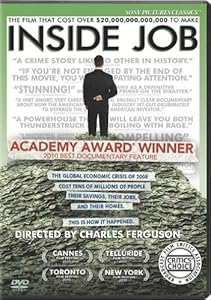
Charles Ferguson’s film – Inside Job – won the Academy Award for Best Documentary in 2011. It narrates the conflicts of interest between the finance industry, politicians, academics and regulators, which eventually led to the trillion-dollar collapse of 2008. Narrated by Matt Damon. From: http://www.theotherschoolofeconomics.org/?p=2499 - which screens the film on-line.

This documentary exposes the facts behind the 2008 global economic disaster. It was triggered by derivatives, primarily based on sub-prime mortgages in the US.  But the roots go back to the Regan deregulation of financial services. What is shocking is that many of the investment banks were betting against their own products and deliberately lying to their own customers. Several lawsuits are still pending.

It is fascinating viewing, but deeply disturbing as many of the key personalities are still in play in various companies and governments and regulatory bodies today.

For a write up see - http://en.wikipedia.org/wiki/Inside_Job_(film)


Tuesday, July 31, 2012

Libor Euribor Fixing Scandal: Banks Cooperate for Lower Fines


Several unidentified banks under investigation for the suspected manipulation of Euro Interbank Offered Rate (Euribor)  are reportedly  cooperating with European Union antitrust regulators in the hope of lower fines, said two unnamed sources cited by Reuters.
When Barclays settled with US and UK regulators for a record fine of £290m for rigging Libor and Euribor, the bank received a 30 percent discount under the UK's Financial Services Authority's (FSA) settlement discount scheme. It paid the FSA £59.5m;  without the discount, this would have been £85m.
The names of the banks under investigation have not been revealed. A total of 43 banks sit on the Euribor panel, which is hosted by the European Banking Federation.
Under the European Commission's leniency policy, the "whistle-blower" firm does not incur any penalty as part of an immunity deal and fines can be reduced by 30-50 percent for the next company to provide evidence of wrongdoing.
Fines can also be reduced by 20-30 percent for the next applicant and all subsequent applicants can get a reduction in any penalty of up to 20 percent.
First the LIBOR scandal, now Euribor.  Is there a US and Asian equivalent?  if so, when will their scandals emerge?

Monday, July 30, 2012

Why Capitalism Has an Image Problem


From WSJ - Charles Murray:
Mitt Romney's résumé at Bain should be a slam dunk. He has been a successful capitalist, and capitalism is the best thing that has ever happened to the material condition of the human race. From the dawn of history until the 18th century, every society in the world was impoverished, with only the thinnest film of wealth on top. Then came capitalism and the Industrial Revolution. Everywhere that capitalism subsequently took hold, national wealth began to increase and poverty began to fall. Everywhere that capitalism didn't take hold, people remained impoverished. Everywhere that capitalism has been rejected since then, poverty has increased.

Enlarge Image
Enlarge Image
image
Getty Images
Henry Ford with his Model T
image
Hulton Archive/Getty Images
Wall Street traders around 1925.

Enlarge Image
Enlarge Image
image
Corbis
A dry-cleaning store
image
Getty Images
Traders on the NYSE floor in 2011


Yet it hasn't worked out that way for Mr. Romney. "Capitalist" has become an accusation. The creative destruction that is at the heart of a growing economy is now seen as evil. Americans increasingly appear to accept the mind-set that kept the world in poverty for millennia: If you've gotten rich, it is because you made someone else poorer.
The Saturday Essay

[image]

Capitalism has lifted the world out of poverty because it gives people a chance to get rich by creating value and reaping the rewards. Who better to be president of the greatest of all capitalist nations than a man who got rich by being a brilliant capitalist?
What happened to turn the mood of the country so far from our historic celebration of economic success?
Two important changes in objective conditions have contributed to this change in mood. One is the rise of collusive capitalism. Part of that phenomenon involves crony capitalism, whereby the people on top take care of each other at shareholder expense (search on "golden parachutes").
But the problem of crony capitalism is trivial compared with the collusion engendered by government. In today's world, every business's operations and bottom line are affected by rules set by legislators and bureaucrats. The result has been corruption on a massive scale. Sometimes the corruption is retail, whereby a single corporation creates a competitive advantage through the cooperation of regulators or politicians (search on "earmarks"). Sometimes the corruption is wholesale, creating an industrywide potential for profit that would not exist in the absence of government subsidies or regulations (like ethanol used to fuel cars and low-interest mortgages for people who are unlikely to pay them back). Collusive capitalism has become visible to the public and increasingly defines capitalism in the public mind.
Another change in objective conditions has been the emergence of great fortunes made quickly in the financial markets. It has always been easy for Americans to applaud people who get rich by creating products and services that people want to buy. That is why Thomas Edison and Henry Ford were American heroes a century ago, and Steve Jobs was one when he died last year.
When great wealth is generated instead by making smart buy and sell decisions in the markets, it smacks of inside knowledge, arcane financial instruments, opportunities that aren't accessible to ordinary people, and hocus-pocus. The good that these rich people have done in the process of getting rich is obscure. The benefits of more efficient allocation of capital are huge, but they are really, really hard to explain simply and persuasively. It looks to a large proportion of the public as if we've got some fabulously wealthy people who haven't done anything to deserve their wealth.
Wednesday, July 18, 2012

South Korean banks also suspected of rate rigging


BBC News: "A South Korea financial regulator has started an investigation into alleged interest rate rigging by some of the country's banks.

The Fair Trade Commission is looking at possible collusion over setting certificates of deposit (CD), used as a benchmark to set lending rates.
Image of National Flag
Kookmin, Shinhan, Woori, and Hana are the banks being investigated.
It follows the Libor-rigging scandal involving Barclays and possibly several other banks.
Brokerage firms, which report CD rates twice a day, are also under suspicion. A CD is a way of saving with a fixed interest rate and maturity sold by banks and circulated in the secondary market by brokerages.
Financial firms benefit from a high CD rates as many household loans are linked to them. They are frequently used to help South Korean's buy homes.
As with the manipulation of the Libor inter-bank rate in the UK, the possible rigging of CD can help flatter companies' financial health."

Friday, July 13, 2012

Losses on 'Whale' Trades Total $5.8 Billion Through Thursday


Another week another banking fiasco
From Wall Street Journal: "J.P. Morgan Chase & Co.'s second-quarter earnings fell 8.7% from a year ago, on a double-digit decline in revenue and a $4.4 billion trading loss at its Chief Investment Office.
The U.S.'s largest bank by assets also said it would restate its first-quarter results to reduce profits and revenue, amid questions about how traders at the unit marked their positions. Including the restatement, total losses on the Chief Investment Office trading hit $5.1 billion in the first half of 2012.

Recap: The J.P. Morgan Call

J.P. Morgan blocked off a two-hour conference call to talk with analysts and investors. Deal Journal live-blogged the call.

Whale & Co. Go

Three London-based employees at the center of J.P. Morgan Chase's multibillion-dollar trading blunder, including one known as the "London whale," have left the bank, according to people familiar with the company.

Risk Measures Go Under Spotlight

Investors are watching closely to see what J.P. Morgan says about how its risk management fell down on the job—and why it changed to a method of measuring risk that effectively helped obscure its losses for months.
Finance chief Doug Braunstein on Friday put the trading loss through Thursday at $5.8 billion.
The bank said the restatement of first-quarter results reflects "recently discovered information that raises questions about the integrity of the trader marks and suggests that certain individuals may have been seeking to avoid showing the full amount of the losses in the portfolio during the first quarter."

LIBOR scandal


See: Libor scandal: In depth news, commentary and analysis from the Financial Times.


Once again, the banks (in this case mostly UK, but possibly also some US) are in the 'hot seat', seen to be working for their own self-interest rather than that of the customers and perhaps not even of its shareholders.
barclays 400


The scandal also shows up the unethical behaviour of some bankers who do not see illegal actions as something to be avoided but rather to be boasted about.


See also - http://www.blogger.com/blogger.g?blogID=2221107729551960243#editor/target=post;postID=6150666644106968603

Thursday, May 3, 2012

Banks at fault

A large part of the problem with the world economy lies with major banks. I don't mean domestic banks offering current and savings accounts for consumers; but commercial and investment banks who lend money to businesses and governments and - at the same time - buy and sell shares and offer all manner of so-called financial instruments.


When they first formed, banks were there to lend money to those who needed it - such as farmers with a poor harvest, parents needing funds for a good wedding, or a merchant who needed to buy stock to sell - and charged a fee or interest. In Europe, many bankers were Jews as due to religious prejudice they often not allowed any other 'respectable' trade. And lending was associated with usury and deemed below the dignity of the upper classes who could have afforded to operate them. Soon banks were lending to kings to fight expensive wars, such as the crusades. Where possible, banks demanded security in the form of assets: a cow, a house or future tax revenues. Initially, the flow of money was largely the initial capital supplemented by the interest charged or the defaulted security.


Later, bankers wanted to lend more than they had, so 'financial instruments' were invented. The recent (2008) financial disaster was laid in the 80s when domestic mortgages were 'securitised'. That meant banks could bundle mortgages and trade them with each other. Initially, it increased the amount banks could lend.  But, as with the US Fannie Mae, many bundles of mortgages included large percentages of so-called sub-prime, high risk mortgages. But as the bundles were re-bundled and sold on, nobody had the time to read all the documentation (which presumably spelt out the risks) much less take them seriously  The net result was: 
1. A large number of Western banks ended up owning a lot of high risk 'assets'
2. The total value of these so-called assets were n times the face value, never mind the risk-discounted real value.
3. When some mortgage holders started to default; the whole 'pyramid' scheme was exposed for what it was and the whole house of cards (pun intended) collapsed.


Roll forward to the Euro crisis. Many countries borrow up to a high % of their GDP. But some countries borrowed well above a single year's GDP, including Greece, Spain and so-forth. How did this happen?  The same investment banks were involved. They encouraged the finance ministers by offering what looked like cheap money with long life cycles. Once again, it took one country to look like it couldn't meet the interest payments and, once again, the pyramid started to collapse - though for the short term it is being propped up.


So, my bottom line is that whereas banks were and are a valuable institution, they have been allowed through various national and international deregulation to become gambling houses, where the stakes, risks and rewards are high. Not only are they now endangering world economy but also subverting things like - in the US and UK - causing the best and brightest from universities to go into banking disproportionate to the value add, instead of into engineering and manufacturing.