Showing posts with label executive pay. Show all posts

Tuesday, February 5, 2013

RBS bankers must pay Libor fine, says George Osborne

From - http://www.guardian.co.uk/business/2013/feb/04/royal-bank-scotland-libor-fine-osborne

George Osborne is forcing Royal Bank of Scotland to cut its bankers' pay to ensure that taxpayers are not left to pick up the cost of the upcoming multimillion-pound fine for Libor rigging.


The chancellor said his views had been made clear to the management of the bailed-out bank in an attempt to defuse public anger about the portion of the fine – which could amount to between £400m to £500m in total – that will be paid to the US authorities.
"When it comes to RBS, I am clear that the bill for any US fine related to this investigation should on this occasion be paid for by the bankers, and not the taxpayer," Osborne said.
Speaking in Bournemouth where he unveiled plans to reform the banking system, Osborne appeared to back the RBS chief executive, Stephen Hester, but indicated he expects heads to roll as a result of the fine for rigging Libor – a key interest rate. It was "well known" that RBS was considering management changes, Osborne said.
The fine from the UK's Financial Services Authority is thought to be just under £90m with US regulators levying fines of around four times that amount. In the furore that followed the £290m Libor fine paid by Barclays last year£59.5m of which was levied by the FSA, the law was changed to ensure that fines went to the government.
"Those who were doing the supervising must also bear their share of the responsibility," Osborne said. "The RBS board and the RBS senior management are well aware of that and decisions are in hand."
He added that Hester is "taking the action to ensure those responsible are held to account".
It is expected that the departure of John Hourican, the head of the investment bank, will be announced once the Libor fine is revealed, possibly later this week, although he is not thought to be personally implicated in the rigging of Libor. The size of the bonus pool for 2012 at RBS has yet to be disclosed. It was £390m for 2011 and is expected to fall by as much as £150m. But the call by the chancellor to ensure bankers pay for the Libor fine does not preclude bonuses being paid for 2012.
Responding to questions about why senior bankers should receive bonuses after a year of scandal, Osborne acknowledged that Hester and Barclays boss Antony Jenkins have waived their bonuses.
He said there could have been "enormous public anger" if fines levied on RBS by US regulators were paid by the taxpayer, not the bankers.
"That is not on," said Osborne, who has told the bank's management that a fine imposed by international regulators should be paid out of bankers' pay. If the fine is paid by shareholders, led by taxpayers who own 83%of the bank, "that could have been a very great source of public anger this spring," said Osborne.
The chancellor confirmed remarks by Treasury sources over the weekend which had suggested he was concerned about how the Libor fine would be paid. In his speech, Osborne insisted that "everyone should exercise restraint and responsibility" over bonuses.
Osborne was accused of "rhetoric" and a "partial climbdown" by Ed Balls, the shadow chancellor, after he said he would use legislation to threaten banks with being broken up if they attempted to flout rules requiring them to ringfence their high street and investment banking operations.
Andrew Tyrie, the Conservative MP whose banking standards commission helped create the idea of "electrifying" the ringfence, said the chancellor had taken an "important step in the right direction". The ringfence was a key plank in proposals by Sir John Vickers' independent commission but the banking standards commission had been concerned banks would try to "game" the ringfence. "They will always try to do so unless strong disincentives are put in place," said Tyrie.


Chancellor insists Royal Bank of Scotland, not UK taxpayers, must take up estimated £500m fine for Libor rigging

Sunday, February 3, 2013

Inequality for All – another Inconvenient Truth?

From The Guardian - http://www.guardian.co.uk/film/2013/feb/02/inequality-for-all-us-economy-robert-reich


The powerful documentary Inequality for All was an unexpected hit at the recent Sundance film festival, arguing that US capitalism has fatally abandoned the middle classes while making the super-rich richer. Can its star, economist Robert Reich, do for economics what Al Gore did for the environment?
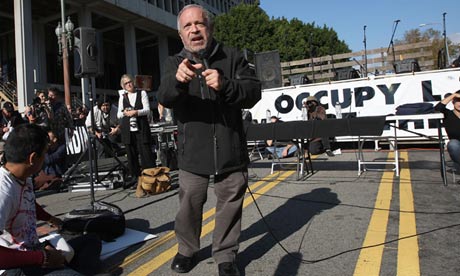
Robert Reich addresses Occupy rally
 Former US labour secretary Robert Reich at an Occupy Los Angeles rally in 2011. Photograph: David Mcnew/Getty Images

In one sense, Inequality for All is absolutely the film of the moment. We are living through tumultuous times. The economy has tanked. Austerity has cut a swath through the country. We're on the verge of a triple-dip recession. And, in another, parallel universe, a small cohort of alien beings – or as we know them, bankers – are currently engaged in trying to figure out what to spend their multimillion-pound bonuses on. Who wouldn't want to know what's going on? Or how it happened? Or why? Or if it is really true that the next generation down is well and truly shafted?

Any synopsis of the film runs the risk of making it seem dry again, but essentially it describes how the middle classes have come to have a smaller and smaller portion of the economic pie. And how, since 70% of the economy is based on the middle classes buying stuff, if they don't have any money to buy this stuff, it cannot grow. Meanwhile, the government has allowed the super-rich, the "one per cent", to take more of the nation's wealth. Half of the US's total assets are now owned by just 400 people – 400! – and, Reich contests that this is not just a threat to the economy, but also to democracy.

And what the film tries to do is thread together evidence that many people know about – the increasing struggle of the middle classes to just get by, the way that the top 1% of society has unshackled itself from the rest of us and has seen its income increase exponentially, and the ever-increasing cost of the traditional avenues of improvement, such as higher education – and weave it into a cohesive and convincing narrative. It is, in some respects, a theory of everything. Reich charts the three decades of increasing median income after the second world war, a period he calls "the great prosperity" and then examines what happened in the late 1970s to put an end to it. The economy didn't falter. It kept on growing. But wages didn't.
The figures that Reich supplies are simply gobsmacking. In 1978, the typical male US worker was making $48,000 a year (adjusted for inflation). Meanwhile the average person in the top 1% was making $390, 000. By 2010, the median wage had plummeted to $33,000, but at the top it had nearly trebled, to $1,100,000.
"Something happened in the late 1970s," we hear him tell his Berkeley class. And much of the rest of the film is working out what happened.
Some inequality is inevitable, he says. Even desirable. It's what makes capitalism tick. But at what point does it become a problem? When the middle classes (in its American sense of the 25% above and below the median wage) have so little of the economic pie that it affects not just their lives but the economy as a whole.
Reich's thesis is that since the 1970s a combination of anti-union legislation and deregulation of the markets contrived to create a situation in which the economy boomed but less of the wealth trickled down. Though for a while, nobody noticed. There were "coping mechanisms". More women entered the workforce, creating dual-income families. Working hours rose. And increasing house prices enabled people to borrow.
And then, in 2007, this all came crashing to a halt. "We have exhausted all the options," he says. There's nowhere else left to go. It's crunch time.
It's crunch time that so many working families understand too well. They may not be familiar with the theory of income inequality but they haven't been able to avoid noticing that they've got less money in their pockets. "I've always thought that kitchen-table economics is the most important topic to most people," says Reich. "Their wages, their jobs, getting by. I've always tried to relate economics to where people live. That's why I was so excited about the film."
… In the UK, Royal Bank of Scotland, having covered itself in glory in the Libor interest-rate fixing scandal, is currently contemplating bonuses for its investment banking division of £250m, according to reports last week. This, to put it another way, is the annual wage bill for at least 12,500 of its call-centre workers. Because this isn't just an American problem. It's a British one too.
"If there was upward mobility it would be OK," says Reich in the film. "But 42% of children born in poverty in the USA will stay there. In Denmark it's 24%. Even in Great Britain, where they still have an aristocracy, it's 30%."
It's probably a shocking statistic for Americans to hear. The problem is that by every index you can measure, inequality is worsening in Britain. There are fewer opportunities to overcome the barriers of your birth in the UK than in any other country in Europe. One of the most chilling moments in Inequality for All for a British audience is that how, faced with the same choices that America had in the 70s, we have, in the last year or so, taken the same path.

One of the key moments for Reich was the underinvestment in education, particularly higher education in the 70s. This was when America introduced tuition fees and its workforce started to fall behind the rest of the world's. When opportunities for those from low- and middle-income backgrounds began shrinking: precisely where the UK is today.
It's not just that wages have remained flat in America – as they have in the UK – it's that the expenses of everyday life have soared, in particular education and healthcare.
Last October, an independent commission in the UK led by the Resolution Foundation predicted that in 2020 wages for low- to middle-income families would be the same as they were in 2000. And yet everything else will have gone up. We too are facing the crunch.
In December, the Office for National Statistics found that richest 10% of people in Britain own 40% of the national wealth. In London and the south-east, one in eight households has almost £1m of assets. The bottom half of the country has no net property wealth and only £4,000 in pensions savings. For them, there is just rising prices. And the ever diminishing possibility of things ever being different for them or their children.

Sunday, November 11, 2012

Do any large companies pay UK tax?


Water companies pay little or no tax on huge profits

Thames Water and Anglian among companies paying little or no corporation tax while executives pocket huge bonuses

water pipes
From - http://www.guardian.co.uk/business/2012/nov/10/water-companies-tax -

"Three of Britain's biggest water companies paid little or no tax on their profits last year while generously rewarding their executives and investors, the Observer can reveal. Thames Water and Anglian Water paid no corporation tax on the profits made from their utility businesses while Yorkshire Water kept its payments to the Revenue in the low millions.
All the companies made hundreds of millions of pounds in operating profits and some have rewarded their senior executives with performance-related bonuses and investors with huge dividends. Martin Baggs, the chief executive of Thames Water, which enjoyed a £76m tax rebate in 2012, was given a bonus of £420,000 on top of his £425,000 salary and is in line for a further windfall of £1m based on company performance through to 2015.
The controversy follows a series of revelations that major companies, including multinationals such as Starbucks, Google and Amazon, have used complex financial manoeuvres to avoid tax, while generating huge profits and rewards for their owners.
The figures will be particularly galling for taxpayers because the water companies implement price rises every year linked to the retail price index by the regulator Ofwat and in effect have a monopoly in their areas. Last night the water companies were accused of "highly questionable" financial arrangements by the deputy leader of the Liberal Democrats, Simon Hughes, who has written to the parliamentary authorities to demand an investigation. He said: "The government should use its powers of licensing to make sure the companies behave in a responsible way to their customers and to society, which includes paying their taxes.""

Saturday, May 26, 2012

Apple CEO forgoes $75m dividend

ABC News: "Apple CEO Tim Cook is offering a $2.65 per share stock dividend to all company employees while forgoing his own shares — a move that will likely cost him $75 million, according to the company’s filings with the Securities and Exchange Commission.


“At Mr. Cook’s request, none of his restricted stock units will participate in dividend equivalents,” says the company’s 8-K form filed with the SEC.
Cook was offered 1 million shares back in January for serving as interim CEO after his predecessor, the late Steve Jobs, was forced by illness to hand over control of the company.
Apple announced in March a plan to spend $45 billion on dividends and share repurchasing.  It was the first time that Apple offered a dividend; Jobs famously refused to offer them when he was CEO.
Cook assumed the role of Apple CEO in August 2011; Jobs died in October."

Sunday, May 6, 2012

Anger over executive pay explodes

from the Observer: "Discontent over corporate salaries and bonuses has been growing for some time. Last week, at annual general meetings across the country, it escalated into a full-scale rebellion

City of London skyline

For Catherine Howarth, "it's been a totally fabulous week". The chief executive of campaign group Fair Pensions, which has long toiled to persuade City investors to rein in the worst excesses of British listed companies, the unprecedented wave of investor rebellions over recent days represents nothing less than a revolution.
"There's this really long history of shareholders being unwilling to use the powers they have. The fact that this is changing at the moment is really something to celebrate," she says. Paul Hewitt of investor lobby group Manifest describes it as a "shareholder spring".
Just weeks after the Occupy protesters were chucked out of the City, the sharp-suited fund managers who picked their way through the tents to get to their desks each morning have staged their own protest against fat-cat capitalism.
On Thursday alone, five companies felt the wrath of investors and suffered revolts over their pay policies. For Aviva, the insurance company, the rebuke was so strong that more than half its investors rejected its remuneration report in protest at pay for underperformance, particularly in respect of chief executive Andrew Moss.
The revolts followed a string of protests at companies as diverse as Barclays and mining company Xstrata. Shareholders' fury has not just been directed against remuneration reports, but also against individuals. Sly Bailey has fallen on her sword at Trinity Mirror, and even a boardroom veteran such as Alison Carnwath has not been immune.
More than one in five investors voted against Carnwath's re-election to the board of Barclays as chair of the remuneration committee that nodded through Bob Diamond's pay; and she also faced a revolt at hedge fund Man Group, where investors feel she has been involved for too long to be truly independent. Advertising giant WPP and bookie William Hill also face protests.
Several factors have come together to make 2012 the most stormy annual meeting season in living memory. One is the government's vocal determination to tackle "rewards for failure". Business secretary Vince Cable has proposed radical reforms, including giving shareholders a binding vote on pay, rather than the advisory vote introduced by Labour, and forcing companies to disclose pay deals for departing directors.
Some of the measures have been fiercely criticised by business groups, including the CBI; but he is expected to stick to his guns when he publishes final proposals next month.
The grim economic backdrop and the pessimistic public mood has also thrown some of the lavish rewards for top executives into sharp relief. George Dallas, director of corporate governance at fund manager F&C, says bumper pay packets have come under increased public pressure because many families are facing declining living standards. "There is a lot of austerity going round and the taxpayer is still feeling that the crisis hasn't gone away," he says.
A third factor driving the "shareholder spring" has been a concerted campaign by groups such as Fair Pensions, trades unions and green groups. They have worked to persuade small shareholders, including retail investors and workers with pensions or insurance funds – who between them hold billions of pounds' worth of shares – to ask how their money is being invested and demand a more active approach."