Showing posts with label unsustainable. Show all posts

Wednesday, March 20, 2013

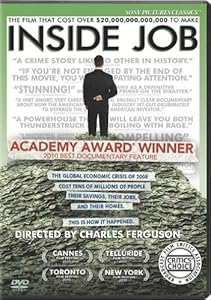
Documentary: Inside Job


Charles Ferguson’s film – Inside Job – won the Academy Award for Best Documentary in 2011. It narrates the conflicts of interest between the finance industry, politicians, academics and regulators, which eventually led to the trillion-dollar collapse of 2008. Narrated by Matt Damon. From: http://www.theotherschoolofeconomics.org/?p=2499 - which screens the film on-line.

This documentary exposes the facts behind the 2008 global economic disaster. It was triggered by derivatives, primarily based on sub-prime mortgages in the US.  But the roots go back to the Regan deregulation of financial services. What is shocking is that many of the investment banks were betting against their own products and deliberately lying to their own customers. Several lawsuits are still pending.

It is fascinating viewing, but deeply disturbing as many of the key personalities are still in play in various companies and governments and regulatory bodies today.

For a write up see - http://en.wikipedia.org/wiki/Inside_Job_(film)


Sunday, February 10, 2013

Shocking figures reveal the growth in UK's wealth gap

From The Observer - http://www.guardian.co.uk/society/2013/feb/10/uk-super-rich-richer-as-majority-squeezed


Inequality has risen sharply since the 1990s, according to a report by the Resolution Foundation thinktank

A young woman loaded with expensive shopping bags in London's West End

Buying essentials in London's West End: Britain's super rich have seen their slice of national income grow from 7% to 10% since the 90s. Photograph: Ruby / Alamy/Alamy


The super-rich – the top 1% of earners – now pocket 10p in every pound of income paid in Britain, while the poorest half of the population take home only 18p of every pound between them, according to a report published this week by the Resolution Foundation thinktank, which reveals the widening gap between those at the very top and the rest of society.
Inequality has grown sharply over the past 15 years, according to Resolution's analysis: the top 1% of earners have seen their slice of the pie increase from 7% in the mid-1990s to 10% today, while the bottom half have seen their share drop from 19% to 18%.
There was a dip in top earnings between 2009-10 and 2010-2011, but Resolution's analysis suggests that may have been because highest-paid employees brought forward earnings to avoid the 50p top tax rate on earnings above £150,000, which Chancellor George Osborne has cut to 45p from this April.
Matthew Whittaker, senior economist at the thinktank, said: "If we take the longer view, we see the very wealthiest have continued to prosper while many others have not.
"The growing gap in incomes is pronounced when you look at the top 10th of households, and overwhelming when you consider the position of the top 1%. The rest of society hasn't kept up. It's the squeezed majority, not just the squeezed middle."

Tuesday, January 29, 2013

Amazon 'lays waste' to the high street with record £14bn in Christmas sales


From Daily Mail - http://www.dailymail.co.uk/news/article-2269842/Amazon-lays-waste-high-street-record-14bn-Christmas-sales.html

Amazon set to announce record Christmas sales as high street struggles


  • Internet store made £14 billion in worldwide sales in just three months
  • Amazon has come under attack though for avoiding millions of pounds in tax

Amazon is set to announce record Christmas trading as it continues to ‘lay waste’ to the beleaguered high street.
In just three months the internet store made £14 billion in worldwide sales – with one tenth of that from UK shoppers.
But Amazon has been under attack for avoiding millions of pounds in taxes. Critics say this enables the company to slash prices and undercut rivals.

An estimated 17,500 high street jobs are at risk after 1,400 stores closed down over the Christmas period. And industry experts warn more retail failures could see one in five shops boarded up.
Household names including HMV, Jessops, Blockbuster and Comet have all collapsed into administration during the past two months.

Yet Amazon’s expected sales rise is an increase of almost a third compared with 2011.
Waterstone’s founder Tim Waterstone previously said Amazon had a ‘rude, contemptuous, arrogant and subversive’ attitude to competitors.

And John Lewis boss Andy Street has called for a ‘level playing field’ to stop it ‘out-trading’ rivals.
Amazon was also dubbed ‘immoral’ for avoiding tax by funnelling revenue to Luxembourg.

In 2011, the most recent year where figures are available, Amazon paid just £1.8 million despite raking in sales of £3.35 billion in the UK – a figure the firm tried to keep secret until it was exposed by MPs.


Wednesday, January 23, 2013

Davos man thrives while the rest of us pay for his excesses


from - http://www.guardian.co.uk/commentisfree/2013/jan/20/davos-world-economic-forum-bad-capitalism?CMP=twt_gu

'Dynamism' is the World Economic Forum's watchword as the way out of the crisis and it is meaningless


The village of Davos
The village of Davos where the World Economic Forum meets. Photograph: Fabrice Coffrini/AFP/Getty Images
More than 2,500 alpha men and women from more than 100 countries will descend on Davos this week to spend four days discussing the world's urgent need to adopt "resilient dynamism". This, the organising watchword for this year's annual gathering of panjandrums at the World Economic Forum, is allegedly the way out of the crisis. It is meaningless.
Who, for example, would support non-resilient stagnation? Western capitalism, and, arguably, global capitalism, has arrived at an apparent dead end. It is in profound trouble. But if the best answer to austerity and economic malaise is resilient dynamism every delegate should stay at home. As a call to action, you might as well urge everyone to be manly, womanly and decisive. Virtuous states of mind, but hardly blueprints for action.
In any case, for most of the business leaders attending Davos, the economic malaise is an abstraction. Profits as a share of GDP in almost all western countries are at record highs, along with executive pay. Meanwhile, real wages for the majority are stagnating, if not falling, justified by our economic leaders in Davos as the proper if sad consequence of "structural adjustment". Goldman Sachs, for example, shamed from deferring its bonus payments into the next financial year so that its staff could enjoy the lower tax rate, has just enjoyed a bumper year. Davos men and women are prospering. No structural adjustment for them.
There will doubtless be the usual appeals for more free trade, more scientific research and more investment in skills as the expensively clad executives move from seminar and sonorous keynote speech to reception and back to the dinner table. But what there will not be at Davos is a willingness to countenance a sea change in the way capitalism is organised. It can do what it will and that is to continue to confer fortunes on those at the top, with little risk, while directing pain on to others.
The paradox is that the chief reason capitalism is in crisis is that without such challenges it has undermined its own dynamism and capacity for innovation. Instead, it merely offers enormous and unjustified self-enrichment for those at the top.
Nor does the malign impact of inequality stop there. I was stunned to read in a recent IMF working paper, with the hardly catchy title Income Inequality and Current Account Imbalances, that the whole – yes the whole – of the deterioration of the British current account deficit between the early 1970s and 2007 could be explained by the rise in British inequality. It is a similar, if less acute, story across the rest of the industrialised or, rather, deindustrialising west.
What the IMF team shows is that as the share of national income devoted to profits and top pay rises to its current levels, so a noxious economic dynamic is created. By definition, there is less of the pie available to the mass of wage earners, whose real wages become squeezed. To sustain their living standards, they borrow, which has been easier than ever over the past 40 years as banks take advantage of financial deregulation. Overall demand thus carries on growing, but at the price of sucking in imports and ever higher personal debt levels for ordinary wage earners.
Finally, the music stops, as it has now, as both debt and import levels become unsustainable. The state of play in Britain – crazy levels of private sector debt and a record trade deficit – can thus be explained by the rise of inequality. And one of the chief causes of that, the IMF believes, is the decline in trade union bargaining power!

Wednesday, November 14, 2012

Citizens arise! Give up your lattes and Kindles


Now we're talking sense. If the government cannot or will not act or is too slow in acting, 'citizen power' is the next best thing.

From - http://www.thetimes.co.uk/tto/opinion/columnists/alicethomson/article3599302.ece#:

"If Starbucks and Amazon wriggle out of paying tax here, customers must take a stand
They track you down if you’re a small business; hound you for every last penny. They’re utterly ruthless, the men from HMRC.
A friend set up the Crazy Baker café in Kensal Rise, West London, three years ago. Every morning she wakes at 4am to knead her sour dough spelt, often working 20-hour days, harder than any CEO, to produce amazing scones, cakes and brioche. She employs a full-time bookkeeper and an accountant, but is still terrified of getting her figures wrong and the taxman’s knock on the door.
Yet down the road are two Starbucks that don’t pay a penny of corporation tax. My complaint is not about their lattes, which are adequate, or their chocolate muffins, which are passable, but about their tax arrangements, which aren’t. Of course small cafés have to compete with the big boys, but then why should they be so disadvantaged?
This week Troy Alstead, the Global Chief Financial Officer of Starbucks, went in front of the Public Accounts Committee to explain why this poor multinational simply cannot pay any corporation tax. It doesn’t make any money in the UK, he said, not a bean for its beans. He wrung his hands, then smirked as he explained the company faces “profitability challenges”.
Although Starbucks has 790 UK stores, second only to McDonald’s in the restaurant trade, it has made a profit just once in 15 years in Britain. When asked how Costa Coffee, a smaller chain, managed to make £49.5 million profit last year and paid £15.5 million in taxes, he simply said: “It’s a failing.”
The MPs of the PAC couldn’t believe it. I listened to three hours of the siege of Troy but you only have to hear five minutes to get the gist that the way Starbucks manages its affairs through Amsterdam is, in the words of one MP, “specifically designed to avoid tax”.
Amazon and Google were grilled too. The man from Amazon insisted that although customers pay in pounds for its products, which are delivered from UK centres through the Royal Mail with a British stamp, it’s a Luxembourg company. At least Matt Brittin, the chief executive officer of Google UK, admitted that the company operates from Ireland and Bermuda because of their low corporation tax rates.
Starbucks tries to sound like the caring corporate. I’ve visited the original shop in Seattle, named after the first mate in Moby-Dick. It’s cosy with its “handcrafted beverages”. Its website says “businesses can and should have a positive impact on the communities they serve”. How does paying virtually no tax fit into this ethos? But you can’t blame Troy; executives have a duty to maximise shareholder return and if they can find a legitimate way not to pay tax, of course they will.
One of Bill Clinton’s most successful TV ads in the 1992 election was: “This is the $825 billion question. That’s how much foreign corporations operating in the US took in one year. But 72 per cent of them didn’t pay a dime in tax. Not one dime.” Ed Miliband could easily borrow the same tactics.
The Government is acting — slowly. George Osborne should demand that these giants are more transparent about their operations and the Revenue should establish a ranking of companies — the good taxpayer’s guide. The Chancellor is trying to clamp down on foreign tax havens and is talking to the Germans about a plan that could see companies taxed on the sales they make in each country.
But all that will take a long time, so now it’s up to us, the consumer. Costa pays tax, so go there or to other small businesses like the Crazy Baker. Or buy McDonald’s: at least it paid £80 million in corporation tax last year. Margaret Hodge, who chairs the PAC, said she felt so incensed by Amazon that she’s given up her Kindle.
Christmas will be tricky without Amazon. But we should boycott companies that don’t pay their fair share of tax. All multinationals are vulnerable to public opinion if they have a product to sell directly to us. If consumers put pressure on them, their executives will think: if we don’t start acting responsibly, our brand will be damaged.
It may be only the “little people” who pay taxes but they also drink coffee. Starbucks should not underestimate the power of this latte lobby."
Amazon receives $252 million back tax claim


It's about time all major countries suffering from tax avoidance by major international corporations followed France's lead. In all probability, Amazon will get away with a fraction of the bill, as they probably have more lawyers than the French goveernment.  But a strong message is being shouted from the rooftops.

Once again, as we have said before, why don't major countries charge a % of turnover/revenue as tax rather than as a % of profit for all companies doing more than, say, £100m pa.  If they claim they are not making a profit, then the top management should be fired by their shareholders!

From -  http://news.yahoo.com/amazon-receives-252-million-back-tax-claim-171904647--sector.html:

A box from Amazon.com is pictured on the porch of a house in Golden, Colorado July 23, 2008. REUTERS/Rick Wilking

"Internet retailer Amazon said it had received a $252 million demand from the French tax authorities for back taxes, interest and penalties in relation to "the allocation of income between foreign jurisdictions".
The claim comes as European countries step up efforts to clamp down on U.S. companies which minimize their tax bills in the continent by channeling profits through low-tax regimes.
Amazon said it would fight the tax claim, in court if necessary, and that the demand related to the calendar years 2006 through 2010.
"We disagree with the proposed assessment and intend to vigorously contest it," the company said in its third quarter results filed last month.
An Amazon official referred to the tax demand, which had not been previously widely reported, at a UK parliamentary committee hearing.
Amazon minimizes its tax bill in France and other European countries by channeling sales through Luxembourg, which offers tax breaks to foreign companies which base themselves there.
Amazon said it received a proposed tax assessment from the tax authority in September but that it was still awaiting a final assessment.
Internet group Google is also under audit by the French tax authority regarding its structure, which channels sales through Ireland, but the company denied a newspaper report last month that it had received a back tax claim for 1 billion euros."

Tuesday, November 6, 2012

G20 leaders call for clampdown on multinational tax avoidance


HM Revenue & Customs tax documents are pictured in London

It's about time that the major nations got on top of the so-far all-powerful multinational corporations who seem to behave as if they do not owe taxes to anyone and can pay as much (or as little) as they feel like.  Hopefully, these days will be ending and the world will be better for it.


From - The Times - http://www.thetimes.co.uk/tto/money/tax/article3591278.ece


George Osborne has recruited the world’s largest economies in a drive for tighter global rules to prevent multinational companies avoiding tax.
Finance ministers from the G20 countries called last night for proposals on how to stop big corporations shifting their profits around the world to minimise their tax bills.
They have asked the OECD to accelerate plans to strengthen tax standards and to report in February. The call came after Mr Osborne and his German counterpart, Wolfgang Schäuble, used the G20 summit in Mexico to call for tougher international tax standards and:
• A Tory MP used parliamentary privilege to reveal that Google, Amazon, Starbucks and Pfizer pay between 0 and 2.5 per cent tax in the UK;
• It emerged that more than 1,000 tax evaders who hid millions of pounds in Swiss bank accounts struck deals with Revenue & Customs to avoid prosecution and to stay anonymous;
• MPs accused the Revenue of failing to target multinationals while harassing ordinary taxpayers for small amounts.
The G20 intervention also comes amid mounting anger at the comparatively low rates of tax paid to the Treasury by US multinationals.

Wednesday, October 10, 2012

What's wrong with Capitalism?


In this - http://www.thersa.org/events/video/animate/rsa-animate-crisis-of-capitalism -


Crises of Capitalism

RSA Animate video - Crisis of Capitalism

28 Jun 2010
Radical sociologist David Harvey asks if it is time to look beyond capitalism, towards a new social order that would allow us to live within a responsible, just and humane system.

Friday, May 4, 2012

You and I are not blameless

In earlier blogs, I blamed the state of the world economy on governments, banks and big business. Sadly, you and I are not blameless.

I did an inventory recently. I have 5 watches, 
innumerable clocks apart from those embedded on PCs, phones, TV sets etc; although retired I still have 6 serviceable suits and who knows how many shirts and ties; I have a dozen pairs of shoes, including trainers and golf shoes; 
and I could go on. I am sure if you did an inventory you too may find yourself surprised at how much you possess that are surplus to requirements. I am told women accumulate even more than men and I can believe it given the number of newspaper/magazine articles, Webpages and TV programmes on it - shelves full of handbags 
and shoes, racks and racks of clothes, some which have never been worn.

Similar excess applies to food. We are now more careful. but even so each week we are throwing away food that has gone past the due date. At least, a minor consolation is that the waste food no longer goes into the general rubbish bin but into a food recycling bin for the council to re-compost.

My point is that if you and I wasted less, then the retailers would sell less and the manufacturers would produce less, and the earth's resources would deplete slower.

Thursday, May 3, 2012

Banks at fault

A large part of the problem with the world economy lies with major banks. I don't mean domestic banks offering current and savings accounts for consumers; but commercial and investment banks who lend money to businesses and governments and - at the same time - buy and sell shares and offer all manner of so-called financial instruments.


When they first formed, banks were there to lend money to those who needed it - such as farmers with a poor harvest, parents needing funds for a good wedding, or a merchant who needed to buy stock to sell - and charged a fee or interest. In Europe, many bankers were Jews as due to religious prejudice they often not allowed any other 'respectable' trade. And lending was associated with usury and deemed below the dignity of the upper classes who could have afforded to operate them. Soon banks were lending to kings to fight expensive wars, such as the crusades. Where possible, banks demanded security in the form of assets: a cow, a house or future tax revenues. Initially, the flow of money was largely the initial capital supplemented by the interest charged or the defaulted security.


Later, bankers wanted to lend more than they had, so 'financial instruments' were invented. The recent (2008) financial disaster was laid in the 80s when domestic mortgages were 'securitised'. That meant banks could bundle mortgages and trade them with each other. Initially, it increased the amount banks could lend.  But, as with the US Fannie Mae, many bundles of mortgages included large percentages of so-called sub-prime, high risk mortgages. But as the bundles were re-bundled and sold on, nobody had the time to read all the documentation (which presumably spelt out the risks) much less take them seriously  The net result was: 
1. A large number of Western banks ended up owning a lot of high risk 'assets'
2. The total value of these so-called assets were n times the face value, never mind the risk-discounted real value.
3. When some mortgage holders started to default; the whole 'pyramid' scheme was exposed for what it was and the whole house of cards (pun intended) collapsed.


Roll forward to the Euro crisis. Many countries borrow up to a high % of their GDP. But some countries borrowed well above a single year's GDP, including Greece, Spain and so-forth. How did this happen?  The same investment banks were involved. They encouraged the finance ministers by offering what looked like cheap money with long life cycles. Once again, it took one country to look like it couldn't meet the interest payments and, once again, the pyramid started to collapse - though for the short term it is being propped up.


So, my bottom line is that whereas banks were and are a valuable institution, they have been allowed through various national and international deregulation to become gambling houses, where the stakes, risks and rewards are high. Not only are they now endangering world economy but also subverting things like - in the US and UK - causing the best and brightest from universities to go into banking disproportionate to the value add, instead of into engineering and manufacturing.

Sunday, April 22, 2012

One of the first things wrong with the world economy ...


... is the unquestioned and universally accepted objective of all nations and businesses to 'grow'.


If a country or a significant company posts zero growth, expressions of major concern immediately surface and all sorts of 'gurus' add their hand-wringing words, full of gloom and doom.


Can this be right?


Given that there are finite resources on planet earth and that there is already 7 billions inhabitants, how can all nations and all businesses continue to strive for growth?  That is surely unsustainable. Some scientists have carried out serious studies into what they call "Limits to Growth" - http://limits-to-growth.org/ Although their initial publication in 1972 was too pessimistic, nevertheless their central notion that there are finite limits to earth's resources, esp in the light of growing human population is true.


A very worrying report is New Scientist's, 26 May, 2007 "Earth Audit" - http://www.newscientist.com/article/mg19426051.200-earths-natural-wealth-an-audit.html This report predicts dire shortages within a 100 years for all kinds of mineral, including uranium and, of course, petroleum. But also other rare minerals that modern high-tech depends on, including iPad, iPod, iPhone, PCs, TVs, car's catalytic converters, batteries needed by new electric cars. In other words, if we don't find alternatives in 100 years, modern society will revert to the stone age!


Also see New Scientist's "How the economy is killing earth" - http://www.newscientist.com/article/mg20026786.000-special-report-how-our-economy-is-killing-the-earth.html