 |
Showing posts with label inequality. Show all posts
Showing posts with label inequality. Show all posts
Sunday, April 7, 2013
Small, micro firms in China are hungry for long-term loans
From - http://www.chinadaily.com.cn/china/2013-04/07/content_16379110.htm
China 's small and micro enterprises are still struggling with lackluster business , and most badly need long-term rather than short-term loans , said a report based on a survey released on Saturday at the Boao Forum for Asia .Of the 1,000 small and micro enterprises surveyed across China , 56.7 percent said their order numbers declined or stayed flat last year compared with 2011, and 57.7 percent said profit dropped or kept flat in 2012. In addition , 49.9 percent complained about an unstable workforce .One-third of SMEs need medium - and long-term loans to upgrade their equipment or invest in new products , the survey found , yet 63.3 percent of loans they got were short-term , less than a year .
"This stands in conflict with the fact that driven by fiercer competition , 39.3 percent of SME s have considered improving their product quality , 43.9 percent of SMEs have considered extending their product chain and 27.7 percent have considered upgrading their technology ,"said Ba Shusong , a banking expert with the Development Research Center under the State Council , who led the research .
A revelation of the report is that though 66.7 percent of SMEs regard bank loans as a primary financing measure , 62.1 percent of them do not now have them .Yao Wang , executive president of the Research Institute of the Boao Forum for Asia , said SMEs have little expectation of getting bank loans ."The survey showed most SMEs don 't have bank loans . They don 't expect to get a loan from big banks . This is pathetic ," Yao said .
In consequence , SMEs sought financing from family members and friends - 24.3 percent of micro enterprises and 7.5 percent of small enterprises . They are much less aware of the multiple new financing methods : 38.8 percent of SMEs , for example , do not know about intangible assets mortgages .==============================================================================
So it's not only British banks who are shy of lending to SMEs!

Sunday, February 10, 2013
Shocking figures reveal the growth in UK's wealth gap
From The Observer - http://www.guardian.co.uk/society/2013/feb/10/uk-super-rich-richer-as-majority-squeezed

Buying essentials in London's West End: Britain's super rich have seen their slice of national income grow from 7% to 10% since the 90s. Photograph: Ruby / Alamy/Alamy
Inequality has risen sharply since the 1990s, according to a report by the Resolution Foundation thinktank
Buying essentials in London's West End: Britain's super rich have seen their slice of national income grow from 7% to 10% since the 90s. Photograph: Ruby / Alamy/Alamy
The super-rich – the top 1% of earners – now pocket 10p in every pound of income paid in Britain, while the poorest half of the population take home only 18p of every pound between them, according to a report published this week by the Resolution Foundation thinktank, which reveals the widening gap between those at the very top and the rest of society.
Inequality has grown sharply over the past 15 years, according to Resolution's analysis: the top 1% of earners have seen their slice of the pie increase from 7% in the mid-1990s to 10% today, while the bottom half have seen their share drop from 19% to 18%.
There was a dip in top earnings between 2009-10 and 2010-2011, but Resolution's analysis suggests that may have been because highest-paid employees brought forward earnings to avoid the 50p top tax rate on earnings above £150,000, which Chancellor George Osborne has cut to 45p from this April.
Matthew Whittaker, senior economist at the thinktank, said: "If we take the longer view, we see the very wealthiest have continued to prosper while many others have not.
"The growing gap in incomes is pronounced when you look at the top 10th of households, and overwhelming when you consider the position of the top 1%. The rest of society hasn't kept up. It's the squeezed majority, not just the squeezed middle."
Tuesday, February 5, 2013
RBS bankers must pay Libor fine, says George Osborne
From - http://www.guardian.co.uk/business/2013/feb/04/royal-bank-scotland-libor-fine-osborne

George Osborne is forcing Royal Bank of Scotland to cut its bankers' pay to ensure that taxpayers are not left to pick up the cost of the upcoming multimillion-pound fine for Libor rigging.
The chancellor said his views had been made clear to the management of the bailed-out bank in an attempt to defuse public anger about the portion of the fine – which could amount to between £400m to £500m in total – that will be paid to the US authorities.
"When it comes to RBS, I am clear that the bill for any US fine related to this investigation should on this occasion be paid for by the bankers, and not the taxpayer," Osborne said.
Speaking in Bournemouth where he unveiled plans to reform the banking system, Osborne appeared to back the RBS chief executive, Stephen Hester, but indicated he expects heads to roll as a result of the fine for rigging Libor – a key interest rate. It was "well known" that RBS was considering management changes, Osborne said.
The fine from the UK's Financial Services Authority is thought to be just under £90m with US regulators levying fines of around four times that amount. In the furore that followed the £290m Libor fine paid by Barclays last year, £59.5m of which was levied by the FSA, the law was changed to ensure that fines went to the government.
"Those who were doing the supervising must also bear their share of the responsibility," Osborne said. "The RBS board and the RBS senior management are well aware of that and decisions are in hand."
He added that Hester is "taking the action to ensure those responsible are held to account".
It is expected that the departure of John Hourican, the head of the investment bank, will be announced once the Libor fine is revealed, possibly later this week, although he is not thought to be personally implicated in the rigging of Libor. The size of the bonus pool for 2012 at RBS has yet to be disclosed. It was £390m for 2011 and is expected to fall by as much as £150m. But the call by the chancellor to ensure bankers pay for the Libor fine does not preclude bonuses being paid for 2012.
Responding to questions about why senior bankers should receive bonuses after a year of scandal, Osborne acknowledged that Hester and Barclays boss Antony Jenkins have waived their bonuses.
He said there could have been "enormous public anger" if fines levied on RBS by US regulators were paid by the taxpayer, not the bankers.
"That is not on," said Osborne, who has told the bank's management that a fine imposed by international regulators should be paid out of bankers' pay. If the fine is paid by shareholders, led by taxpayers who own 83%of the bank, "that could have been a very great source of public anger this spring," said Osborne.
The chancellor confirmed remarks by Treasury sources over the weekend which had suggested he was concerned about how the Libor fine would be paid. In his speech, Osborne insisted that "everyone should exercise restraint and responsibility" over bonuses.
Osborne was accused of "rhetoric" and a "partial climbdown" by Ed Balls, the shadow chancellor, after he said he would use legislation to threaten banks with being broken up if they attempted to flout rules requiring them to ringfence their high street and investment banking operations.
Andrew Tyrie, the Conservative MP whose banking standards commission helped create the idea of "electrifying" the ringfence, said the chancellor had taken an "important step in the right direction". The ringfence was a key plank in proposals by Sir John Vickers' independent commission but the banking standards commission had been concerned banks would try to "game" the ringfence. "They will always try to do so unless strong disincentives are put in place," said Tyrie.
Chancellor insists Royal Bank of Scotland, not UK taxpayers, must take up estimated £500m fine for Libor rigging
Sunday, February 3, 2013
Inequality for All – another Inconvenient Truth?
From The Guardian - http://www.guardian.co.uk/film/2013/feb/02/inequality-for-all-us-economy-robert-reich

The powerful documentary Inequality for All was an unexpected
hit at the recent Sundance film festival, arguing that US capitalism has
fatally abandoned the middle classes while making the super-rich richer. Can
its star, economist Robert Reich, do for economics what Al Gore did for the
environment?
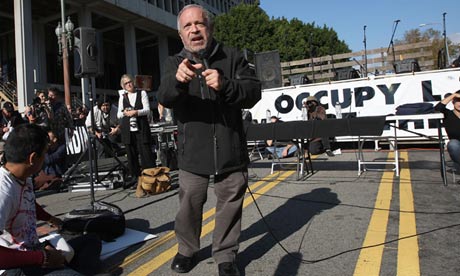
Former US labour secretary Robert Reich at an Occupy Los Angeles rally in 2011. Photograph: David Mcnew/Getty Images
In one sense, Inequality
for All is absolutely the film of the moment.
We are living through tumultuous times. The economy has tanked. Austerity has
cut a swath through the country. We're on the verge of a triple-dip recession.
And, in another, parallel universe, a small cohort of alien beings – or as we
know them, bankers – are currently engaged in trying to figure out what to
spend their multimillion-pound bonuses on. Who wouldn't want to know what's
going on? Or how it happened? Or why? Or if it is really true that the next
generation down is well and truly shafted?
…
Any synopsis of the film runs the risk of making it seem dry again, but
essentially it describes how the middle classes have come to have a smaller and
smaller portion of the economic pie. And how, since 70% of the economy is based
on the middle classes buying stuff, if they don't have any money to buy this
stuff, it cannot grow. Meanwhile, the government has allowed the super-rich,
the "one per cent", to take more of the nation's wealth. Half of the
US's total assets are now owned by just 400 people – 400! – and, Reich contests
that this is not just a threat to the economy, but also to democracy.
…
And what the film tries to do is thread together evidence that many
people know about – the increasing struggle of the middle classes to just get
by, the way that the top 1% of society has unshackled itself from the rest of
us and has seen its income increase exponentially, and the ever-increasing cost
of the traditional avenues of improvement, such as higher education – and weave
it into a cohesive and convincing narrative. It is, in some respects, a theory
of everything. Reich charts the three decades of increasing median income after
the second world war, a period he calls "the great prosperity" and
then examines what happened in the late 1970s to put an end to it. The economy
didn't falter. It kept on growing. But wages didn't.
The figures that Reich supplies are simply gobsmacking. In 1978, the
typical male US worker was making $48,000 a year (adjusted for inflation).
Meanwhile the average person in the top 1% was making $390, 000. By 2010, the
median wage had plummeted to $33,000, but at the top it had nearly trebled, to
$1,100,000.
"Something happened in the late 1970s," we hear him tell his
Berkeley class. And much of the rest of the film is working out what happened.
Some inequality is inevitable, he says. Even desirable. It's what makes
capitalism tick. But at what point does it become a problem? When the middle
classes (in its American sense of the 25% above and below the median wage) have
so little of the economic pie that it affects not just their lives but the
economy as a whole.
Reich's thesis is that since the 1970s a combination of anti-union
legislation and deregulation of the markets contrived to create a situation in
which the economy boomed but less of the wealth trickled down. Though for a
while, nobody noticed. There were "coping mechanisms". More women
entered the workforce, creating dual-income families. Working hours rose. And
increasing house prices enabled people to borrow.
And then, in 2007, this all came crashing to a halt. "We have
exhausted all the options," he says. There's nowhere else left to go. It's
crunch time.
It's crunch time that so many working families understand too well. They
may not be familiar with the theory of income inequality but they haven't been
able to avoid noticing that they've got less money in their pockets. "I've
always thought that kitchen-table economics is the most important topic to most
people," says Reich. "Their wages, their jobs, getting by. I've
always tried to relate economics to where people live. That's why I was so
excited about the film."
…
… In the UK, Royal Bank of Scotland, having covered itself in glory in
the Libor interest-rate fixing scandal, is currently contemplating bonuses for
its investment banking division of £250m, according to reports last week. This,
to put it another way, is the annual wage bill for at least 12,500 of its
call-centre workers. Because this isn't just an American problem. It's a
British one too.
"If there was upward mobility it would be OK," says Reich in
the film. "But 42% of children born in poverty in the USA will stay there.
In Denmark it's 24%. Even in Great Britain, where they still have an
aristocracy, it's 30%."
It's probably a shocking statistic for Americans to hear. The problem is
that by every index you can measure, inequality is worsening in Britain. There
are fewer opportunities to overcome the barriers of your birth in the UK than
in any other country in Europe. One of the most chilling moments in Inequality for All for a British audience is that how,
faced with the same choices that America had in the 70s, we have, in the last
year or so, taken the same path.
One of the key moments for Reich was the underinvestment in education,
particularly higher education in the 70s. This was when America introduced
tuition fees and its workforce started to fall behind the rest of the world's.
When opportunities for those from low- and middle-income backgrounds began
shrinking: precisely where the UK is today.
It's not just that wages have remained flat in America – as they have in
the UK – it's that the expenses of everyday life have soared, in particular
education and healthcare.
Last October, an independent
commission in the UK led by the Resolution Foundation predicted that in 2020 wages for low- to middle-income families would be
the same as they were in 2000. And yet everything else will have gone up. We
too are facing the crunch.
In December, the Office for National Statistics found that richest 10% of
people in Britain own 40% of the national wealth. In London and the
south-east, one in eight households has almost £1m of assets. The bottom half
of the country has no net property wealth and only £4,000 in pensions savings.
For them, there is just rising prices. And the ever diminishing possibility of
things ever being different for them or their children.
Wednesday, January 23, 2013
Davos man thrives while the rest of us pay for his excesses
from - http://www.guardian.co.uk/commentisfree/2013/jan/20/davos-world-economic-forum-bad-capitalism?CMP=twt_gu
'Dynamism' is the World Economic Forum's watchword as the way out of the crisis and it is meaningless


The village of Davos where the World Economic Forum meets. Photograph: Fabrice Coffrini/AFP/Getty Images
More than 2,500 alpha men and women from more than 100 countries will descend on Davos this week to spend four days discussing the world's urgent need to adopt "resilient dynamism". This, the organising watchword for this year's annual gathering of panjandrums at the World Economic Forum, is allegedly the way out of the crisis. It is meaningless.
Who, for example, would support non-resilient stagnation? Western capitalism, and, arguably, global capitalism, has arrived at an apparent dead end. It is in profound trouble. But if the best answer to austerity and economic malaise is resilient dynamism every delegate should stay at home. As a call to action, you might as well urge everyone to be manly, womanly and decisive. Virtuous states of mind, but hardly blueprints for action.
In any case, for most of the business leaders attending Davos, the economic malaise is an abstraction. Profits as a share of GDP in almost all western countries are at record highs, along with executive pay. Meanwhile, real wages for the majority are stagnating, if not falling, justified by our economic leaders in Davos as the proper if sad consequence of "structural adjustment". Goldman Sachs, for example, shamed from deferring its bonus payments into the next financial year so that its staff could enjoy the lower tax rate, has just enjoyed a bumper year. Davos men and women are prospering. No structural adjustment for them.
There will doubtless be the usual appeals for more free trade, more scientific research and more investment in skills as the expensively clad executives move from seminar and sonorous keynote speech to reception and back to the dinner table. But what there will not be at Davos is a willingness to countenance a sea change in the way capitalism is organised. It can do what it will and that is to continue to confer fortunes on those at the top, with little risk, while directing pain on to others.
The paradox is that the chief reason capitalism is in crisis is that without such challenges it has undermined its own dynamism and capacity for innovation. Instead, it merely offers enormous and unjustified self-enrichment for those at the top.
Nor does the malign impact of inequality stop there. I was stunned to read in a recent IMF working paper, with the hardly catchy title Income Inequality and Current Account Imbalances, that the whole – yes the whole – of the deterioration of the British current account deficit between the early 1970s and 2007 could be explained by the rise in British inequality. It is a similar, if less acute, story across the rest of the industrialised or, rather, deindustrialising west.
What the IMF team shows is that as the share of national income devoted to profits and top pay rises to its current levels, so a noxious economic dynamic is created. By definition, there is less of the pie available to the mass of wage earners, whose real wages become squeezed. To sustain their living standards, they borrow, which has been easier than ever over the past 40 years as banks take advantage of financial deregulation. Overall demand thus carries on growing, but at the price of sucking in imports and ever higher personal debt levels for ordinary wage earners.
Finally, the music stops, as it has now, as both debt and import levels become unsustainable. The state of play in Britain – crazy levels of private sector debt and a record trade deficit – can thus be explained by the rise of inequality. And one of the chief causes of that, the IMF believes, is the decline in trade union bargaining power!
Wednesday, October 10, 2012
What's wrong with Capitalism?
In this - http://www.thersa.org/events/video/animate/rsa-animate-crisis-of-capitalism -

RSA Animate video - Crisis of Capitalism
28 Jun 2010
Radical sociologist David Harvey asks if it is time to look beyond capitalism, towards a new social order that would allow us to live within a responsible, just and humane system.
Radical sociologist David Harvey asks if it is time to look beyond capitalism, towards a new social order that would allow us to live within a responsible, just and humane system.
Thursday, September 20, 2012
Scale of Monaco tax avoidance revealed
From The Times: http://www.thetimes.co.uk/tto/money/tax/article3543834.ece
"More than 2,000 Britons in Monaco are costing the UK economy £1 billion a year in lost tax revenue.

"More than 2,000 Britons in Monaco are costing the UK economy £1 billion a year in lost tax revenue.
An investigation by The Times into tax avoidance has revealed the scale of activity in the principality, where a wealthy elite reaps the benefits of British assets and connections, but escapes the levies that apply to other citizens.
Some have been awarded knighthoods, while others have been able to make political donations — despite government pledges to close a loophole enabling them to do so.
Packed into a seaside strip covering 0.75 square miles, hundreds of businessmen enjoy the benefits of a favourable tax regime while continuing to play such an active role in British life that they control more than 1,000 UK companies. Their links to Britain, which range from scores of firms to properties, spouses and social commitments, have to satisfy HM Revenue & Customs rules requiring tax exiles to demonstrate a “definite break” with Britain.
The Times has discovered:
• 533 directors of UK companies have registered addresses in Monaco, and control 1,302 firms. John De Stefano, a restaurant and property magnate, runs 81 companies from the principality.
• At least 11 people who live in Monaco as tax exiles, or benefit through family members, have been awarded honours even after being vetted by HMRC. They include the billionaires Sir Philip Green and Jim McColl, OBE.
• Six Monaco-based Tory donors have boosted the party’s coffers by millions. Lord Laidlaw gave £5 million, and David Instance, a Kent businessman, provided a helicopter used by David Cameron in his leadership campaign.
A “ghost law” capping political donations by tax exiles received Royal Assent more than three years ago, but has not been enforced because the main parties are unable to put aside self-interest to reach consensus. The Government says it is grappling with the practicalities of the £7,500-a-year limit.
Under British rules on “non-resident” tax status, those who live abroad can avoid capital gains tax on the sale of properties and shares; income tax on work carried out outside Britain; and tax on interest. Once someone has spent five years living outside the UK, they are free to return and keep the capital gains tax they saved while abroad.
But moving to Monaco is an option only available to the rich. Property prices are the highest in the world, and opening a bank account normally requires a €300,000 (£238,000) deposit.
The Times has used specially commissioned data and public records to show how people can keep a substantial part of their lives and livelihoods in Britain while legally escaping tax liabilities.
One Monaco property developer has 68 UK companies, three UK properties and a wife who gives her address as the Warwickshire manor they own.
HMRC was shown examples of the extensive Monaco-British links of five individuals. A spokesman said: “We would look at all of these. Eighty-one companies, even if some are non-trading, is a lot of UK-based economic activity. We would not say automatically that they are out of the game ... but we look for indicators and there are issues there we would police.”
HMRC believes that Monaco leaves a £1 billion hole in its coffers, compared with a system like that of the US where tax is paid on worldwide income unless someone gives up their citizenship.
Contacted by The Times, Monaco residents rejected the term tax exile and said they enjoyed the safety, weather, travel links and restaurants in the principality. They contribute to the British economy by creating jobs and paying corporate tax at source, and they pay 19.6 per cent VAT in Monaco."
Thursday, August 9, 2012
So it's not only the rich individuals, but rich global corporations are at it too!
From The Telegraph: http://www.telegraph.co.uk/technology/google/9460950/Google-pays-just-6m-UK-tax-on-profits-of-395m.html

"Google pays just £6m UK tax on profits of £395m
Anger over the amount of tax paid by Google in the UK could escalate after documents showed the web giant contributed just £6m to the exchequer in 2011 on UK profits of £395m.
The UK arm of the search giant will also report a loss after tax of £24.1million in accounts filed yesterday at Companies House. Much of this, however, is due to the £51.45 million cost of giving shares to employees. Excepting that, the firm reports a profit of just £27million.

Last year Google paid £935,000 tax on £2.39billion in revenue.
In the six years to the end of 2010, Google paid just £8million of Corporation Tax in the UK, but in the 2011 calendar year alone that rose to £6.09m.
Worldwide Google profit rose 11pc in the most recent quarter, ended June 30, as consolidated revenue climbed 35pc to $12.21bn compared with the same fiscal quarter a year earlier. Google reported a jump in quarterly worldwide profits to $2.8bn (£1.8bn) on rising online advertising revenue, beating Wall Street's expectations.
Google’s executive chairman Eric Schmidt claimed last year that Google was obliged to pay the legal minimum in UK taxation, implicitly attacking lax British laws. "We could pay more tax but we would have to do so voluntarily,” he said. “There are lots of benefits to [being in Britain]. It's very good for us, but to go back to shareholders and say 'We looked at 200 countries but felt sorry for those British people so we want to [pay them more]' . . . there is probably some law against doing that." The latest figures are likely to reignite the debate over how little tax global corporations, such as Google and Vodafone, pay in Britain."
I'm sure that Google is not alone. What about Apple, Microsoft, Facebook, et al Also, Google's original motto was "Don't do evil". I think its revised motto should be "Don't do evil, unless you can get away with it."
The evolution of inequality
In the 28 July 2012 issue of New Scientist, there is an excellent article on why anthropologists believe the human race, after 50,000 years of relative equality, became very unequal in the last 5,000 years; resulting in today's 1% owning up to 20% of the total wealth.
The reason they believe was the root cause of this trend is the surplus that started to build up once mankind changed from nomadic hunter-gatherers to settled farmers. Those who accumulated most were able to lord it over their less fortunate village mates. Soon hierarchies of chiefs and super-chiefs and kings and emperors evolved.
Later, in the European middle ages, religious and political power gradually changed hands and the merchant classes started to rule the roost - at least as far as wealth is concerned. Fighting wars was and is not cheap and the one constant beneficiaries were and are the banks and bankers. So today's top 1% includes not only land and other asset owners of the past, but also builders and manufacturers and, surprise, surprise, bankers and other financiers.

For more information on inequality, read: http://en.wikipedia.org/wiki/List_of_countries_by_income_equality
The reason they believe was the root cause of this trend is the surplus that started to build up once mankind changed from nomadic hunter-gatherers to settled farmers. Those who accumulated most were able to lord it over their less fortunate village mates. Soon hierarchies of chiefs and super-chiefs and kings and emperors evolved.
Later, in the European middle ages, religious and political power gradually changed hands and the merchant classes started to rule the roost - at least as far as wealth is concerned. Fighting wars was and is not cheap and the one constant beneficiaries were and are the banks and bankers. So today's top 1% includes not only land and other asset owners of the past, but also builders and manufacturers and, surprise, surprise, bankers and other financiers.
For more information on inequality, read: http://en.wikipedia.org/wiki/List_of_countries_by_income_equality
Monday, July 30, 2012
Why Capitalism Has an Image Problem
From WSJ - Charles Murray:
Mitt Romney's résumé at Bain should be a slam dunk. He has been a successful capitalist, and capitalism is the best thing that has ever happened to the material condition of the human race. From the dawn of history until the 18th century, every society in the world was impoverished, with only the thinnest film of wealth on top. Then came capitalism and the Industrial Revolution. Everywhere that capitalism subsequently took hold, national wealth began to increase and poverty began to fall. Everywhere that capitalism didn't take hold, people remained impoverished. Everywhere that capitalism has been rejected since then, poverty has increased.
Getty Images


Henry Ford with his Model T


Corbis


A dry-cleaning store


Yet it hasn't worked out that way for Mr. Romney. "Capitalist" has become an accusation. The creative destruction that is at the heart of a growing economy is now seen as evil. Americans increasingly appear to accept the mind-set that kept the world in poverty for millennia: If you've gotten rich, it is because you made someone else poorer.The Saturday Essay
![[image]](http://si.wsj.net/public/resources/images/RV-AH663_CAPITA_DV_20120727172640.jpg)
Capitalism has lifted the world out of poverty because it gives people a chance to get rich by creating value and reaping the rewards. Who better to be president of the greatest of all capitalist nations than a man who got rich by being a brilliant capitalist?
What happened to turn the mood of the country so far from our historic celebration of economic success?
Two important changes in objective conditions have contributed to this change in mood. One is the rise of collusive capitalism. Part of that phenomenon involves crony capitalism, whereby the people on top take care of each other at shareholder expense (search on "golden parachutes").
But the problem of crony capitalism is trivial compared with the collusion engendered by government. In today's world, every business's operations and bottom line are affected by rules set by legislators and bureaucrats. The result has been corruption on a massive scale. Sometimes the corruption is retail, whereby a single corporation creates a competitive advantage through the cooperation of regulators or politicians (search on "earmarks"). Sometimes the corruption is wholesale, creating an industrywide potential for profit that would not exist in the absence of government subsidies or regulations (like ethanol used to fuel cars and low-interest mortgages for people who are unlikely to pay them back). Collusive capitalism has become visible to the public and increasingly defines capitalism in the public mind.
Another change in objective conditions has been the emergence of great fortunes made quickly in the financial markets. It has always been easy for Americans to applaud people who get rich by creating products and services that people want to buy. That is why Thomas Edison and Henry Ford were American heroes a century ago, and Steve Jobs was one when he died last year.
When great wealth is generated instead by making smart buy and sell decisions in the markets, it smacks of inside knowledge, arcane financial instruments, opportunities that aren't accessible to ordinary people, and hocus-pocus. The good that these rich people have done in the process of getting rich is obscure. The benefits of more efficient allocation of capital are huge, but they are really, really hard to explain simply and persuasively. It looks to a large proportion of the public as if we've got some fabulously wealthy people who haven't done anything to deserve their wealth.
Sunday, July 22, 2012
Wealth doesn't trickle down – it just floods offshore, new research reveals
From The Guardian - http://www.guardian.co.uk/business/2012/jul/21/offshore-wealth-global-economy-tax-havens
"A far-reaching new study suggests a staggering $21tn in assets has been lost to global tax havens. If taxed, that could have been enough to put parts of Africa back on its feet – and even solve the euro crisis


The world's super-rich have taken advantage of lax tax rules to siphon off at least $21 trillion, and possibly as much as $32tn, from their home countries and hide it abroad – a sum larger than the entire American economy.
James Henry, a former chief economist at consultancy McKinsey and an expert on tax havens, has conducted groundbreaking new research for the Tax Justice Network campaign group – sifting through data from the Bank for International Settlements (BIS), the International Monetary Fund (IMF) and private sector analysts to construct an alarming picture that shows capital flooding out of countries across the world and disappearing into the cracks in the financial system.
...
"This offshore economy is large enough to have a major impact on estimates of inequality of wealth and income; on estimates of national income and debt ratios; and – most importantly – to have very significant negative impacts on the domestic tax bases of 'source' countries," Henry says.
...
"These estimates reveal a staggering failure," says John Christensen of the Tax Justice Network. "Inequality is much, much worse than official statistics show, but politicians are still relying on trickle-down to transfer wealth to poorer people.
"This new data shows the exact opposite has happened: for three decades extraordinary wealth has been cascading into the offshore accounts of a tiny number of super-rich."
In total, 10 million individuals around the world hold assets offshore, according to Henry's analysis; but almost half of the minimum estimate of $21tn – $9.8tn – is owned by just 92,000 people. And that does not include the non-financial assets – art, yachts, mansions in Kensington – that many of the world's movers and shakers like to use as homes for their immense riches.
"If we could figure out how to tax all this offshore wealth without killing the proverbial golden goose, or at least entice its owners to reinvest it back home, this sector of the global underground is easily large enough to make a significant contribution to tax justice, investment and paying the costs of global problems like climate change," Henry says.
...
In many cases, , the total worth of these assets far exceeds the value of the overseas debts of the countries they came from.
The struggles of the authorities in Egypt to recover the vast sums hidden abroad by Hosni Mubarak, his family and other cronies during his many years in power have provided a striking recent example of the fact that kleptocratic rulers can use their time to amass immense fortunes while many of their citizens are trapped in poverty.
The world's poorest countries, particularly in sub-Saharan Africa, have fought long and hard in recent years to receive debt forgiveness from the international community; but this research suggests that in many cases, if they had been able to draw their richest citizens into the tax net, they could have avoided being dragged into indebtedness in the first place. Oil-rich Nigeria has seen more than $300bn spirited away since 1970, for example, while Ivory Coast has lost $141bn.
Assuming that super-rich investors earn a relatively modest 3% a year on their $21tn, taxing that vast wall of money at 30% would generate a very useful $189bn a year – more than rich economies spend on aid to the rest of the world.
...
Milorad Kovacevic, chief statistician of the UN Development Programme's Human Development Report, says both the very wealthy and the very poor tend to be excluded from mainstream calculations of inequality.
"People that are in charge of measuring inequality based on survey data know that the both ends of the distribution are underrepresented – or, even better, misrepresented," he says.
"There is rarely a household from the top 1% earners that participates in the survey. On the other side, the poor people either don't have addresses to be selected into the sample, or when selected they misquote their earnings – usually biasing them upwards."
...
Globalisation has exposed low-skilled workers to competition from cheap economies such as China, while the surging profitability of the financial services industry – and the spread of the big bonus culture before the credit crunch – led to what economists have called a "racing away" at the top of the income scale.
However, Henry's research suggests that this acknowledged jump in inequality is a dramatic underestimate. Stewart Lansley, author of the recent book The Cost of Inequality, says: "There is absolutely no doubt at all that the statistics on income and wealth at the top understate the problem."
The surveys that are used to compile the Gini coefficient "simply don't touch the super-rich," he says. "You don't pick up the multimillionaires and billionaires, and even if you do, you can't pick it up properly."
In fact, some experts believe the amount of assets being held offshore is so large that accounting for it fully would radically alter the balance of financial power between countries. The French economist Thomas Piketty, an expert on inequality who helps compile the World Top Incomes Database, says research by his colleagues has shown that "the wealth held in tax havens is probably sufficiently substantial to turnEurope into a very large net creditor with respect to the rest of the world."
In other words, even a solution to the eurozone's seemingly endless sovereign debt crisis might be within reach – if only Europe's governments could get a grip on the wallets of their own wealthiest citizens."
Subscribe to:
Posts (Atom)