Showing posts with label self-interest. Show all posts

Thursday, May 16, 2013

Amazon paid £3m tax on £4bn UK sales

From: http://www.guardian.co.uk/business/2013/may/15/amazon-uk-tax-3m

Online retailer's tax charge brings to £6m the total corporation tax raised from Amazon.co.uk in a decade


Amazon.co.uk
Amazon.co.uk paid £3m in tax. Photograph: Chris Radburn/PA
Amazon's main UK subsidiary paid just £3.2m in tax last year, according to accounts filed on Wednesday, despite overall UK sales of £4.2bn.
Amazon's taxes for last year are only marginally higher than the £2.5m the company received in government grants during the year, according to the annual accounts published at Companies House.
The revelation comes amid public unrest over the minimal contribution of Amazon and fellow digital giants Apple and Google to the British public purse, despite the important contribution UK sales make to their international revenues.
The online retailer's tax charge brings to £6m the total corporation tax raised from Amazon.co.uk Limited in a decade. The company's tax bill was £1.9m in 2011, but these sums may not actually be paid to HM Revenue and Customs because of cumulative losses across the Amazon group.
Amazon employed 4,191 people at the end of 2012 in the UK, and thousands more in its warehouses via contracting agencies, but reduced payments to the British government by routing sales via a subsidiary in Luxembourg.
The UK company declared a turnover of £320m for 2012, up 50% on 2011. However, its income is largely raised from other Amazon companies in return for services such as warehousing and distribution and negotiating purchasing deals with book publishers.
Amazon gives a fuller picture of its UK revenues on regulatory filings to US investors, and this data showed a growth in UK turnover of 20% during 2012, to $6.5bn (£4.2bn).
The company's UK filing states: the company recorded a profit before taxation of £10.8m in the current year and "is expected to remain profitable for the foreseeable future".
Liberal Democrat MP John Hemming said the figures showed the inadequacy of existing rules to tackle the problem of profit shifting by major corporations.
"The government clearly needs to do a detailed study on how to handle the tax implications of e-commerce," he told Reuters.
Nick Smith, a Labour MP, said he wanted the tax authorities to take a close look at Amazon, describing its tax payment as "pathetic".
"HMRC should be going through this company's tax arrangements with a fine-tooth comb," he said.

Friday, May 3, 2013

Fake bomb detector salesman sentenced to 10 years

From: http://www.guardian.co.uk/world/2013/may/02/iraq-military

An Old Bailey judge sentenced Jim McCormick, 57, to 10 years in jail on Thursday for a fraud he described as the worst he could imagine and "a callous confidence trick".


The survivors of lethal Baghdad truck bombs driven through checkpoints equipped with fake bomb detectors are to lay claim to at least £7m of the assets of the Somerset fraudster who sold them.


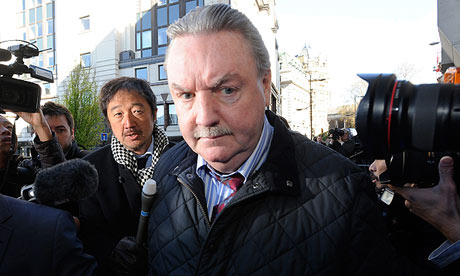
James McCormick arrives for sentencing at the Old Bailey over selling fake bomb detectors
Now a list of around 200 people either injured or related to the 95 killed in a double bombing on the Iraqi ministries of justice and foreign affairs in 2009 will be presented to the UK authorities.
McCormick sold 7,000 fake bomb detectors based on useless golf ball finders to the Iraqi government and other international agencies for prices ranging from £1,600 per unit to £19,000.
They cost McCormick less than $50 (£32) and police believe sales toIraq alone were worth more than £55m, buying McCormick a mansion in Bath, holiday homes abroad and a yacht.
Judge Richard Hone told McCormick: "Your fraudulent conduct in selling so many useless devices for simply enormous profit promoted a false sense of security and in all probability materially contributed to causing death and injury to innocent individuals."
An adviser to Nouri al-Maliki, the Iraqi prime minister, said he intends to make a claim on behalf of the victims of the 2009 attack which the Old Bailey heard on Thursday was an example of McCormick's fraud contributing to terrorists' success.
"A list of those who died and were injured and their kin is already available and I will bring that list to London and provide it to the British government," said Saad al-Muttalibi, a city councillor in Baghdad.
"This money should be paid to the people who can prove they were victims of terrorism. These bomb detectors became the main deterrent in Iraq."
Brigadier Simon Marriner, who served in Iraq from 2009-2011, had told the court in a statement that McCormick's ADE-brand machines were used at checkpoints across Baghdad through which truck bombs had to pass before blowing up the ministries of justice and foreign affairs.
"These checkpoints were equipped with the ADE," he said. "The truck bomb attacks were very successful in causing significant loss of life and considerable material damage which remains to this day."
Outside court Iraqi exiles called for compensation from at least £7m in assets that are expected to be confiscated from McCormick, from Langport, Somerset.
"He destroyed Iraqi lives," said Nidhal Ailshbib, an Iraqi activist based in London. "Thousands of Iraqi people are dead and handicapped."
DS Steve Mapp, of Avon and Somerset police, urged people who believe they were victims of the bomb detectors to make a claim for compensation from the confiscation hearing scheduled for May 2014.
"We can invite them to come forward to be considered to be compensated for their loss," he said. "That is something we are considering and it is only right."
Richard Whittam QC, defending, said: 

Thursday, April 25, 2013

We pay £6m tax on £2.6bn UK profits, but that's OK because we help start-ups: Google


Senior MPs called on David Cameron to consider stripping the boss of Google from his role as a government adviser tonight after he suggested that his company’s contribution to the British economy was more important than paying its fair share of tax.

Politicians from all three parties rounded on Google’s executive chairman, Eric Schmidt, after he defended its use of loopholes to minimise its UK tax bill. He insisted that Google would comply only with the letter of the law – despite paying only £6m of taxes on £2.6bn of revenue generated in the  UK in 2011. Google uses anomalies in international law to move profits into low-tax jurisdictions even if they have been generated by business carried out in Britain. Chancellor George Osborne has made tackling the practice a priority for Britain’s chairmanship of the G8.

But in an interview with the BBC, Mr Schmidt defended his company’s practice, suggesting that its contribution to the UK economy was more important than the tax it paid to the Exchequer. “We are investing heavily in Britain,” he said. “We power literally billions of pounds of start-ups through advertising networks and so forth, and we’re a key part of the electronic commerce expansion of Britain, which is driving a lot of economic growth for the country. So from our perspective, I think, you have to look at it in a totality.

“The people we employ in Britain are certainly paying British taxes, and more importantly, they’re British citizens and they’re driving a lot of GDP. I think the most important thing to say about our taxes is that we fully comply with the law, and well, obviously, should the law change we’ll comply with that as well.”
His comments were condemned by MPs, who pointed out that much of the investment in broadband internet infrastructure that had allowed Google to grow had been paid for by taxpayers.

Margaret Hodge, the chairman of the powerful Commons Public Accounts Committee (PAC), which carried out an investigation into the tax practices of multinational companies, said the Government should consider whether Mr Schmidt was an appropriate person to remain on its Business Advisory Group if Google maintained its tax position. “I think we should be careful who we talk to, and I think if people want to have the voice of Government, they have a responsibility to pay their fair share,” she said.

A government source also questioned Mr Schmidt’s position, claiming Google was “not really investing very much in Britain” and that the company had a “disproportionate influence” on Mr Cameron. “It’s a bit like The Wizard of Oz,” the source said. “From the outside, they appear terribly important and powerful but, when you look closely at what they are actually investing in Britain, it is pretty insubstantial.”

Wednesday, April 10, 2013

Horsemeat scandal: Dutch uncover large-scale meat fraud

From - http://www.bbc.co.uk/news/world-europe-22098763


Some 50,000 tonnes of meat supplied by two Dutch trading companies and sold as beef across Europe since January 2011 may have contained horsemeat.
minced beef - file pic
The meat is being recalled where possible, the Dutch authorities say.
There was no evidence that the meat was a threat to human health, the Netherlands Food and Consumer Product Safety Authority said.
In total, 132 companies in the Netherlands and some 370 more around Europe are affected by the discovery.
The suspect meat was supplied by Wiljo Import en Export BV and Vleesgroothandel Willy Selten.
The two companies are owned by one man who has already previously been investigated by food safety officials, the BBC's Matthew Price reports.
The latest find was made as part of EU-wide tests to trace horse DNA in processed beef foods and to detect a veterinary drug used on horses.
=================================================================
Are there no honest people left in the world?

Sunday, April 7, 2013

British police make £20 million from personal injury claims

From - http://www.telegraph.co.uk/news/uknews/law-and-order/9964617/Police-make-20-million-from-personal-injury-claims.html


The officers are using “ambulance chasing” lawyers to sue over accidents which happen whilst they are on duty – including falls and animal attacks.
Crime scene, scene of a crime, criminal, road rage, police tape, police, forensicsThere is even a hotline run by the Police Federation which is encouraging the practice. A lot of the £42million paid out in the last two years has been taxpayer funded.
The revelations come as public anger grows over the case of PC Kelly Jones, who is seeking damages from petrol station owner Steve Jones after reportedly tripping on a curb whilst attending a suspected break-in.
Mr Jones and the officer were checking the outside of the building after an alarm had gone off, when PC Jones is alleged to have fallen and injured herself.
Mr Jones has now received a letter from her solicitor claiming he is at fault after she suffered an injury to her leg and wrist and attended hospital, although she had been well enough to continue searching.
Mr Jones, 50, said he was "dismayed" to have received the letter seven months after the incident on August 25 last year.
-------------------------------------------------------------------------------------------------------------------------------
Now that the 'cat's out of the bag', the British fire fighters and ambulance crew and maybe lots of others willbe  making similar claims - if they haven't done so already.

Wednesday, March 20, 2013

Documentary: Inside Job


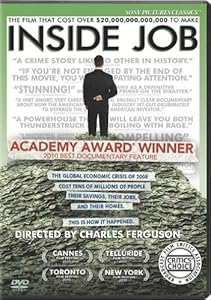
Charles Ferguson’s film – Inside Job – won the Academy Award for Best Documentary in 2011. It narrates the conflicts of interest between the finance industry, politicians, academics and regulators, which eventually led to the trillion-dollar collapse of 2008. Narrated by Matt Damon. From: http://www.theotherschoolofeconomics.org/?p=2499 - which screens the film on-line.

This documentary exposes the facts behind the 2008 global economic disaster. It was triggered by derivatives, primarily based on sub-prime mortgages in the US.  But the roots go back to the Regan deregulation of financial services. What is shocking is that many of the investment banks were betting against their own products and deliberately lying to their own customers. Several lawsuits are still pending.

It is fascinating viewing, but deeply disturbing as many of the key personalities are still in play in various companies and governments and regulatory bodies today.

For a write up see - http://en.wikipedia.org/wiki/Inside_Job_(film)


Monday, February 25, 2013

Horsemeat scandal: EU ministers want faster action on meat labelling

From - http://www.guardian.co.uk/uk/2013/feb/24/horsemeat-scandal-country-origin-labelling


A European Commission report on tougher rules about origins of frozen beef products is expected but not until the end of 2013
Horsemeat scandal EU ministers action food labelling
Horsemeat found in frozen beef products has destroyed the trust many people placed in their local supermarkets. Photograph: Luke Macgregor/Reuters
Owen Paterson, the environment secretary, will be among ministers from across the EU pressing on Monday for speedier action on introducing country-of-origin labelling for processed beef and other meat products as they struggle to get a grip on the horsemeat scandal.
On Saturday the French president, François Hollande, joined the growing calls for more traceability at European level and critics have complained that the UK coalition government had been dragging its feet on the issue before the crisis began last month. Country of origin and slaughter for cattle must already be included on labels for fresh and frozen beef but the European commission is paving the way to extend that to other meats and ingredients in processed food. However, a report on implementing tougher rules is not expected until the end of the year. This month, the Commons environment, food and rural affairs select committee said UK ministers had been caught "flat-footed" by the scandal, which has been blamed on mislabelling and criminal fraud, and criticised them for having sought UK exemption from some EU rules.
This would allow minced meat sold in Britain to have a higher fat and collagen content than permitted in other EU member states and remove the requirement for loose meat products to declare the amount of meat they contained. "This is not the time for the government to be proposing reducing the labelling standards applied to British food", said the committee.
Glenis Willmott, Labour MEP for the East Midlands and the party's leader in the European parliament, said last week that in 2011 UK ministers had opposed plans backed by the parliament for more comprehensive country of origin labelling. This had forced MEPs "into a much weaker compromise" as the coalition tried "to kick the issue into the long grass".
She said: "It is interesting that Mr Paterson, one of the most Eurosceptic of ministers, is now advocating EU legislation as a solution to the current crisis. It is simply common sense that a problem in the meat supply chain … needs EU-wide measures to combat it. But it is precisely this kind of EU regulation that Eurosceptics deem 'red tape from Brussels'. In 2011 the UK government said my plans would be too difficult to put into practice because the meat supply chain was too complex. We have now seen what the complexities of the industry can hide."

Friday, February 15, 2013

US GOVERNMENT SUES CREDIT RATING AGENCY OVER DODGY MORTGAGE RATINGS

From - http://worldnewscurator.com/2013/02/05/us-government-to-sue-standard-poors-moodys-may-be-next/#1RKLvw8kY5BBqHQG.99


The United States government is to sue credit rating agency Standard & Poor’s over the triple A ratings the firm gave to mortgage securities prior to the credit crunch and global economic crisis of 2009.
The civil lawsuit, which several US states are expected to join, will focus on decisions by the firm to award the highest rating to a range of mortgage-backed securities – including those based on sub-prime mortgages – in 2007. These securities later collapsed in value. The high rating given to these mortgage bonds helped to fuel a bubble in the sub-prime mortgage sector, and their subsequent collapse in value played a key role in the ensuing credit crunch and debt crisis whose effects are still ravaging the economies of many countries around the world.
Credit rating agencies such as Standard & Poor’s are paid by the issuers of such bonds to provide a rating of their risk, leading to concerns that there may have been a ‘conflict of interests’ – a polite way of saying that these agencies may have been issuing high ratings to secure repeat business, rather than because they had actually assessed the bonds as safe in a proper manner.
Share is Standard & Poor’s parent compay McGraw Hill fell by 14% on Monday as a result of the announcement. interestingly shares in Moody’s – another credit ratings agency – fell by almost as much (10%), suggesting that market analysts believe that they will be next Justice departments hit list.
Credit ratings agency have drawn a great deal of criticism from politicians and pundits, who have suggested that their activities played a large part in creating the conditions for the global economic crisis. In a report published in January 2011 the Financial Crisis Inquiry Commission described the agencies as “essential cogs in the wheel of financial destruction” and “key enablers of the financial meltdown”.

Sunday, February 10, 2013

Making Sense of the "Circular Economy"

From - http://www.triplepundit.com/2013/01/make-sense-circular-economy/


 resource recovery recycling Here Today Garbage Tomorrow Heather Rogers Ellen MacArthur Foundation Ellen MacArthur ecovative Digital Lumens Dell green Circular Economy Brockelsby Ltd. 3M green
If the name Ellen MacArthur rings a bell, you’re probably thinking of the person who set a record for circumnavigating the world in a high tech sailboat, solo no less, but that’s not the only circle for which she is known. Ms. MacArthur, through the charitable organization that bears her name, has formulated an economic concept called the circular economy, which is quickly becoming a buzzword around sustainability circles.
As far as buzzwords go, “circular economy” is a fairly pedestrian combination (as opposed to, say, Sex Pistols) and perhaps that’s just as well. Rather than getting distracted by the words, it’s far more interesting to pick through the concept itself and see how MacArthur’s vision of economic growth meets the challenges of a world of shrinking resources.

The Circular Economy

MacArthur was profiled and interviewed just last week on the Harvard Business Review blog by Eric Hellweg, and for those of you who don’t have time to read the whole thing (though you really should, it’s fascinating), the circular economy concept basically boils down to managing resource scarcity in the context of consumer demand for environmental responsibility.
As described by the Ellen MacArthur Foundation, it comes out like this:
“The circular economy is a generic term for an industrial economy that is, by design or intention, restorative and in which materials flows are of two types, biological nutrients, designed to reenter the biosphere safely, and technical nutrients, which are designed to circulate at high quality without entering the biosphere.”

Why the Circular Economy is more than mere recycling

While the emphasis on reentering and circulating call recycling to mind, MacArthur’s concept of a circular economy is on a different plane entirely. The Foundation’s website is careful to note the difference by referencing Heather Rogers, journalist and author of Here Today, Garbage Tomorrow:
“One of the biggest confusions around a circular economy framework is that sparked by the word ‘recycling’…’The vast majority of wastes are created during the manufacturing process, and that is where we should focus.’”
Recycling puts the onus on consumers to use goods more carefully and to dispose of the leftovers responsibly. The circular economy asks that manufacturers produce goods that involve less waste in the first place, and that enable consumers to integrate recycling into their daily habits more intensively.

Case studies for the Circular Economy

When you look at the Foundation’s case studies, the potentials for economic growth become clear. That’s especially true when you consider that “consumers” doesn’t just mean individual householders, it also means companies that consume products through their supply chains.
The waste oil sector in England, for example, was historically focused on animal feed until new legislation targeted biofuels. The Yorkshire waste oil processor Brockelsby Ltd. adapted not only by pivoting to the biofuel market, but also by double-purposing its operations as a research and development platform to find new values for low-grade waste products, which normally would be discarded.
Another Foundation case study is Massachusetts-based Digital Lumens, which aims to help industrial customers transition out of the “criminally inefficient” incandescent light bulb into high-efficiency LEDs integrated with an energy management system. The company is transitioning, too, from an equipment sales model to a service-based model that could enable it to reclaim spent or damaged components more efficiently.
One final example is New York’s Ecovative, which produces fully compostable bio-based packaging products that stand in for petroleum-based plastics. Ecovative’s unique approach is to literally custom-grow its packages using fungi, which has caught the eye of green-transitioning companies like 3M and Dell among others.

Where the rubber hits the circular road

The sustainability foundation of the circular economy is interesting enough in itself, but real proof of the concept’s viability is the potential for economic growth.
To buttress the case for the circular economy, the Foundation has begun to issue detailed reports on the economic benefits of transitioning out of “an increasingly resource constrained ‘take-make-dispose’ model,” both in the short term and over the long run.
The first report, in 2011, took a look at the stimulating effect on European Union manufacturing sectorfrom economic activity related to product development, remanufacturing and refurbishment.
The second report just came out in 2013, and it focuses on applying the principles of the circular economyto “fast-moving” consumer goods, namely food, beverages, textiles and packaging, which also happen to account for a good deal of municipal waste while absorbing – and wasting – a significant amount of agricultural output.
British sugar giant caught in global tax scandal

From The Guardian - http://www.guardian.co.uk/business/2013/feb/09/british-sugar-giant-tax-scandal


One of Britain's biggest multinationals, whose brands include Silver Spoon sugar, Twinings Tea and Kingsmill bread, is avoiding paying millions of pounds of tax in an African state blighted by malnutrition, a year-long investigation revealed on Sunday.
The Zambian sugar-producing subsidiary of Associated British Foods, a FTSE100 company, contributed virtually no corporation tax to the state's exchequer between 2007 and 2012, and none at all for two of those years.
The firm, Zambia Sugar, has recently posted record pre-tax profits and its huge plantation is increasing its capacity to produce more sugar for markets in Europe and Africa. Yet it paid less than 0.5% of its $123m pre-tax profits in corporation tax between 2007 and 2012.
The company benefits from generous capital allowance and tax-relief schemes in Zambia, but the investigation also found that it funnels around a third of its pre-tax profits to sister companies in tax havens, including Ireland, Mauritius and the Netherlands. Tax treaties between Zambia and some of those countries mean the state's revenue authorities are unable to charge their normal tax on money leaving their shores.
The revelations are contained in a report published by ActionAid, which exposes how Zambia Sugar has kept its contribution to the state's exchequer so low, although the company says that globally it actually pays a higher rate of tax on its profits than it otherwise would due to its corporate structure.
It is estimated that the tax haven transactions of this one British headquartered multinational deprived Zambia of a sum 14 times larger than the UK aid provided to the country to combat hunger and food insecurity.
ActionAid's findings will heap more pressure on the chancellor, George Osborne, to make progress in closing gaps in international tax standards and tackling avoidance at the G20 meeting of world leaders this week and the G8 in June.

Tuesday, February 5, 2013

RBS bankers must pay Libor fine, says George Osborne

From - http://www.guardian.co.uk/business/2013/feb/04/royal-bank-scotland-libor-fine-osborne

George Osborne is forcing Royal Bank of Scotland to cut its bankers' pay to ensure that taxpayers are not left to pick up the cost of the upcoming multimillion-pound fine for Libor rigging.


The chancellor said his views had been made clear to the management of the bailed-out bank in an attempt to defuse public anger about the portion of the fine – which could amount to between £400m to £500m in total – that will be paid to the US authorities.
"When it comes to RBS, I am clear that the bill for any US fine related to this investigation should on this occasion be paid for by the bankers, and not the taxpayer," Osborne said.
Speaking in Bournemouth where he unveiled plans to reform the banking system, Osborne appeared to back the RBS chief executive, Stephen Hester, but indicated he expects heads to roll as a result of the fine for rigging Libor – a key interest rate. It was "well known" that RBS was considering management changes, Osborne said.
The fine from the UK's Financial Services Authority is thought to be just under £90m with US regulators levying fines of around four times that amount. In the furore that followed the £290m Libor fine paid by Barclays last year£59.5m of which was levied by the FSA, the law was changed to ensure that fines went to the government.
"Those who were doing the supervising must also bear their share of the responsibility," Osborne said. "The RBS board and the RBS senior management are well aware of that and decisions are in hand."
He added that Hester is "taking the action to ensure those responsible are held to account".
It is expected that the departure of John Hourican, the head of the investment bank, will be announced once the Libor fine is revealed, possibly later this week, although he is not thought to be personally implicated in the rigging of Libor. The size of the bonus pool for 2012 at RBS has yet to be disclosed. It was £390m for 2011 and is expected to fall by as much as £150m. But the call by the chancellor to ensure bankers pay for the Libor fine does not preclude bonuses being paid for 2012.
Responding to questions about why senior bankers should receive bonuses after a year of scandal, Osborne acknowledged that Hester and Barclays boss Antony Jenkins have waived their bonuses.
He said there could have been "enormous public anger" if fines levied on RBS by US regulators were paid by the taxpayer, not the bankers.
"That is not on," said Osborne, who has told the bank's management that a fine imposed by international regulators should be paid out of bankers' pay. If the fine is paid by shareholders, led by taxpayers who own 83%of the bank, "that could have been a very great source of public anger this spring," said Osborne.
The chancellor confirmed remarks by Treasury sources over the weekend which had suggested he was concerned about how the Libor fine would be paid. In his speech, Osborne insisted that "everyone should exercise restraint and responsibility" over bonuses.
Osborne was accused of "rhetoric" and a "partial climbdown" by Ed Balls, the shadow chancellor, after he said he would use legislation to threaten banks with being broken up if they attempted to flout rules requiring them to ringfence their high street and investment banking operations.
Andrew Tyrie, the Conservative MP whose banking standards commission helped create the idea of "electrifying" the ringfence, said the chancellor had taken an "important step in the right direction". The ringfence was a key plank in proposals by Sir John Vickers' independent commission but the banking standards commission had been concerned banks would try to "game" the ringfence. "They will always try to do so unless strong disincentives are put in place," said Tyrie.


Chancellor insists Royal Bank of Scotland, not UK taxpayers, must take up estimated £500m fine for Libor rigging

Sunday, February 3, 2013

Inequality for All – another Inconvenient Truth?

From The Guardian - http://www.guardian.co.uk/film/2013/feb/02/inequality-for-all-us-economy-robert-reich


The powerful documentary Inequality for All was an unexpected hit at the recent Sundance film festival, arguing that US capitalism has fatally abandoned the middle classes while making the super-rich richer. Can its star, economist Robert Reich, do for economics what Al Gore did for the environment?
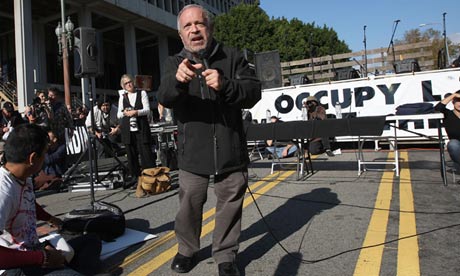
Robert Reich addresses Occupy rally
 Former US labour secretary Robert Reich at an Occupy Los Angeles rally in 2011. Photograph: David Mcnew/Getty Images

In one sense, Inequality for All is absolutely the film of the moment. We are living through tumultuous times. The economy has tanked. Austerity has cut a swath through the country. We're on the verge of a triple-dip recession. And, in another, parallel universe, a small cohort of alien beings – or as we know them, bankers – are currently engaged in trying to figure out what to spend their multimillion-pound bonuses on. Who wouldn't want to know what's going on? Or how it happened? Or why? Or if it is really true that the next generation down is well and truly shafted?

Any synopsis of the film runs the risk of making it seem dry again, but essentially it describes how the middle classes have come to have a smaller and smaller portion of the economic pie. And how, since 70% of the economy is based on the middle classes buying stuff, if they don't have any money to buy this stuff, it cannot grow. Meanwhile, the government has allowed the super-rich, the "one per cent", to take more of the nation's wealth. Half of the US's total assets are now owned by just 400 people – 400! – and, Reich contests that this is not just a threat to the economy, but also to democracy.

And what the film tries to do is thread together evidence that many people know about – the increasing struggle of the middle classes to just get by, the way that the top 1% of society has unshackled itself from the rest of us and has seen its income increase exponentially, and the ever-increasing cost of the traditional avenues of improvement, such as higher education – and weave it into a cohesive and convincing narrative. It is, in some respects, a theory of everything. Reich charts the three decades of increasing median income after the second world war, a period he calls "the great prosperity" and then examines what happened in the late 1970s to put an end to it. The economy didn't falter. It kept on growing. But wages didn't.
The figures that Reich supplies are simply gobsmacking. In 1978, the typical male US worker was making $48,000 a year (adjusted for inflation). Meanwhile the average person in the top 1% was making $390, 000. By 2010, the median wage had plummeted to $33,000, but at the top it had nearly trebled, to $1,100,000.
"Something happened in the late 1970s," we hear him tell his Berkeley class. And much of the rest of the film is working out what happened.
Some inequality is inevitable, he says. Even desirable. It's what makes capitalism tick. But at what point does it become a problem? When the middle classes (in its American sense of the 25% above and below the median wage) have so little of the economic pie that it affects not just their lives but the economy as a whole.
Reich's thesis is that since the 1970s a combination of anti-union legislation and deregulation of the markets contrived to create a situation in which the economy boomed but less of the wealth trickled down. Though for a while, nobody noticed. There were "coping mechanisms". More women entered the workforce, creating dual-income families. Working hours rose. And increasing house prices enabled people to borrow.
And then, in 2007, this all came crashing to a halt. "We have exhausted all the options," he says. There's nowhere else left to go. It's crunch time.
It's crunch time that so many working families understand too well. They may not be familiar with the theory of income inequality but they haven't been able to avoid noticing that they've got less money in their pockets. "I've always thought that kitchen-table economics is the most important topic to most people," says Reich. "Their wages, their jobs, getting by. I've always tried to relate economics to where people live. That's why I was so excited about the film."
… In the UK, Royal Bank of Scotland, having covered itself in glory in the Libor interest-rate fixing scandal, is currently contemplating bonuses for its investment banking division of £250m, according to reports last week. This, to put it another way, is the annual wage bill for at least 12,500 of its call-centre workers. Because this isn't just an American problem. It's a British one too.
"If there was upward mobility it would be OK," says Reich in the film. "But 42% of children born in poverty in the USA will stay there. In Denmark it's 24%. Even in Great Britain, where they still have an aristocracy, it's 30%."
It's probably a shocking statistic for Americans to hear. The problem is that by every index you can measure, inequality is worsening in Britain. There are fewer opportunities to overcome the barriers of your birth in the UK than in any other country in Europe. One of the most chilling moments in Inequality for All for a British audience is that how, faced with the same choices that America had in the 70s, we have, in the last year or so, taken the same path.

One of the key moments for Reich was the underinvestment in education, particularly higher education in the 70s. This was when America introduced tuition fees and its workforce started to fall behind the rest of the world's. When opportunities for those from low- and middle-income backgrounds began shrinking: precisely where the UK is today.
It's not just that wages have remained flat in America – as they have in the UK – it's that the expenses of everyday life have soared, in particular education and healthcare.
Last October, an independent commission in the UK led by the Resolution Foundation predicted that in 2020 wages for low- to middle-income families would be the same as they were in 2000. And yet everything else will have gone up. We too are facing the crunch.
In December, the Office for National Statistics found that richest 10% of people in Britain own 40% of the national wealth. In London and the south-east, one in eight households has almost £1m of assets. The bottom half of the country has no net property wealth and only £4,000 in pensions savings. For them, there is just rising prices. And the ever diminishing possibility of things ever being different for them or their children.