Showing posts with label social commitment. Show all posts

Sunday, June 30, 2013

Prince Charles aide to be quizzed by MPs over Duchy of Cornwall tax affairs

Private secretary to defend tax status of estate from which prince received record personal income of £19m last year
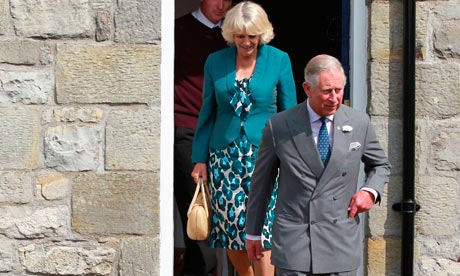
Prince Charles
The Prince of Wales's most senior official is to defend the tax status of his £763m Duchy of Cornwall hereditary estate before the Commons public accounts committee, which has already scrutinised the tax affairs of Starbucks, Google and Amazon.
As Clarence House revealed Prince Charles received a record private income of £19m from the duchy last year – a 4.1% increase on the previous year – his principal private secretary, William Nye, said: "Naturally we are happy to appear before the PAC if they would like to see us."
Nye and the estate's finance director, Keith Willis, have been summoned before the committee on 15 July. MPs on the committee have questioned whether the tax status of the hereditary duchy – which saw its capital value increase by 4.9% last year – "remains defensible". It pays no corporation or capital gains tax.
The duchy, which has a portfolio of land, property and investments and published its annual accounts late on Thursday evening, provides income for the heir to the throne.
Nye stressed that the prince "voluntarily" paid income tax on the surplus of his duchy income after official expenses had been deducted. His tax bill fell sightly last year by £70,000 to £4.26m, a drop of 1.5%.
But it is not income tax that interests the PAC who have noted public concern over the duchy's exemption from corporation and capital gains tax. Any change to the duchy's tax status threatens to reduce the annual surplus paid to the prince for his private and official spending.
Charles's annual accounts show that he spent more than half – £10,952,000 – on official expenditure. He is also believed to have spent at least £1m on official activities carried out by the Duke and Duchess of Cambridge and Prince Harry, including covering their office staff costs, though their official travel, security and refurbishment of the Cambridges' Kensington Palace apartment are met by the taxpayer. A breakdown of the young royals' costs was not revealed, but they are said to be "a significant element" of the £2,088,000 Charles paid out on "other expenditure."
His funding from the British taxpayer fell by 47% from £2.1m to £1.1m, but officials admitted this was due in large part to his travel costs visiting the realms of Australia, Canada and New Zealand where the Queen is also head of state, being met by the host countries.
Charles's expenditure includes the costs of 125.4 full-time official positions plus eight personal staff, including secretaries, chefs and valets, and 15 estate, farm, garden and stable staff. He also funds the 10.5 full-time staff employed for the Duke and Duchess of Cambridge and Prince Harry.
At a briefing on the prince's finances, Nye said that "special rules" applied to the duchy. "The Prince of Wales gets the income from the duchy but he doesn't have access to the capital. That has always been the case," he said.
"The duchy is a unique organisation. And, because it is unique, it isn't completely straightforward. We can explain it but it takes a little bit of explanation and we're happy to provide that explanation."
The duchy, founded in 1337, was not a corporation, so did not pay corporation tax. And to pay capital gains tax would undermine the reason behind it being set up, he said.
"The whole point about the duchy is that it is set up specifically, and indeed is required by law, to maintain its capital, to roll over and maintain its capital and to invest in the future so as to generate income for the future.
"Indeed, the only reason why accounts are put before parliament in the first place is because there is an obligation to the treasury to produce those accounts to demonstrate that the treasury is doing its job of checking that the duchy is maintaining its capital . So whatever the duchy sells, any asset, it has to put the money back in to maintain the capital.
"Of course, parliament could legislate to require the duchy to pay capital gains tax if they wish to, but that would completely undermine the point of why it evolved in the first place."

Sunday, January 27, 2013

Libor Scandal summarised

From FT - http://www.ft.com/indepth/libor-scandal


From COMPANIES Jan 25, 2013

Ex-Barclays chiefs named in Libor case

Bob Diamond, chief executive of Barclays©Bloomberg

Former bank executives among 25 detailed in regulatory case

From COMPANIES Jan 24, 2013

Barclays top brass face fresh Libor heat

Email suggests executives knew about lowball submissions

From COMPANIES Jan 24, 2013

Barclays executives named in Libor case

Diamond and Ricci are among those released to the High Court


From MARKETS Jan 23, 2013

UK watchdog investigation into possible rule breaches

From COMPANIES Jan 22, 2013

Barclays staff lose plea for anonymity

Judge rejects request ahead of Libor-related damages lawsuit

From COMPANIES Jan 17, 2013

Barclays eyes bonus pool to pay Libor fine

Move comes as new chief warns employees over ethics

Chief Executive Officer of UBS, Andrea Orcel arrives at Portcullis House in London©ReutersFrom COMPANIES Jan 9, 2013

UBS’s Orcel admits banks must change

‘We became too arrogant,’ says investment bank head

UBS AG logo at the London offices©BloombergFrom COMPANIES Jan 10, 2013

Former UBS bosses deny Libor knowledge

Quartet say they did not know rate-setting system under scrutiny

From COMPANIES Jan 11, 2013

RBS eyes bonus pot to recoup Libor losses

Lender might dip into funds to help pay possible fine

Starbucks threatens Cameron after 'unfair' tax attacks


From the Telegraph - http://www.telegraph.co.uk/news/politics/9829108/Starbucks-threatens-Cameron-after-unfair-tax-attacks.html

Starbucks has threatened to suspend millions of pounds of investment in Britain after what it described as constant and unfair attacks over its tax affairs by David Cameron and the Government.

Photo: Getty
Kris Engskov, the multinational’s UK managing director, demanded talks at Downing Street after the Prime Minister said tax-avoiding companies had to “wake up and smell the coffee”.
Mr Cameron’s use of the phrase at the World Economic Forum in Switzerland last week was taken as a direct attack on Starbucks which has been criticised for not paying corporation tax in Britain.
Mr Engskov was so concerned about the “politicisation” of the tax issue that he asked for the talks at No 10, where he met officials last Friday. Starbucks argues that it makes no profits in the UK and so is not required to pay the tax. “The PM is singling the business out for cheap shots, a company that, it should not be forgotten, has pledged to pay tax now and into the future,” said a source close to the firm.
The warning on investment comes amid concern among businesses that Government rhetoric on tax avoidance is hurting their image while their creation of jobs and wealth is not highlighted. Today, Boris Johnson, the Mayor of London, tells The Sunday Telegraph: “We should stop bashing wealth creation — such talk is absolute nonsense.”
The US coffee chain has found itself under regular attack after it was disclosed that since its arrival in Britain in 1998, it has paid £8.5 million in corporation tax, despite total sales of £3 billion. It said last month it had made a profit in only one year.

Apple stuffs $1bn a week into tax havens

From Sunday Times - http://www.thesundaytimes.co.uk/sto/business/Tech_and_Media/article1202350.ece

iPhone display showing Apple share performance
APPLE is stashing almost $1bn a week beyond the reach of the American taxman after ramping up efforts to slash its bill.
The Silicon Valley company squirrelled away more than $11bn (£7bn) in its warren of subsidiaries in low-tax countries and tax havens in the final three months of 2012.
This legitimate manoeuvre raises the amount of cash Apple has shielded from the American authorities to a colossal $94bn, according to documents filed last week. The revelation will inflame public anger over tax avoidance by large corporations, which is raging on both sides of the Atlantic.

Monday, November 26, 2012

If only most wealthy people are like Warren Buffet


From -  Reuters  - http://www.reuters.com/article/2012/11/26/us-buffett-tax-idUSBRE8AP0LY20121126?feedType=RSS&feedName=topNews&utm_source=feedburner&utm_medium=feed&utm_campaign=Feed%3A+reuters%2FtopNews+%28News+%2F+US+%2F+Top+News%29&utm_content=Google+Feedfetcher

"Warren Buffett, the legendary investor who changed the debate about U.S. tax reform in 2011 with a call for the rich to pay more, is now calling for minimum tax rates for millionaires.
Investor Warren Buffet arrives for the premiere of the film ''Wall Street: Money Never Sleeps'' in New York September 20, 2010. REUTERS/Lucas Jackson
In a New York Times editorial printed on Monday, Buffett suggested Congress move immediately to implement minimum taxes of 30 percent on incomes of $1 million to $10 million and 35 percent above that.
"A plain and simple rule like that will block the efforts of lobbyists, lawyers and contribution-hungry legislators to keep the ultra rich paying rates well below those incurred by people with income just a tiny fraction of ours," Buffett wrote.
"Only a minimum tax on very high incomes will prevent the stated tax rate from being eviscerated by these warriors for the wealthy," he added.
The new push is in keeping with the one he made in the same newspaper in August 2011, in which he decried the "coddling" of the super-rich. He used himself and his secretary as an example, noting that her tax rate was much higher than his even though her income was just a tiny fraction of what he made.
"Warren Buffett's secretary" became a political meme following that editorial, and the said secretary, Debbie Bosanek, was ultimately a guest of President Barack Obama at this year's State of the Union address.
The 2011 editorial spurred Obama to seek the implementation of what he called the "Buffett Rule," which set a 30 percent tax rate on millionaires. Opponents said it would stifle spending by the job-creating well-to-do, a notion Buffett ridiculed in the new editorial.
"So let's forget about the rich and ultra rich going on strike and stuffing their ample funds under their mattresses if — gasp — capital gains rates and ordinary income rates are increased," he said. "The ultra rich, including me, will forever pursue investment opportunities."
Buffett, whom Forbes ranks as the world's third-richest person, is the chief executive officer of Berkshire Hathaway Inc, the ice-cream-to-insurance conglomerate that employs more than a quarter-million people around the world.
He acknowledged in Monday's editorial that some people like him might stop investing as they wait for Congress to act.
"In the meantime, maybe you'll run into someone with a terrific investment idea, who won't go forward with it because of the tax he would owe when it succeeds," Buffett said. "Send him my way. Let me unburden him.""

Tuesday, May 29, 2012

"New energy leapfrogs the old"


ECAMI wins Ashden Award
"New energy leapfrogs the old"

Ashden Awards Photo
Max Lacayo recieves the 2009 Ashden Award from Prince Charles in London, UK.
"ECAMI's family-owned business has installed thousands of renewable energy systems in rural communities across Nicaragua since it began in 1982. A company with strong social commitment, it provides PV light and communications for schools; vaccine refrigeration for clinics; pumps to supply village water; entertainment and battery-charging for tourist facilities; and power for mobile phone masts. It also installs micro hydro and solar water heating. Now ECAMI is growing fast, setting up regional branches to meet the growing demand for renewable energy." from Ashden Awards website.

Can the telecom industry solve Africa’s power problems?


Africa is plagued by unreliable, intermittent and often non-existent access to electricity, especially in rural areas. This is a huge inconvenience and a big obstacle to economic development. Can mobile operators be the unlikely saviours, bringing power to the people in rural Africa, asks Peter Karaszi*?
Lack of power, inhospitable terrain, electricity thefts, shoddy and neglected infrastructure, mismanaged power companies, dirty coal fired stations, expensive power and frequent power cuts at best… the list of Africa’s power problems is long. According to the International Energy Agency (IEA), the overall electrification rate in Africa is less than 42%. In rural sub-Saharan Africa, it is a shocking 14%.
To quote the IEA: “Energy alone is not sufficient for creating the conditions for economic growth, but it is certainly necessary. It is impossible to operate a factory, run a shop, grow crops or deliver goods to consumers without using some form of energy. Access to electricity is particularly crucial to human development as electricity is, in practice, indispensable for certain basic activities, such as lighting, refrigeration and the running of household appliances.”

Some countries are actually moving backwards
 Government-run electrification projects are painstakingly slow, for a variety of reasons. Some countries are actually moving backwards. In South Africa, as an example, Eskom lacks capacity and has been forced to introduce “load-shedding” (a nicer word for planned blackouts). However, there are some very promising new developments in power production coming from an unlikely source: the mobile operators.
Mobile operators are used to operate in rural Africa. They have base stations off-grid that need a lot of power, which has so far been provided by diesel-fuelled generators. However, this is a very expensive (and dirty) way to power base stations. So mobile operators have started to introduce “green” power solutions for base stations, based on renewable energy sources (sun and wind)
In just the last two years, there has been impressive technological progress in the efficiency of green power management solutions for the telecom industry. Better batteries for storage of energy and more sophisticated control systems for e.g. more energy efficient battery charging and usage of the various energy sources are two examples.

A flexible, green solution
One clear indication that these solutions are taking off, is the recent announcement from Airtel in Nigeria that it will upgrade an initial batch of 250 diesel-powered base stations in Nigeria with E-site, a “green” energy solution from Sweden’s Flexenclosure.
Taking the E-site solution as an example, it has proven to be able to power base stations by more than 90% using renewable energy sources, over an entire year and considering all weather factors. Over long periods, there is actually more green power produced than is needed to power the base stations.
So power management companies, network suppliers and mobile operators are now contemplating what to do with the excess power produced, and whether more power can be generated for a small additional cost. The most obvious answer is to share it with the surrounding local communities.

Free excess power used to keep vaccines and medicines fresh
From a government point of view, there should also be considerable interest in alternative ways of providing power for rural areas. It would be much cheaper to sponsor additional infrastructure, e.g. solar panels, at a telecom site for community applications like streetlights and water pumps, than to expand the grid to remote locations.
At the longest running test site, in Dertu in Kenya, the excess power produced by E-site has powered for two years a cold-storage room for vaccines and other medicines that to date has helped more than 5,000 people in the area with snake anti-venom and vaccines for newborn babies.
A new initiative by Flexenclosure and Ericsson, the world’s largest mobile telecommunications equipment vendor, is called Community Power. As a system it provides the possibility to share the power produced by E-site with the surrounding local communities to power e.g. mobile and battery chargers street lights, clinics etc – in effect turning the site solution into a power station as well.

No more walking to do the talking
The Community Power solution in itself strengthens the business case for off-grid deployments for mobile operators. The handset charging dock eliminates the villagers’ need to walk for hours in order to charge their handsets, while on the other hand the operator benefits due to higher utilisation of the network, which increases revenues.
There are many alternative uses and social benefits for the excess power. Extending mobile communications and power to even more remote areas in developing countries will have a profound impact on the communities giving them the means to get information, communicate with their families, starting and running businesses, and getting access to banking services.
It will be the next step in the empowerment of people, and a mean for providing clean water, lighting, battery charging and power for private or business applications. A tool for self-uplifting is far better than passive handouts.
The blistering African sun and the strong desert and savannah winds are free. Africa is on the threshold of bring finally able to harvest these clean and constantly renewable energy sources, not only for communications but also to bring power to its people.


*Peter Karaszi is a communications expert in intelligent telecom solutions based in Cape Town, South Africa.