Showing posts with label 'waste' fresh food. Show all posts

Monday, June 3, 2013

Why do we have to trawl for the facts about Britain and the EU?

Finally, the absurd fishing quota policy that sometimes results in 50% of the catch being discarded is going to change.
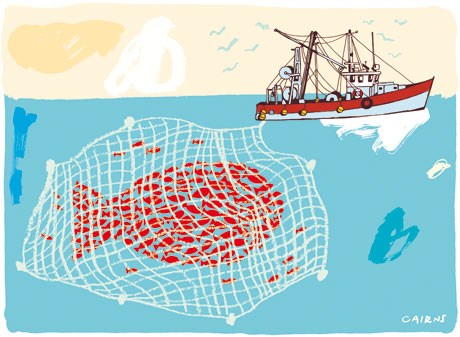
With fishing policy, as with Italy's attempt to ban plastic bags, our government is terrified of appearing to allow the EU to undermine British 'interests'
Brian Cairns illustration
For years, campaigners have been fighting against industrial fishing in European waters and last week, at long last, they had something to celebrate. Their target has been the huge factory ships that hoover up everything in their wake, discarding the dead fish they don't want – often half the catch – and returning to port with their quotas met the most profitable way. The result has not just been dwindling fish stocks – the entire marine ecosystem is under assault, including the coastal fishing communities that depend on it for their livelihood.
No one European country can make a difference by itself: fish do not respect borders. In any case, the danger for any one country acting unilaterally to husband fish stocks and ban the practice of discarding dead fish is that if others do not follow suit it will be the sucker. It will have hurt its own fishing interests just to benefit others. This is a problem that can only be solved by European countries acting together.
Last Thursday at 3am, EU members states finally agreed the outlines of a tough Common Fisheries Policy. First, there was a commitment for the first time to set quotas – based on hard scientific advice – that aim to go beyond stabilising fish stocks to achieving growth. Crucially, from 2015, boats will be forbidden from discarding unwanted dead fish, starting with species such as mackerel that live in the upper oceans, and extended to all fish types by 2020. Every country will have to submit a detailed plan for how it intends to meet its quota, but making its own decision about which types of fishing it will favour. But with discards effectively banned – inevitably, under British pressure, boats will still be allowed to discard 5% of their catch after 2020 – there will be an inbuilt bias against industrial fishing. This is a major move to help stocks.
Battle-hardened campaigners could only blink in semi-disbelief. Hugh Fearnley-Whittingstall, the leader of Fish Fight, who has signed up more than 860,000 supporters to work for tougher quotas and a ban on discards, hailed the deal as a "tremendous achievement". Even Greenpeace managed a grudging congratulation: "For all its loopholes and sluggish timelines the policy has the potential to turn Europe's destructive and oversized fishing industry into a sustainable, low-impact sector." The fishing industry acknowledged a corner had been turned.
It was a great example of an increasingly democratic EU beginning to work rather well. For the policy to become law, the European parliament will have to give its assent – and on this question it is very radical. EU fisheries ministers, managed cleverly by EU Commissioner Maria Damanaki, knew they had to come up with something strong, or parliament's endorsement would be impossible. But equally, the deal is only sellable domestically if governments accountable to national parliaments and electorates work out exactly which parts of their domestic fishing industry are going to shoulder the pain. Here is a policy that is democratically legitimate at EU and national levels, respects national sovereignty and solves a problem that no one country could solve itself.
However, this will be news to almost every reader of this column. No national newspaper printed it. It did break at 3am, but apart from the FTthere was not even online coverage and no follow-up the following day. Intriguingly, even the BBC's Today programme felt the story could be ignored; the juicy European news of the day was a BBC scoop that the EU Commission is going to take Britain to court over the government's alleged discriminatory withdrawal of welfare benefits from EU nationals. It was a good story, but listeners might also have been interested in hearing the fishing deal discussed – or even that it had happened. After all, the news was only hours old. Fish Fight does have 860,000 supporters: the effective ending of discards was hardly marginal news.
But the story did not fit the narrative. The British view, hardwired into the political and media class's DNA, is that the EU is a mess about to disintegrate under the weight of its absurd, anti-democratic ambitions to become a superstate, with its even more absurd single currency. It does nothing worthwhile, harms all British interests and we must stay disengaged or, at best, leave altogether. Every editor knows that no positive stories emanate from Brussels, and even if they do, there are no penalties for ignoring them.
It is utterly disabling. The technical reason why Britain fought so hard to continue to allow boats to discard 5% of their catch after 2020 is that allegedly in British waters, shoals of fish are more intertwined than in other waters, so catching fish that have to be discarded is more likely. Really? My hunch is that without the concession officials and ministers were terrified of Nigel Farage and Eurosceptic Tory MPs lining up with some disgruntled fishermen to claim the big bad EU had undermined British "interests".
Certainly, that was why Britain last week blocked Italy from implementing a ban on single-use plastic bags as discriminatory under EU law against British plastic bag manufacturers. Now no EU country can adopt what is clearly a sane environmental move – at one time supported by the prime minister – because of a reflex terror of a complaint by "wealth-creating" business that EU regulation is undermining British interests. (Both Wales and Northern Ireland have introduced a plastic bag levy.)
Nor will anybody have juxtaposed the richly comic spectacle of the British government prosecuting Italy for being discriminatory under EU law even as it protests against the injustice of being called discriminatory itself over welfare. Instead, there is synthetic outrage about Britain being singled out by a mutton-headed and politically insensitive European Commission. Yet the entire EU is based on the principle that there are common European interests, extending from how we fish our seas to how we explore space, that are underpinned by the notion that member states do not discriminate against each other. The rule of European law is universal, as it should be in rule-of-law societies. The Commission has no option but to uphold it.
This is a club worth staying in. It is much better for Britain's fishing industry – along with every other industry – that we are in the EU as it makes its rules. If the British are to make an informed choice about their destiny in any future referendum, then at least they deserve to know the facts. Judging by last week they will not be able to rely on their media for those or on their terrified politicians.

Sunday, February 10, 2013

Making Sense of the "Circular Economy"

From - http://www.triplepundit.com/2013/01/make-sense-circular-economy/


 resource recovery recycling Here Today Garbage Tomorrow Heather Rogers Ellen MacArthur Foundation Ellen MacArthur ecovative Digital Lumens Dell green Circular Economy Brockelsby Ltd. 3M green
If the name Ellen MacArthur rings a bell, you’re probably thinking of the person who set a record for circumnavigating the world in a high tech sailboat, solo no less, but that’s not the only circle for which she is known. Ms. MacArthur, through the charitable organization that bears her name, has formulated an economic concept called the circular economy, which is quickly becoming a buzzword around sustainability circles.
As far as buzzwords go, “circular economy” is a fairly pedestrian combination (as opposed to, say, Sex Pistols) and perhaps that’s just as well. Rather than getting distracted by the words, it’s far more interesting to pick through the concept itself and see how MacArthur’s vision of economic growth meets the challenges of a world of shrinking resources.

The Circular Economy

MacArthur was profiled and interviewed just last week on the Harvard Business Review blog by Eric Hellweg, and for those of you who don’t have time to read the whole thing (though you really should, it’s fascinating), the circular economy concept basically boils down to managing resource scarcity in the context of consumer demand for environmental responsibility.
As described by the Ellen MacArthur Foundation, it comes out like this:
“The circular economy is a generic term for an industrial economy that is, by design or intention, restorative and in which materials flows are of two types, biological nutrients, designed to reenter the biosphere safely, and technical nutrients, which are designed to circulate at high quality without entering the biosphere.”

Why the Circular Economy is more than mere recycling

While the emphasis on reentering and circulating call recycling to mind, MacArthur’s concept of a circular economy is on a different plane entirely. The Foundation’s website is careful to note the difference by referencing Heather Rogers, journalist and author of Here Today, Garbage Tomorrow:
“One of the biggest confusions around a circular economy framework is that sparked by the word ‘recycling’…’The vast majority of wastes are created during the manufacturing process, and that is where we should focus.’”
Recycling puts the onus on consumers to use goods more carefully and to dispose of the leftovers responsibly. The circular economy asks that manufacturers produce goods that involve less waste in the first place, and that enable consumers to integrate recycling into their daily habits more intensively.

Case studies for the Circular Economy

When you look at the Foundation’s case studies, the potentials for economic growth become clear. That’s especially true when you consider that “consumers” doesn’t just mean individual householders, it also means companies that consume products through their supply chains.
The waste oil sector in England, for example, was historically focused on animal feed until new legislation targeted biofuels. The Yorkshire waste oil processor Brockelsby Ltd. adapted not only by pivoting to the biofuel market, but also by double-purposing its operations as a research and development platform to find new values for low-grade waste products, which normally would be discarded.
Another Foundation case study is Massachusetts-based Digital Lumens, which aims to help industrial customers transition out of the “criminally inefficient” incandescent light bulb into high-efficiency LEDs integrated with an energy management system. The company is transitioning, too, from an equipment sales model to a service-based model that could enable it to reclaim spent or damaged components more efficiently.
One final example is New York’s Ecovative, which produces fully compostable bio-based packaging products that stand in for petroleum-based plastics. Ecovative’s unique approach is to literally custom-grow its packages using fungi, which has caught the eye of green-transitioning companies like 3M and Dell among others.

Where the rubber hits the circular road

The sustainability foundation of the circular economy is interesting enough in itself, but real proof of the concept’s viability is the potential for economic growth.
To buttress the case for the circular economy, the Foundation has begun to issue detailed reports on the economic benefits of transitioning out of “an increasingly resource constrained ‘take-make-dispose’ model,” both in the short term and over the long run.
The first report, in 2011, took a look at the stimulating effect on European Union manufacturing sectorfrom economic activity related to product development, remanufacturing and refurbishment.
The second report just came out in 2013, and it focuses on applying the principles of the circular economyto “fast-moving” consumer goods, namely food, beverages, textiles and packaging, which also happen to account for a good deal of municipal waste while absorbing – and wasting – a significant amount of agricultural output.

Tuesday, July 3, 2012

Food-share database to end supermarket waste: Stores boost links with charities to help the hungry


From Daily Mail - Supermarkets and sandwich chains could soon share surplus food with families struggling in the economic downturn.
Under a proposal backed by the Government, retailers would log details of products approaching the end of their shelf-life on a database.

Charities, who are increasingly working with families who cannot afford to feed themselves, would use the information to arrange pick-ups of food and other unsold products set aside during the week by stores.
Charities would then put together parcels or cook meals using the surplus food and distribute it to the needy.
Tackling food poverty: The scheme would help families who cannot afford to feed themselves as well as cutting down on food wastage
Britain has seen an explosion in demand for food banks and food parcels amid the biggest squeeze on living standards in 60 years. 

The Government is putting pressure on food giants to back the scheme, which is designed to both cut food waste and help those in need. ...

‘Charities and retailers are already working together to make great use of surplus food and I’m hosting the roundtable today to look at new ways to make the system work even better.’ 

FareShare collects surplus from the food and drink industry and redistributes it to around 700 charities including the Salvation Army and homeless shelters.
The nation’s biggest stores, including Tesco, Asda, Sainsbury’s Morrisons, the Co-op, M&S and Boots, will take part. Charities FareShare and FoodCycle, which were set up to tackle food poverty, will also be present.

The charities it supplies are also increasingly working with families living in food poverty.
The group wants supermarkets to provide food at each of its 18 outlets which would be picked up on a rota basis by local charities.

FoodCycle has called for the creation of a database so that food can be shared more effectively. 
The charity uses professional kitchens to produce free meals in 14 locations across the country and is currently in partnership with Sainsbury’s and  Waitrose, as well as smaller grocers and markets. 
Other retailers have been reluctant to back its work because they are worried about being sued if people fall ill as a result of eating surplus food.

The charities are supporting the introduction of a so-called Good Samaritan law which exists in the US, and ensures firms providing food in good faith are exempt from legal action.

The British Retail Consortium said its members already give excess food to charities but said discussions on improving communication between charities and retailers will be held.

It said the scheme should apply to all food retailers and could involve sandwich chains.
It comes as Waitrose announced  a commitment to donate surplus food from all branches to charities by the end of this year.

In the future, making donations to charities will be its preferred option for any unsold food that is still fit for consumption.

Friday, May 4, 2012

You and I are not blameless

In earlier blogs, I blamed the state of the world economy on governments, banks and big business. Sadly, you and I are not blameless.

I did an inventory recently. I have 5 watches, 
innumerable clocks apart from those embedded on PCs, phones, TV sets etc; although retired I still have 6 serviceable suits and who knows how many shirts and ties; I have a dozen pairs of shoes, including trainers and golf shoes; 
and I could go on. I am sure if you did an inventory you too may find yourself surprised at how much you possess that are surplus to requirements. I am told women accumulate even more than men and I can believe it given the number of newspaper/magazine articles, Webpages and TV programmes on it - shelves full of handbags 
and shoes, racks and racks of clothes, some which have never been worn.

Similar excess applies to food. We are now more careful. but even so each week we are throwing away food that has gone past the due date. At least, a minor consolation is that the waste food no longer goes into the general rubbish bin but into a food recycling bin for the council to re-compost.

My point is that if you and I wasted less, then the retailers would sell less and the manufacturers would produce less, and the earth's resources would deplete slower.

Monday, April 30, 2012

Fruity answer to food waste

Sunday Times: "JENNY DAWSON was disgusted as she looked down at the heap of wasted food at New Covent Garden Market in west London. The mangetout that had come from Kenya was still in its packaging and had been discarded as rubbish when wholesale trading closed at 7am. Tomatoes, courgettes, apples and onions lay abandoned in a pile, waiting to be binned.


Jenny Dawson makes chutney from fruit and vegetables normally dumped in landfill

Dawson had a brainwave — she would use the abandoned stock to start a business. Now, two years later, she sells chutneys made from leftover fruit and vegetables at Borough Market in south London. Her business, Rubies in the Rubble, gives the produce a second chance, preserving it in jars with a shelf life of up to two years.
“There’s nothing wrong with the food, it just hasn’t been bought by anyone. Nobody is at fault, but it is such a waste to throw it all away,” said Dawson.
“When you see the waste with your own eyes, it touches a nerve.”
Food waste is typically disposed of in landfill sites. As it decomposes, it produces methane and carbon dioxide, which are released into the atmosphere, where they act as greenhouse gases.
According to the latest report by Wrap, the environmental body, of the 7.2m tonnes of food thrown away in Britain each year, more than half is good enough to be eaten.
Dawson, 26, spent two years working for the hedge fund Odey Asset Management before making her career change."


http://www.facebook.com/rubiesintherubble

Feeding 5000 with 'waste' food


The Guardian: " ... The Feeding the 5000 team – a coalition of Fareshare, FoodCycle, Love Food Hate Waste and Friends of the Earth, led by food waste expert Tristram Stuart– treated Grondona and 4,999 others to a free meal using food that would otherwise have been wasted, such as cosmetically imperfect fresh fruit 
and vegetables – in short, wonky carrots.


The misshapen ingredients were not salvaged from nearby skips but supplied directly by farmers who sell their goods to supermarkets. "The supermarkets have strict cosmetic standards, so if a carrot is too long or slightly bent, it either goes in the bin or is left out in the field and simply ploughed back into the ground," Stuart says. "Today, that's not happened and all that food is here to be eaten."
While UK consumers cannot access farmers' surplus produce, Stuart hopes the event will inspire people to stop wasting food and to demand businesses end the practice of dismissing unsightly goods. Some supermarkets tried selling ugly vegetables in 2008 after an EU ruling meant odd-shaped and oversized produce could be sold in the UK.
As well as the 5,000 portions of curry on offer, a live cooking tent was showing the public how to cook and eat discarded bits of animals such as hearts, lungs and offal (offal consumption has apparently halved in the UK during the past 30 years). There were also 1,600 pints of apple juice ready to be drunk and celebrity chefs turning waste into well-seasoned goodies."


http://www.guardian.co.uk/uk/2011/nov/18/waste-food-feeds-5000-trafalgar