Showing posts with label global economy. Show all posts

Monday, July 29, 2013

Capability building in China

All too often in the UK we hear senior business leaders and politicians bemoaning the lack of skilled labour.  But China 30 or so years ago had very few skilled staff.  So how did they progress to be the world's leading manufacturer and exporter?


Article|McKinsey Quarterly

Capability building in China

Skill building must be rewards-based, rooted in real work, and tailored to local conditions.


July 2013 | byKarel Eloot, Gernot Strube, and Arthur Wang
Capability building—leadership, managerial, and team-based skills rather than technical ones—has become an urgent imperative for many companies in China. As the country loses its extreme low-cost-labor advantage, businesses must look for ways to increase productivity and internal collaboration, to better understand consumers, and to develop a more sophisticated appetite for risk.
Companies in China face many of the same challenges—a lack of up-front planning and inadequate resources—that bedevil capability-building exercises everywhere. But certain “China factors” stand out. For starters, the demand for managers with strong leadership skills and international experience is growing significantly faster than the supply of qualified candidates. That imbalance makes it more difficult to pull off successful skill-building efforts, even for multinationals that typically invest more in training than Chinese companies do. (Indeed, one implication of China’s white-hot war for talent is that outside trainers brought in by multinational companies to set up and run new programs often move on before relevant tools and internal processes are in place.) Another perennial challenge for multinationals: the Chinese context and culture, which may require local tailoring of global approaches.
Then, of course, there are China’s state-owned enterprises. Many of them only recently converted from government departments into commercial entities and are still working to adapt to a competitive environment and adopt a true business mind-set. These companies generally lack a systematic approach to nurturing employees moving up the organizational ladder. They misconstrue capability building as a classroom activity, missing the impact of linking it to actual business. And they are too inflexible either to fire underperformers or to reward and promote employees, including managers, who change their behavior and adopt the necessary mind-sets.
While the challenges facing multinationals and state-owned enterprises differ, our experience with leaders at both kinds of organizations (as well as with private-sector Chinese companies) has highlighted the importance of some common, broadly applicable principles. In this article, we describe three that should help companies overcome many of the obstacles that have frustrated capability-building efforts in the past.

1. Relate capability building to real activities

...

2. Instill incentives and create opportunities for promotion

...

3. Don’t forget China’s unique culture

...
The solutions may sound obvious: developing Chinese teaching materials to help solve problems, building day-to-day business problems around products that participants would find in the Chinese market, and localizing global training materials through culturally appropriate metaphors and examples. But we know from experience how easy it is to overlook these issues. In our own work, we routinely use a case involving a coffee machine to teach managers about the seven types of waste and how a “lean” perspective can address them. When we recently used this case at a Chinese state-owned enterprise, however, the managers couldn’t make sense of the story, because they had never used a coffee machine. We have now adapted the context to tea making.
About the authors
Karel Eloot is a director in McKinsey’s Shanghai office; Gernot Strube is a director in the Hong Kong office, where Arthur Wang is a principal.

Tuesday, May 21, 2013

Apple 'among largest tax avoiders in US' - Senate committee

A few days ago Google claimed that the reason it seems to be paying low taxes outside of its home country is because the buklk of its taxes are paid in the US.  Apple obviously does not have the same excuse.

From - http://www.bbc.co.uk/news/business-22600984

Apple has been accused of being "among America's largest tax avoiders".
Apple chief executive Tim Cook


A Senate committee said Apple had used "a complex web of offshore entities" to avoid paying billions of dollars in US income taxes. But it said there was no indication the firm acted illegally.
Apple chief Tim Cook will go before the panel on Tuesday. In prepared testimony Apple said it did not use tax gimmicks.
The Irish Republic, home to three Apple subsidiaries, says it is not to blame for the firm's low tax payments.
The US Senate had said that Apple paid little or nothing on billions of dollars in profits placed in Irish subsidiaries.
"They are not issues that arise from the Irish taxation system," Deputy Prime Minister Eamon Gilmore told national broadcaster RTE when asked about the Senate committee report.
"They are issues that arise from the taxation systems in other jurisdictions and that is an issue that has to be addressed first of all in those jurisdictions."
Apple has a cash stockpile of $145bn (£95bn), but the Senate committee said $102bn of this was held offshore.
The company says it is one of the largest taxpayers in the US, having paid $6bn in federal corporate income tax in the 2012 fiscal year.
The Senate Permanent Subcommittee on Investigations has been examining "methods employed by multinational corporations to shift profits offshore".
Some large firms in the US have come under fire for their reluctance to repatriate their foreign earnings as they could face a top tax rate of 35%.
US corporation tax is one of the highest in the world at 35%. However, companies typically pay far less, thanks to numerous deductions and exemptions.


Sunday, May 19, 2013

Fury at corporate tax avoidance leads to call for a global response

From - http://www.guardian.co.uk/business/2013/may/18/corporate-tax-avoidance

Anger over the financial affairs of multinationals such as Google, Amazon and Starbucks is gathering momentum in Westminster. Now the UK is poised to lead the debate about international tax reform at next month's G8 summit.i

Google I/O developers conference
Google's approach to its taxes has been branded as evil by Margaret Hodge, chair of the public accounts committee. Photograph: John G Mabanglo/EPA
Huge orange and green cranes hover over a vast building site at King's Cross, London. Over the next three years, 2.4 acres of this site will be transformed into a million square feet of an 11-storey headquarters for the internet giant Google, no doubt chock-a-block with colourful Big Brother-house-style sofas and surreal chill-out zones that mark out its other 70 offices in 40 countries.
The property deal is estimated to have cost around £1bn and was heralded by the site's development consortium as the "most significant property transaction of recent years".
"This is a big investment by Google, we're committing further to the UK where computing and the web were invented. It's good news for Google, for London and for the UK," said Matt Brittin, vice-president for northern and central Europe, when the purchase was announced in January.
Like Amazon, Google is seeing increasing success in the UK where one in every $10 of sales is now generated. Yet both firms claim they are merely touching down on UK soil, without a "permanent establishment" and therefore are not paying tax on profits from billions of pounds worth of sales made here.
On Wednesday, Google won the advertiser of the year trophy at the 54th annual Clio Awards – the Oscars for advertising professionals. Accepting the award in New York, Robert Wong, chief creative officer of Google Creative Lab, said: "At the highest order, our job is to remind the world what it is they love about Google."
That popularity has hit a serious snag. The next day the company was branded "evil" by Margaret Hodge, chair of the public accounts committee, while this weekend Ed Miliband called it "irresponsible". "If everyone approached their tax affairs as some of these companies have approached theirs we wouldn't have a health service, we wouldn't have an education system," he said.
Along with Amazon and, before that, Starbucks, Topshop, Boots, Vodafone, Goldman Sachs and Greene King, Google is the latest to have become the target of grassroots hostility towards their aggressivetax avoidance policies. The actions of these corporations are not illegal, nor underhand, but especially when we're all supposed to be in austerity together, jarring horribly with public opinion.
Something "doesn't smell right", as the Guardian's editorial said this weekend, after it ran an account of the extent of Amazon's dealings in the UK, far wider than what its tax lawyers are implying.
The debate is now raging over whether these companies are the happy beneficiaries of a tax system knitted with loopholes, or the malicious purveyors of smoke-and-mirror accounting. HM Revenue and Customs claims the former – public opinion is rolling towards the latter. Lin Homer, chief executive of HMRC, claimed the public don't understand. Asked why she was not taking a tougher line with internet giants, she told the public accounts committee: "We see, but understand more fully, some of the information that might seem to the general public to be surprising."
But campaigners say tax collectors and leading politicians have been caught out; too engrossed in austerity plans, they are scrabbling to keep up with people who point out that there are other ways to balance the books.
"Without a doubt, they are behind the curve," said Richard Murphy, a chartered accountant, economist and founder of Tax Justice Network. "They have all been caught by surprise because this has come from civil society, a campaign that has been going on for almost a decade but has only been picked up by politicians after the banking crisis when they suddenly realised they were desperately short of cash."
He said HMRC had been ducking tax avoidance completely. He said it had powers to tackle any suspect tax returns of foreign-based companies. "If the breach is blatant, then they can act. What we haven't got is politicians who will stand up to this. It's a critical point. If the state will not stand up for its right to tax big corporations then we are in deep trouble."
UK Uncut began campaigning on the issue in 2010 and it was its legal challenge that revealed how HMRC waived a £20m bill for Goldman Sachs, as well as a £6bn bill to Vodafone. Journalists, tax experts and campaigners have been investigating and exposing the tax scams being perpetrated by big businesses for far longer – pointing out glaring loopholes in Britain's tax system.
When Matt Brittin of Google told the public accounts committee in November 2012 that Google did not have a sales presence in the UK, it was the news agency Reuters that quickly uncovered evidence to the contrary, resulting in Brittin being recalled in front of the committee on Thursday, where his company's behaviour was described as "devious, calculated and, in my view, unethical" by Margaret Hodge.
"You are a company that says you 'do no evil'. And I think that you do do evil," said Hodge, referring to Google's motto, "Don't be evil".
Amazon may also be recalled, after numerous whistleblowers from among its employees approached journalists to contest official accounts of its trading practices within Britain.
For the moment the government's line is that this is a global problem that cannot be solved unilaterally. On Monday, Google's executive chairman, Eric Schmidt, will meet David Cameron, a meeting No 10 insists is not about tax, but to do with Schmidt's role on the prime minister's business advisory group.
Labour leader Ed Miliband, who is due to give a speech to Google employees on Wednesday, has backed a "country by country" international scheme on tax declaration but says that he is concerned that no firm proposals have so far been put forward for the G8. "You have to have much greater transparency. Tax offices have to know country by country how much profit people are making, how much tax they are paying. Unless you know that you won't get to the bottom of what is happening. You have to deal with tax avoidance schemes. You have to deal with tax havens.
"We are saying there has to be a big, big push on this. It has to be done internationally and if it is not done internationally, Britain should act on its own."
All eyes will be on what, if anything, can be agreed at next month's G8 meeting in Scotland, where, as host of the event, David Cameron has pledged to put tax avoidance at the top of the agenda as he insists it is an issue for international co-operation rather than unilateral action.
And it would not be just the wealthy who would be watching the progress of the talks, said Melanie Ward, head of advocacy at ActionAid UK.

Thursday, May 16, 2013

Amazon paid £3m tax on £4bn UK sales

From: http://www.guardian.co.uk/business/2013/may/15/amazon-uk-tax-3m

Online retailer's tax charge brings to £6m the total corporation tax raised from Amazon.co.uk in a decade


Amazon.co.uk
Amazon.co.uk paid £3m in tax. Photograph: Chris Radburn/PA
Amazon's main UK subsidiary paid just £3.2m in tax last year, according to accounts filed on Wednesday, despite overall UK sales of £4.2bn.
Amazon's taxes for last year are only marginally higher than the £2.5m the company received in government grants during the year, according to the annual accounts published at Companies House.
The revelation comes amid public unrest over the minimal contribution of Amazon and fellow digital giants Apple and Google to the British public purse, despite the important contribution UK sales make to their international revenues.
The online retailer's tax charge brings to £6m the total corporation tax raised from Amazon.co.uk Limited in a decade. The company's tax bill was £1.9m in 2011, but these sums may not actually be paid to HM Revenue and Customs because of cumulative losses across the Amazon group.
Amazon employed 4,191 people at the end of 2012 in the UK, and thousands more in its warehouses via contracting agencies, but reduced payments to the British government by routing sales via a subsidiary in Luxembourg.
The UK company declared a turnover of £320m for 2012, up 50% on 2011. However, its income is largely raised from other Amazon companies in return for services such as warehousing and distribution and negotiating purchasing deals with book publishers.
Amazon gives a fuller picture of its UK revenues on regulatory filings to US investors, and this data showed a growth in UK turnover of 20% during 2012, to $6.5bn (£4.2bn).
The company's UK filing states: the company recorded a profit before taxation of £10.8m in the current year and "is expected to remain profitable for the foreseeable future".
Liberal Democrat MP John Hemming said the figures showed the inadequacy of existing rules to tackle the problem of profit shifting by major corporations.
"The government clearly needs to do a detailed study on how to handle the tax implications of e-commerce," he told Reuters.
Nick Smith, a Labour MP, said he wanted the tax authorities to take a close look at Amazon, describing its tax payment as "pathetic".
"HMRC should be going through this company's tax arrangements with a fine-tooth comb," he said.

Saturday, May 11, 2013

Osborne: G7 agree to target tax evasion and avoidanc

From: http://www.bbc.co.uk/news/business-22476233


The G7 group of industrialised nations have agreed that there must be collective action against tax evasion and avoidance, the UK's finance minister has said.
Chancellor George Osborne said after the talks that it was "incredibly important" that firms and individuals paid the tax they owed.
Chancellor George Osborne at a news conference following the G7 meeting
The members agreed on more policy issues than had been assumed, he added.
The G7 comprises the US, Germany, the UK, Japan, Italy, France and Canada.
In a news conference held jointly with Bank of England governor Sir Mervyn King, Mr Osborne said the finance ministers and central bank governors of the G7, meeting in Aylesbury, Buckinghamshire, had also agreed no bank should be "too big to fail".

Friday, May 10, 2013

Kofi Annan turns up heat on ENRC and Glencore in pursuit of Africa’s lost tax

From: http://www.thetimes.co.uk/tto/business/industries/naturalresources/article3760812.ece


Kofi Annan has called on Britain to use its presidency of the G8 to stamp out the “unconscionable” business practices of companies such as Glencore Xstrata and ENRC in Africa.
ENRC handout pic

The Africa Progress Panel, chaired by the former Secretary-General of the United Nations, wants an international crackdown on tax avoidance with a particular push for transparency in the mining and oil sector, it said in a report.
ENRC and Glencore strongly deny any wrongdoing and said that they were not contacted by the Africa Progress Panel before the publication of its report. The panel estimates that Africa lost $63 billion (£40 billion) in tax revenues through illicit practices between 2008 and 2010 alone.
“It is unconscionable that some companies, often supported by dishonest officials, are using unethical tax avoidance, transfer pricing and anonymous company ownership to maximise their profits, while millions of Africans go without adequate nutrition, health and education,” the report said.
It highlights recent deals by ENRC, the miner being investigated by the Serious Fraud Office for “fraud, bribery and corruption”, and Glencore Xstrata in the Democratic Republic of Congo.
The report claims that assets were undervalued, costing the country an estimated $1.4 billion, a figure close to 10 per cent of its GDP.
The panel counts prominent executives and policymakers among its members, including Tidjane Thiam, the chief executive of Prudential, Robert Rubin, the former US Treasury Secretary, and Michel Camdessus, the former managing director of the IMF. Its donors include the UK Department for International Development and the Bill & Melinda Gates Foundation.
The panel’s criticism could focus the spotlight on Britain’s regulatory regime. Kevin Watkins, author of the report, asked why it had taken British authorities so long to investigate ENRC’s dealings in the DRC.
“We call on the G8 and the G20 to step up to the mark to show leadership,” the report read.

The net closes in on super rich tax dodgers: Spies expose how hundreds of Britons are 'hiding billions' in foreign tax havens


Hundreds of ultra-wealthy Britons are being investigated for tax evasion following the exposure of their secret offshore accounts.

International spy agencies are thought to have helped obtain a 'goldmine' of data that names high-profile multi-millionaires and their financial advisers.
The files show how the rich have hidden billions in Singapore, the British Virgin Islands and the Caymans. 
Ultra-wealthy Britons are being investigated over claims they are hiding cash in secret offshore accounts in places like the Cayman Islands (pictured)
More than 100 individuals have been identified so far – and have already been sent warning letters by HM Revenue & Customs.
'You're talking about super-rich people,' said one source, who added that many of the names on the list were well known.
Offenders face paying the tax they have dodged along with massive fines.
Officials are unsure what sums are at stake but pointed out that a crackdown on millionaires who hid money in Liechtenstein is expected to raise £3billion.
Last night George Osborne said: 'The message is simple: if you evade tax we're coming after you. This data is another weapon in HMRC's arsenal.'
The Chancellor has previously expressed shock at the extent to which the wealthy were exploiting tax loopholes.


Read more: http://www.dailymail.co.uk/news/article-2322212/The-net-closes-super-rich-tax-dodgers-Spies-expose-hundreds-Britons-hiding-billions-foreign-tax-havens.html#ixzz2SsdiSVhL
Follow us: @MailOnline on Twitter | DailyMail on Facebook

Wednesday, April 10, 2013

France's President Hollande: Eradicate tax havens

From - http://www.bbc.co.uk/news/world-europe-22094194


French President Francois Hollande has called for "eradication" of the world's tax havens and told French banks they must declare all of their subsidiaries.
French President Francois Hollande, 10 Apr 13
He was speaking after presenting a draft law aimed at "moralising" French public life - a response to the tax scandal that has shaken his presidency.
France's ex-Budget Minister Jerome Cahuzac has been charged with fraud over a secret Swiss bank account.
Mr Hollande said a new central agency would fight fraud and corruption.
Earlier the French Socialist government set a deadline of 15 April for ministers to declare their assets, as part of the new transparency drive.
Mr Cahuzac admitted last week that he had hidden about 600,000 euros (£509,000; $770,000) in a Swiss bank account, causing shock in France. He has now been expelled from the Socialist Party for lying about his financial affairs.
Addressing a news conference on Wednesday, Mr Hollande said "tax havens must be eradicated in Europe and worldwide".
"I won't hesitate to consider as a tax haven any country that refuses to co-operate fully with France."
He said French banks "will have to publish every year the full list of their subsidiaries in the world, country by country". They will also have to explain their business, he said.
"In other words it won't be possible for a bank to hide transactions carried out in a tax haven."
===============================================================
Will work if only other major countries do the same.  Will they?

Sunday, April 7, 2013

Small, micro firms in China are hungry for long-term loans

From - http://www.chinadaily.com.cn/china/2013-04/07/content_16379110.htm


China's small and micro enterprises are still struggling with lackluster businessand most badly need long-term rather than short-term loanssaid a report based on a survey released on Saturday at the Boao Forum for Asia.
Of the 1,000 small and micro enterprises surveyed across China, 56.7 percent said their order numbers declined or stayed flat last year compared with 2011, and 57.7 percent said profit dropped or kept flat in 2012. In addition, 49.9 percent complained about an unstable workforce.
One-third of SMEs need mediumand long-term loans to upgrade their equipment or invest in new productsthe survey foundyet 63.3 percent of loans they got were short-termless than year.
Small, micro firms hungry for long-term loans
Zhang Xuyanggeneral manager of the retail department of China Everbright Bankis interviewed about the "Report on Small and Micro Business Financing Development". [Huang Yiming / China Daily]
"This stands in conflict with the fact that driven by fiercer competition, 39.3 percent of SME shave considered improving their product quality, 43.9 percent of SMEs have considered extending their product chain and 27.7 percent have considered upgrading their technology,"said Ba Shusonga banking expert with the Development Research Center under the State Councilwho led the research.
A revelation of the report is that though 66.7 percent of SMEs regard bank loans as a primary financing measure, 62.1 percent of them do not now have them.
Yao Wangexecutive president of the Research Institute of the Boao Forum for Asiasaid SMEs have little expectation of getting bank loans.
"The survey showed most SMEs don't have bank loansThey don't expect to get a loan from big banksThis is pathetic," Yao said.
In consequenceSMEs sought financing from family members and friends - 24.3 percent of micro enterprises and 7.5 percent of small enterprisesThey are much less aware of the multiple new financing methods: 38.8 percent of SMEsfor exampledo not know about intangible assets mortgages.
==============================================================================
So it's not only British banks who are shy of lending to SMEs!

Wednesday, March 20, 2013

Documentary: Inside Job


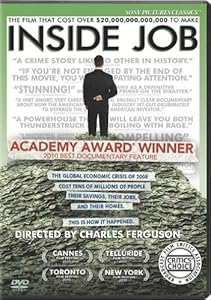
Charles Ferguson’s film – Inside Job – won the Academy Award for Best Documentary in 2011. It narrates the conflicts of interest between the finance industry, politicians, academics and regulators, which eventually led to the trillion-dollar collapse of 2008. Narrated by Matt Damon. From: http://www.theotherschoolofeconomics.org/?p=2499 - which screens the film on-line.

This documentary exposes the facts behind the 2008 global economic disaster. It was triggered by derivatives, primarily based on sub-prime mortgages in the US.  But the roots go back to the Regan deregulation of financial services. What is shocking is that many of the investment banks were betting against their own products and deliberately lying to their own customers. Several lawsuits are still pending.

It is fascinating viewing, but deeply disturbing as many of the key personalities are still in play in various companies and governments and regulatory bodies today.

For a write up see - http://en.wikipedia.org/wiki/Inside_Job_(film)


Friday, February 15, 2013

US GOVERNMENT SUES CREDIT RATING AGENCY OVER DODGY MORTGAGE RATINGS

From - http://worldnewscurator.com/2013/02/05/us-government-to-sue-standard-poors-moodys-may-be-next/#1RKLvw8kY5BBqHQG.99


The United States government is to sue credit rating agency Standard & Poor’s over the triple A ratings the firm gave to mortgage securities prior to the credit crunch and global economic crisis of 2009.
The civil lawsuit, which several US states are expected to join, will focus on decisions by the firm to award the highest rating to a range of mortgage-backed securities – including those based on sub-prime mortgages – in 2007. These securities later collapsed in value. The high rating given to these mortgage bonds helped to fuel a bubble in the sub-prime mortgage sector, and their subsequent collapse in value played a key role in the ensuing credit crunch and debt crisis whose effects are still ravaging the economies of many countries around the world.
Credit rating agencies such as Standard & Poor’s are paid by the issuers of such bonds to provide a rating of their risk, leading to concerns that there may have been a ‘conflict of interests’ – a polite way of saying that these agencies may have been issuing high ratings to secure repeat business, rather than because they had actually assessed the bonds as safe in a proper manner.
Share is Standard & Poor’s parent compay McGraw Hill fell by 14% on Monday as a result of the announcement. interestingly shares in Moody’s – another credit ratings agency – fell by almost as much (10%), suggesting that market analysts believe that they will be next Justice departments hit list.
Credit ratings agency have drawn a great deal of criticism from politicians and pundits, who have suggested that their activities played a large part in creating the conditions for the global economic crisis. In a report published in January 2011 the Financial Crisis Inquiry Commission described the agencies as “essential cogs in the wheel of financial destruction” and “key enablers of the financial meltdown”.

Sunday, February 10, 2013

Making Sense of the "Circular Economy"

From - http://www.triplepundit.com/2013/01/make-sense-circular-economy/


 resource recovery recycling Here Today Garbage Tomorrow Heather Rogers Ellen MacArthur Foundation Ellen MacArthur ecovative Digital Lumens Dell green Circular Economy Brockelsby Ltd. 3M green
If the name Ellen MacArthur rings a bell, you’re probably thinking of the person who set a record for circumnavigating the world in a high tech sailboat, solo no less, but that’s not the only circle for which she is known. Ms. MacArthur, through the charitable organization that bears her name, has formulated an economic concept called the circular economy, which is quickly becoming a buzzword around sustainability circles.
As far as buzzwords go, “circular economy” is a fairly pedestrian combination (as opposed to, say, Sex Pistols) and perhaps that’s just as well. Rather than getting distracted by the words, it’s far more interesting to pick through the concept itself and see how MacArthur’s vision of economic growth meets the challenges of a world of shrinking resources.

The Circular Economy

MacArthur was profiled and interviewed just last week on the Harvard Business Review blog by Eric Hellweg, and for those of you who don’t have time to read the whole thing (though you really should, it’s fascinating), the circular economy concept basically boils down to managing resource scarcity in the context of consumer demand for environmental responsibility.
As described by the Ellen MacArthur Foundation, it comes out like this:
“The circular economy is a generic term for an industrial economy that is, by design or intention, restorative and in which materials flows are of two types, biological nutrients, designed to reenter the biosphere safely, and technical nutrients, which are designed to circulate at high quality without entering the biosphere.”

Why the Circular Economy is more than mere recycling

While the emphasis on reentering and circulating call recycling to mind, MacArthur’s concept of a circular economy is on a different plane entirely. The Foundation’s website is careful to note the difference by referencing Heather Rogers, journalist and author of Here Today, Garbage Tomorrow:
“One of the biggest confusions around a circular economy framework is that sparked by the word ‘recycling’…’The vast majority of wastes are created during the manufacturing process, and that is where we should focus.’”
Recycling puts the onus on consumers to use goods more carefully and to dispose of the leftovers responsibly. The circular economy asks that manufacturers produce goods that involve less waste in the first place, and that enable consumers to integrate recycling into their daily habits more intensively.

Case studies for the Circular Economy

When you look at the Foundation’s case studies, the potentials for economic growth become clear. That’s especially true when you consider that “consumers” doesn’t just mean individual householders, it also means companies that consume products through their supply chains.
The waste oil sector in England, for example, was historically focused on animal feed until new legislation targeted biofuels. The Yorkshire waste oil processor Brockelsby Ltd. adapted not only by pivoting to the biofuel market, but also by double-purposing its operations as a research and development platform to find new values for low-grade waste products, which normally would be discarded.
Another Foundation case study is Massachusetts-based Digital Lumens, which aims to help industrial customers transition out of the “criminally inefficient” incandescent light bulb into high-efficiency LEDs integrated with an energy management system. The company is transitioning, too, from an equipment sales model to a service-based model that could enable it to reclaim spent or damaged components more efficiently.
One final example is New York’s Ecovative, which produces fully compostable bio-based packaging products that stand in for petroleum-based plastics. Ecovative’s unique approach is to literally custom-grow its packages using fungi, which has caught the eye of green-transitioning companies like 3M and Dell among others.

Where the rubber hits the circular road

The sustainability foundation of the circular economy is interesting enough in itself, but real proof of the concept’s viability is the potential for economic growth.
To buttress the case for the circular economy, the Foundation has begun to issue detailed reports on the economic benefits of transitioning out of “an increasingly resource constrained ‘take-make-dispose’ model,” both in the short term and over the long run.
The first report, in 2011, took a look at the stimulating effect on European Union manufacturing sectorfrom economic activity related to product development, remanufacturing and refurbishment.
The second report just came out in 2013, and it focuses on applying the principles of the circular economyto “fast-moving” consumer goods, namely food, beverages, textiles and packaging, which also happen to account for a good deal of municipal waste while absorbing – and wasting – a significant amount of agricultural output.

British sugar giant caught in global tax scandal

From The Guardian - http://www.guardian.co.uk/business/2013/feb/09/british-sugar-giant-tax-scandal


One of Britain's biggest multinationals, whose brands include Silver Spoon sugar, Twinings Tea and Kingsmill bread, is avoiding paying millions of pounds of tax in an African state blighted by malnutrition, a year-long investigation revealed on Sunday.
The Zambian sugar-producing subsidiary of Associated British Foods, a FTSE100 company, contributed virtually no corporation tax to the state's exchequer between 2007 and 2012, and none at all for two of those years.
The firm, Zambia Sugar, has recently posted record pre-tax profits and its huge plantation is increasing its capacity to produce more sugar for markets in Europe and Africa. Yet it paid less than 0.5% of its $123m pre-tax profits in corporation tax between 2007 and 2012.
The company benefits from generous capital allowance and tax-relief schemes in Zambia, but the investigation also found that it funnels around a third of its pre-tax profits to sister companies in tax havens, including Ireland, Mauritius and the Netherlands. Tax treaties between Zambia and some of those countries mean the state's revenue authorities are unable to charge their normal tax on money leaving their shores.
The revelations are contained in a report published by ActionAid, which exposes how Zambia Sugar has kept its contribution to the state's exchequer so low, although the company says that globally it actually pays a higher rate of tax on its profits than it otherwise would due to its corporate structure.
It is estimated that the tax haven transactions of this one British headquartered multinational deprived Zambia of a sum 14 times larger than the UK aid provided to the country to combat hunger and food insecurity.
ActionAid's findings will heap more pressure on the chancellor, George Osborne, to make progress in closing gaps in international tax standards and tackling avoidance at the G20 meeting of world leaders this week and the G8 in June.

Tuesday, February 5, 2013

RBS bankers must pay Libor fine, says George Osborne

From - http://www.guardian.co.uk/business/2013/feb/04/royal-bank-scotland-libor-fine-osborne

George Osborne is forcing Royal Bank of Scotland to cut its bankers' pay to ensure that taxpayers are not left to pick up the cost of the upcoming multimillion-pound fine for Libor rigging.


The chancellor said his views had been made clear to the management of the bailed-out bank in an attempt to defuse public anger about the portion of the fine – which could amount to between £400m to £500m in total – that will be paid to the US authorities.
"When it comes to RBS, I am clear that the bill for any US fine related to this investigation should on this occasion be paid for by the bankers, and not the taxpayer," Osborne said.
Speaking in Bournemouth where he unveiled plans to reform the banking system, Osborne appeared to back the RBS chief executive, Stephen Hester, but indicated he expects heads to roll as a result of the fine for rigging Libor – a key interest rate. It was "well known" that RBS was considering management changes, Osborne said.
The fine from the UK's Financial Services Authority is thought to be just under £90m with US regulators levying fines of around four times that amount. In the furore that followed the £290m Libor fine paid by Barclays last year£59.5m of which was levied by the FSA, the law was changed to ensure that fines went to the government.
"Those who were doing the supervising must also bear their share of the responsibility," Osborne said. "The RBS board and the RBS senior management are well aware of that and decisions are in hand."
He added that Hester is "taking the action to ensure those responsible are held to account".
It is expected that the departure of John Hourican, the head of the investment bank, will be announced once the Libor fine is revealed, possibly later this week, although he is not thought to be personally implicated in the rigging of Libor. The size of the bonus pool for 2012 at RBS has yet to be disclosed. It was £390m for 2011 and is expected to fall by as much as £150m. But the call by the chancellor to ensure bankers pay for the Libor fine does not preclude bonuses being paid for 2012.
Responding to questions about why senior bankers should receive bonuses after a year of scandal, Osborne acknowledged that Hester and Barclays boss Antony Jenkins have waived their bonuses.
He said there could have been "enormous public anger" if fines levied on RBS by US regulators were paid by the taxpayer, not the bankers.
"That is not on," said Osborne, who has told the bank's management that a fine imposed by international regulators should be paid out of bankers' pay. If the fine is paid by shareholders, led by taxpayers who own 83%of the bank, "that could have been a very great source of public anger this spring," said Osborne.
The chancellor confirmed remarks by Treasury sources over the weekend which had suggested he was concerned about how the Libor fine would be paid. In his speech, Osborne insisted that "everyone should exercise restraint and responsibility" over bonuses.
Osborne was accused of "rhetoric" and a "partial climbdown" by Ed Balls, the shadow chancellor, after he said he would use legislation to threaten banks with being broken up if they attempted to flout rules requiring them to ringfence their high street and investment banking operations.
Andrew Tyrie, the Conservative MP whose banking standards commission helped create the idea of "electrifying" the ringfence, said the chancellor had taken an "important step in the right direction". The ringfence was a key plank in proposals by Sir John Vickers' independent commission but the banking standards commission had been concerned banks would try to "game" the ringfence. "They will always try to do so unless strong disincentives are put in place," said Tyrie.


Chancellor insists Royal Bank of Scotland, not UK taxpayers, must take up estimated £500m fine for Libor rigging