The powerful documentary Inequality for All was an unexpected
hit at the recent Sundance film festival, arguing that US capitalism has
fatally abandoned the middle classes while making the super-rich richer. Can
its star, economist Robert Reich, do for economics what Al Gore did for the
environment?
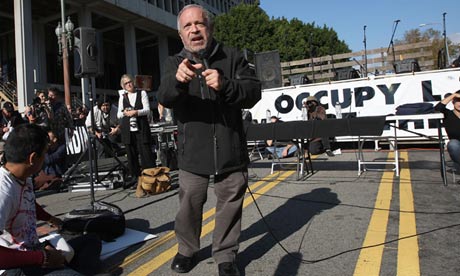
Former US labour secretary Robert Reich at an Occupy Los Angeles rally in 2011. Photograph: David Mcnew/Getty Images
In one sense, Inequality
for All is absolutely the film of the moment.
We are living through tumultuous times. The economy has tanked. Austerity has
cut a swath through the country. We're on the verge of a triple-dip recession.
And, in another, parallel universe, a small cohort of alien beings – or as we
know them, bankers – are currently engaged in trying to figure out what to
spend their multimillion-pound bonuses on. Who wouldn't want to know what's
going on? Or how it happened? Or why? Or if it is really true that the next
generation down is well and truly shafted?
…
Any synopsis of the film runs the risk of making it seem dry again, but
essentially it describes how the middle classes have come to have a smaller and
smaller portion of the economic pie. And how, since 70% of the economy is based
on the middle classes buying stuff, if they don't have any money to buy this
stuff, it cannot grow. Meanwhile, the government has allowed the super-rich,
the "one per cent", to take more of the nation's wealth. Half of the
US's total assets are now owned by just 400 people – 400! – and, Reich contests
that this is not just a threat to the economy, but also to democracy.
…
And what the film tries to do is thread together evidence that many
people know about – the increasing struggle of the middle classes to just get
by, the way that the top 1% of society has unshackled itself from the rest of
us and has seen its income increase exponentially, and the ever-increasing cost
of the traditional avenues of improvement, such as higher education – and weave
it into a cohesive and convincing narrative. It is, in some respects, a theory
of everything. Reich charts the three decades of increasing median income after
the second world war, a period he calls "the great prosperity" and
then examines what happened in the late 1970s to put an end to it. The economy
didn't falter. It kept on growing. But wages didn't.
The figures that Reich supplies are simply gobsmacking. In 1978, the
typical male US worker was making $48,000 a year (adjusted for inflation).
Meanwhile the average person in the top 1% was making $390, 000. By 2010, the
median wage had plummeted to $33,000, but at the top it had nearly trebled, to
$1,100,000.
"Something happened in the late 1970s," we hear him tell his
Berkeley class. And much of the rest of the film is working out what happened.
Some inequality is inevitable, he says. Even desirable. It's what makes
capitalism tick. But at what point does it become a problem? When the middle
classes (in its American sense of the 25% above and below the median wage) have
so little of the economic pie that it affects not just their lives but the
economy as a whole.
Reich's thesis is that since the 1970s a combination of anti-union
legislation and deregulation of the markets contrived to create a situation in
which the economy boomed but less of the wealth trickled down. Though for a
while, nobody noticed. There were "coping mechanisms". More women
entered the workforce, creating dual-income families. Working hours rose. And
increasing house prices enabled people to borrow.
And then, in 2007, this all came crashing to a halt. "We have
exhausted all the options," he says. There's nowhere else left to go. It's
crunch time.
It's crunch time that so many working families understand too well. They
may not be familiar with the theory of income inequality but they haven't been
able to avoid noticing that they've got less money in their pockets. "I've
always thought that kitchen-table economics is the most important topic to most
people," says Reich. "Their wages, their jobs, getting by. I've
always tried to relate economics to where people live. That's why I was so
excited about the film."
…
… In the UK, Royal Bank of Scotland, having covered itself in glory in
the Libor interest-rate fixing scandal, is currently contemplating bonuses for
its investment banking division of £250m, according to reports last week. This,
to put it another way, is the annual wage bill for at least 12,500 of its
call-centre workers. Because this isn't just an American problem. It's a
British one too.
"If there was upward mobility it would be OK," says Reich in
the film. "But 42% of children born in poverty in the USA will stay there.
In Denmark it's 24%. Even in Great Britain, where they still have an
aristocracy, it's 30%."
It's probably a shocking statistic for Americans to hear. The problem is
that by every index you can measure, inequality is worsening in Britain. There
are fewer opportunities to overcome the barriers of your birth in the UK than
in any other country in Europe. One of the most chilling moments in Inequality for All for a British audience is that how,
faced with the same choices that America had in the 70s, we have, in the last
year or so, taken the same path.
One of the key moments for Reich was the underinvestment in education,
particularly higher education in the 70s. This was when America introduced
tuition fees and its workforce started to fall behind the rest of the world's.
When opportunities for those from low- and middle-income backgrounds began
shrinking: precisely where the UK is today.
It's not just that wages have remained flat in America – as they have in
the UK – it's that the expenses of everyday life have soared, in particular
education and healthcare.
In December, the Office for National Statistics found that richest 10% of
people in Britain own 40% of the national wealth. In London and the
south-east, one in eight households has almost £1m of assets. The bottom half
of the country has no net property wealth and only £4,000 in pensions savings.
For them, there is just rising prices. And the ever diminishing possibility of
things ever being different for them or their children.