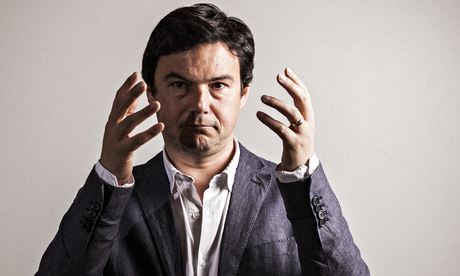
Thomas Piketty has mined 200 years of data to support his theory that capitalism does not work. Photograph: Ed Alcock for the Observer
Suddenly, there is a new economist making waves – and he is not on the right. At the conference of the Institute of New Economic Thinking in Toronto last week, Thomas Piketty's book Capital in the Twenty-First Century got at least one mention at every session I attended. You have to go back to the 1970s and Milton Friedman for a single economist to have had such an impact.
Like Friedman, Piketty is a man for the times. For 1970s anxieties about inflation substitute today's concerns about the emergence of the plutocratic rich and their impact on economy and society. Piketty is in no doubt, as he indicates in an interview in today's Observer New Review, that the current level of rising wealth inequality, set to grow still further, now imperils the very future of capitalism. He has proved it.
It is a startling thesis and one extraordinarily unwelcome to those who think capitalism and inequality need each other. Capitalism requires inequality of wealth, runs this right-of-centre argument, to stimulate risk-taking and effort; governments trying to stem it with taxes on wealth, capital, inheritance and property kill the goose that lays the golden egg. Thus Messrs Cameron and Osborne faithfully champion lower inheritance taxes, refuse to reshape the council tax and boast about the business-friendly low capital gains and corporation tax regime.
Piketty deploys 200 years of data to prove them wrong. Capital, he argues, is blind. Once its returns – investing in anything from buy-to-let property to a new car factory – exceed the real growth of wages and output, as historically they always have done (excepting a few periods such as 1910 to 1950), then inevitably the stock of capital will rise disproportionately faster within the overall pattern of output. Wealth inequality rises exponentially.
The process is made worse by inheritance and, in the US and UK, by the rise of extravagantly paid "super managers". High executive pay has nothing to do with real merit, writes Piketty – it is much lower, for example, in mainland Europe and Japan. Rather, it has become an Anglo-Saxon social norm permitted by the ideology of "meritocratic extremism", in essence, self-serving greed to keep up with the other rich. This is an important element in Piketty's thinking: rising inequality of wealth is not immutable. Societies can indulge it or they can challenge it.
Inequality of wealth in Europe and US is broadly twice the inequality of income – the top 10% have between 60% and 70% of all wealth but merely 25% to 35% of all income. But this concentration of wealth is already at pre-First World War levels, and heading back to those of the late 19th century, when the luck of who might expect to inherit what was the dominant element in economic and social life. There is an iterative interaction between wealth and income: ultimately, great wealth adds unearned rentier income to earned income, further ratcheting up the inequality process.
The extravagances and incredible social tensions of Edwardian England, belle epoque France and robber baron America seemed for ever left behind, but Piketty shows how the period between 1910 and 1950, when that inequality was reduced, was aberrant. It took war and depression to arrest the inequality dynamic, along with the need to introduce high taxes on high incomes, especially unearned incomes, to sustain social peace. Now the ineluctable process of blind capital multiplying faster in fewer hands is under way again and on a global scale. The consequences, writes Piketty, are "potentially terrifying".
For a start, almost no new entrepreneurs, except one or two spectacular Silicon Valley start-ups, can ever make sufficient new money to challenge the incredibly powerful concentrations of existing wealth. In this sense, the "past devours the future". It is telling that the Duke of Westminster and the Earl of Cadogan are two of the richest men in Britain. This is entirely by virtue of the fields in Mayfair and Chelsea their families owned centuries ago and the unwillingness to clamp down on the loopholes that allow the family estates to grow.
Anyone with the capacity to own in an era when the returns exceed those of wages and output will quickly become disproportionately and progressively richer. The incentive is to be a rentier rather than a risk-taker: witness the explosion of buy-to-let. Our companies and our rich don't need to back frontier innovation or even invest to produce: they just need to harvest their returns and tax breaks, tax shelters and compound interest will do the rest.
Capitalist dynamism is undermined, but other forces join to wreck the system. Piketty notes that the rich are effective at protecting their wealth from taxation and that progressively the proportion of the total tax burden shouldered by those on middle incomes has risen. In Britain, it may be true that the top 1% pays a third of all income tax, but income tax constitutes only 25% of all tax revenue: 45% comes from VAT, excise duties and national insurance paid by the mass of the population.
As a result, the burden of paying for public goods such as education, health and housing is increasingly shouldered by average taxpayers, who don't have the wherewithal to sustain them. Wealth inequality thus becomes a recipe for slowing, innovation-averse, rentier economies, tougher working conditions and degraded public services. Meanwhile, the rich get ever richer and more detached from the societies of which they are part: not by merit or hard work, but simply because they are lucky enough to be in command of capital receiving higher returns than wages over time. Our collective sense of justice is outraged.
The lesson of the past is that societies try to protect themselves: they close their borders or have revolutions – or end up going to war. Piketty fears a repeat. His critics argue that with higher living standards resentment of the ultra-rich may no longer be as great – and his data is under intense scrutiny for mistakes. So far it has all held up.


