Showing posts with label corruption. Show all posts

Friday, May 10, 2013

Kofi Annan turns up heat on ENRC and Glencore in pursuit of Africa’s lost tax

From: http://www.thetimes.co.uk/tto/business/industries/naturalresources/article3760812.ece


Kofi Annan has called on Britain to use its presidency of the G8 to stamp out the “unconscionable” business practices of companies such as Glencore Xstrata and ENRC in Africa.
ENRC handout pic

The Africa Progress Panel, chaired by the former Secretary-General of the United Nations, wants an international crackdown on tax avoidance with a particular push for transparency in the mining and oil sector, it said in a report.
ENRC and Glencore strongly deny any wrongdoing and said that they were not contacted by the Africa Progress Panel before the publication of its report. The panel estimates that Africa lost $63 billion (£40 billion) in tax revenues through illicit practices between 2008 and 2010 alone.
“It is unconscionable that some companies, often supported by dishonest officials, are using unethical tax avoidance, transfer pricing and anonymous company ownership to maximise their profits, while millions of Africans go without adequate nutrition, health and education,” the report said.
It highlights recent deals by ENRC, the miner being investigated by the Serious Fraud Office for “fraud, bribery and corruption”, and Glencore Xstrata in the Democratic Republic of Congo.
The report claims that assets were undervalued, costing the country an estimated $1.4 billion, a figure close to 10 per cent of its GDP.
The panel counts prominent executives and policymakers among its members, including Tidjane Thiam, the chief executive of Prudential, Robert Rubin, the former US Treasury Secretary, and Michel Camdessus, the former managing director of the IMF. Its donors include the UK Department for International Development and the Bill & Melinda Gates Foundation.
The panel’s criticism could focus the spotlight on Britain’s regulatory regime. Kevin Watkins, author of the report, asked why it had taken British authorities so long to investigate ENRC’s dealings in the DRC.
“We call on the G8 and the G20 to step up to the mark to show leadership,” the report read.

The net closes in on super rich tax dodgers: Spies expose how hundreds of Britons are 'hiding billions' in foreign tax havens


Hundreds of ultra-wealthy Britons are being investigated for tax evasion following the exposure of their secret offshore accounts.

International spy agencies are thought to have helped obtain a 'goldmine' of data that names high-profile multi-millionaires and their financial advisers.
The files show how the rich have hidden billions in Singapore, the British Virgin Islands and the Caymans. 
Ultra-wealthy Britons are being investigated over claims they are hiding cash in secret offshore accounts in places like the Cayman Islands (pictured)
More than 100 individuals have been identified so far – and have already been sent warning letters by HM Revenue & Customs.
'You're talking about super-rich people,' said one source, who added that many of the names on the list were well known.
Offenders face paying the tax they have dodged along with massive fines.
Officials are unsure what sums are at stake but pointed out that a crackdown on millionaires who hid money in Liechtenstein is expected to raise £3billion.
Last night George Osborne said: 'The message is simple: if you evade tax we're coming after you. This data is another weapon in HMRC's arsenal.'
The Chancellor has previously expressed shock at the extent to which the wealthy were exploiting tax loopholes.


Read more: http://www.dailymail.co.uk/news/article-2322212/The-net-closes-super-rich-tax-dodgers-Spies-expose-hundreds-Britons-hiding-billions-foreign-tax-havens.html#ixzz2SsdiSVhL
Follow us: @MailOnline on Twitter | DailyMail on Facebook

Wednesday, April 10, 2013

France's President Hollande: Eradicate tax havens

From - http://www.bbc.co.uk/news/world-europe-22094194


French President Francois Hollande has called for "eradication" of the world's tax havens and told French banks they must declare all of their subsidiaries.
French President Francois Hollande, 10 Apr 13
He was speaking after presenting a draft law aimed at "moralising" French public life - a response to the tax scandal that has shaken his presidency.
France's ex-Budget Minister Jerome Cahuzac has been charged with fraud over a secret Swiss bank account.
Mr Hollande said a new central agency would fight fraud and corruption.
Earlier the French Socialist government set a deadline of 15 April for ministers to declare their assets, as part of the new transparency drive.
Mr Cahuzac admitted last week that he had hidden about 600,000 euros (£509,000; $770,000) in a Swiss bank account, causing shock in France. He has now been expelled from the Socialist Party for lying about his financial affairs.
Addressing a news conference on Wednesday, Mr Hollande said "tax havens must be eradicated in Europe and worldwide".
"I won't hesitate to consider as a tax haven any country that refuses to co-operate fully with France."
He said French banks "will have to publish every year the full list of their subsidiaries in the world, country by country". They will also have to explain their business, he said.
"In other words it won't be possible for a bank to hide transactions carried out in a tax haven."
===============================================================
Will work if only other major countries do the same.  Will they?

Horsemeat scandal: Dutch uncover large-scale meat fraud

From - http://www.bbc.co.uk/news/world-europe-22098763


Some 50,000 tonnes of meat supplied by two Dutch trading companies and sold as beef across Europe since January 2011 may have contained horsemeat.
minced beef - file pic
The meat is being recalled where possible, the Dutch authorities say.
There was no evidence that the meat was a threat to human health, the Netherlands Food and Consumer Product Safety Authority said.
In total, 132 companies in the Netherlands and some 370 more around Europe are affected by the discovery.
The suspect meat was supplied by Wiljo Import en Export BV and Vleesgroothandel Willy Selten.
The two companies are owned by one man who has already previously been investigated by food safety officials, the BBC's Matthew Price reports.
The latest find was made as part of EU-wide tests to trace horse DNA in processed beef foods and to detect a veterinary drug used on horses.
=================================================================
Are there no honest people left in the world?

Wednesday, March 20, 2013

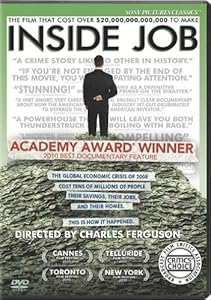
Documentary: Inside Job


Charles Ferguson’s film – Inside Job – won the Academy Award for Best Documentary in 2011. It narrates the conflicts of interest between the finance industry, politicians, academics and regulators, which eventually led to the trillion-dollar collapse of 2008. Narrated by Matt Damon. From: http://www.theotherschoolofeconomics.org/?p=2499 - which screens the film on-line.

This documentary exposes the facts behind the 2008 global economic disaster. It was triggered by derivatives, primarily based on sub-prime mortgages in the US.  But the roots go back to the Regan deregulation of financial services. What is shocking is that many of the investment banks were betting against their own products and deliberately lying to their own customers. Several lawsuits are still pending.

It is fascinating viewing, but deeply disturbing as many of the key personalities are still in play in various companies and governments and regulatory bodies today.

For a write up see - http://en.wikipedia.org/wiki/Inside_Job_(film)


Monday, February 25, 2013

Horsemeat scandal: EU ministers want faster action on meat labelling

From - http://www.guardian.co.uk/uk/2013/feb/24/horsemeat-scandal-country-origin-labelling


A European Commission report on tougher rules about origins of frozen beef products is expected but not until the end of 2013
Horsemeat scandal EU ministers action food labelling
Horsemeat found in frozen beef products has destroyed the trust many people placed in their local supermarkets. Photograph: Luke Macgregor/Reuters
Owen Paterson, the environment secretary, will be among ministers from across the EU pressing on Monday for speedier action on introducing country-of-origin labelling for processed beef and other meat products as they struggle to get a grip on the horsemeat scandal.
On Saturday the French president, François Hollande, joined the growing calls for more traceability at European level and critics have complained that the UK coalition government had been dragging its feet on the issue before the crisis began last month. Country of origin and slaughter for cattle must already be included on labels for fresh and frozen beef but the European commission is paving the way to extend that to other meats and ingredients in processed food. However, a report on implementing tougher rules is not expected until the end of the year. This month, the Commons environment, food and rural affairs select committee said UK ministers had been caught "flat-footed" by the scandal, which has been blamed on mislabelling and criminal fraud, and criticised them for having sought UK exemption from some EU rules.
This would allow minced meat sold in Britain to have a higher fat and collagen content than permitted in other EU member states and remove the requirement for loose meat products to declare the amount of meat they contained. "This is not the time for the government to be proposing reducing the labelling standards applied to British food", said the committee.
Glenis Willmott, Labour MEP for the East Midlands and the party's leader in the European parliament, said last week that in 2011 UK ministers had opposed plans backed by the parliament for more comprehensive country of origin labelling. This had forced MEPs "into a much weaker compromise" as the coalition tried "to kick the issue into the long grass".
She said: "It is interesting that Mr Paterson, one of the most Eurosceptic of ministers, is now advocating EU legislation as a solution to the current crisis. It is simply common sense that a problem in the meat supply chain … needs EU-wide measures to combat it. But it is precisely this kind of EU regulation that Eurosceptics deem 'red tape from Brussels'. In 2011 the UK government said my plans would be too difficult to put into practice because the meat supply chain was too complex. We have now seen what the complexities of the industry can hide."

Sunday, January 27, 2013

Libor Scandal summarised

From FT - http://www.ft.com/indepth/libor-scandal


From COMPANIES Jan 25, 2013

Ex-Barclays chiefs named in Libor case

Bob Diamond, chief executive of Barclays©Bloomberg

Former bank executives among 25 detailed in regulatory case

From COMPANIES Jan 24, 2013

Barclays top brass face fresh Libor heat

Email suggests executives knew about lowball submissions

From COMPANIES Jan 24, 2013

Barclays executives named in Libor case

Diamond and Ricci are among those released to the High Court


From MARKETS Jan 23, 2013

UK watchdog investigation into possible rule breaches

From COMPANIES Jan 22, 2013

Barclays staff lose plea for anonymity

Judge rejects request ahead of Libor-related damages lawsuit

From COMPANIES Jan 17, 2013

Barclays eyes bonus pool to pay Libor fine

Move comes as new chief warns employees over ethics

Chief Executive Officer of UBS, Andrea Orcel arrives at Portcullis House in London©ReutersFrom COMPANIES Jan 9, 2013

UBS’s Orcel admits banks must change

‘We became too arrogant,’ says investment bank head

UBS AG logo at the London offices©BloombergFrom COMPANIES Jan 10, 2013

Former UBS bosses deny Libor knowledge

Quartet say they did not know rate-setting system under scrutiny

From COMPANIES Jan 11, 2013

RBS eyes bonus pot to recoup Libor losses

Lender might dip into funds to help pay possible fine

Saturday, August 25, 2012

Transparency may be the key

From The Times, 24 August 2012 - by Richard Dowden:

"Gold, diamonds, platinum ... what is extracted from the soil brings misery not prosperity

We touch the products of African soil every day: aluminium and steel in our homes and cars, copper in our wires and coltan in our mobile phones. Not to mention gold and diamonds. Do we wonder where they came from? Or what sort of lives the miners lead who dug them or the people beneath whose land these minerals lay? If we did, we might feel a little uneasy.

Africa is a rich continent with a lot of poor people. Almost every mineral on the planet can be found there, often in rich veins. The discovery of these riches is one reason the European countries sliced up Africa and took it over at the end of the 19th century. Vast wealth has been created and fortunes made from mining but lives and landscapes have also been destroyed. Much of the wealth from Africa’s mineral resources flows out of the continent and its people do not benefit from it.
But Africans are waking up to the rip-off. Yesterday 44 people were buried at the Marikana platinum mine in South Africa; 34 of them were miners shot by police during a pay protest last week. Trouble at the mine had been brewing for some time. A report by the Bench Marks Foundation last year revealed that locals at the Marikana mine were “frustrated and angry with the mining company . . . levels of fatal incidents were unacceptable ... residential conditions under which Lonmin employees live are appalling”.
Lonmin, the London-based company that owns the mine, is the reconstituted Lonrho that was described in 1973 by Ted Heath, as “the unacceptable face of capitalism”. One of its current non-executive directors is Cyril Ramaphosa, the key negotiator for the Africa National Congress in the talks that led to the end of apartheid. Evidently not even his status and skills could create a deal that would have avoided these deaths.
Meanwhile in Congo last week 60 died when a shaft collapsed at a gold mine in the northeast. And in eastern Congo the war that has flared since 1994, renowned for its mass rapes and massacres, is fuelled by the excavation of gold, diamonds, tantalum and tungsten; gangs of workers are forced to dig by armies and armed bands.
Time and again mineral resources seem to bring conflict and misery rather than prosperity. Areas that have been mined out and abandoned are often the poorest places I have ever visited — eastern Sierra Leone, Namibia, parts of South Africa. Until recently secret deals were often struck between governments and mining and oil companies — sometimes deals with the president alone. The people of those countries were never told how much the minerals beneath their feet were worth and they never saw any benefit from them. Some of the worst examples have been the diamond conflicts that fuelled wars in Angola, Sierra Leone and Liberia.
Today it is common to hear the Chinese being blamed for raping Africa of its resources but according to one industry watcher the Chinese behave like any Western-owned company. They do what they are told to do by the host government. The only difference is that they will often barter rather than pay cash as Western companies do.
Transparency seems to be the key — making public what governments receive from mining companies so that people can see what their governments receive, and what the companies say they give them; and check that these match. They can then have a say in how it is spent. Here the news is not all bad. This week the US Securities and Exchange Commission has made two rulings.
First it said that US-registered companies must be aware of where their minerals come from and not buy anything from conflict zones. It has also ruled that oil companies must report annually on payments to governments so that the people know what their government is getting from their oil.
And this week the International Development Select Committee in Britain drew attention to the issue when it pointed out that aid-dependent countries may lose about $160 billion a year through multinational companies — many of them mining companies — not paying tax by registering offshore and not disclosing the source of their profits. The committee will now look into capital flight from poor countries, estimated by the think-tank Global Financial Integrity at $854 billion between 1970 to 2008, mainly through companies mispricing imports and exports.
Disclosing these numbers in detail could put a simple but powerful tool in the hands of poor societies who happen to live on some of the most valuable real estate on the planet."
Richard Dowden is Director of the Royal African Society and author of Africa: Altered States, Ordinary Miracles

Tuesday, August 7, 2012

Another week, another bank!

From BBC News: http://www.bbc.co.uk/news/business-19159286


Shares of Standard Chartered bank have tumbled despite the bank denying allegations that it illegally "schemed" with Iran to launder money.

Shares fell 15% in early London trade, after falling 16% in Hong Kong.
The New York State Department of Financial Services said the UK-based bank laundered as much as $250bn (£161bn) over nearly a decade.
It said the bank hid transactions for "Iranian financial institutions" that were subject to US economic sanctions.
The regulator said that Standard Chartered had hidden 60,000 such secret transactions.
However, the bank denied the allegations, saying that it "strongly rejects the position or portrayal of facts as set out in the order" issued by the regulator.

Tuesday, July 31, 2012

Libor Euribor Fixing Scandal: Banks Cooperate for Lower Fines


Several unidentified banks under investigation for the suspected manipulation of Euro Interbank Offered Rate (Euribor)  are reportedly  cooperating with European Union antitrust regulators in the hope of lower fines, said two unnamed sources cited by Reuters.
When Barclays settled with US and UK regulators for a record fine of £290m for rigging Libor and Euribor, the bank received a 30 percent discount under the UK's Financial Services Authority's (FSA) settlement discount scheme. It paid the FSA £59.5m;  without the discount, this would have been £85m.
The names of the banks under investigation have not been revealed. A total of 43 banks sit on the Euribor panel, which is hosted by the European Banking Federation.
Under the European Commission's leniency policy, the "whistle-blower" firm does not incur any penalty as part of an immunity deal and fines can be reduced by 30-50 percent for the next company to provide evidence of wrongdoing.
Fines can also be reduced by 20-30 percent for the next applicant and all subsequent applicants can get a reduction in any penalty of up to 20 percent.
First the LIBOR scandal, now Euribor.  Is there a US and Asian equivalent?  if so, when will their scandals emerge?

Monday, July 30, 2012

Why Capitalism Has an Image Problem


From WSJ - Charles Murray:
Mitt Romney's résumé at Bain should be a slam dunk. He has been a successful capitalist, and capitalism is the best thing that has ever happened to the material condition of the human race. From the dawn of history until the 18th century, every society in the world was impoverished, with only the thinnest film of wealth on top. Then came capitalism and the Industrial Revolution. Everywhere that capitalism subsequently took hold, national wealth began to increase and poverty began to fall. Everywhere that capitalism didn't take hold, people remained impoverished. Everywhere that capitalism has been rejected since then, poverty has increased.

Enlarge Image
Enlarge Image
image
Getty Images
Henry Ford with his Model T
image
Hulton Archive/Getty Images
Wall Street traders around 1925.

Enlarge Image
Enlarge Image
image
Corbis
A dry-cleaning store
image
Getty Images
Traders on the NYSE floor in 2011


Yet it hasn't worked out that way for Mr. Romney. "Capitalist" has become an accusation. The creative destruction that is at the heart of a growing economy is now seen as evil. Americans increasingly appear to accept the mind-set that kept the world in poverty for millennia: If you've gotten rich, it is because you made someone else poorer.
The Saturday Essay

[image]

Capitalism has lifted the world out of poverty because it gives people a chance to get rich by creating value and reaping the rewards. Who better to be president of the greatest of all capitalist nations than a man who got rich by being a brilliant capitalist?
What happened to turn the mood of the country so far from our historic celebration of economic success?
Two important changes in objective conditions have contributed to this change in mood. One is the rise of collusive capitalism. Part of that phenomenon involves crony capitalism, whereby the people on top take care of each other at shareholder expense (search on "golden parachutes").
But the problem of crony capitalism is trivial compared with the collusion engendered by government. In today's world, every business's operations and bottom line are affected by rules set by legislators and bureaucrats. The result has been corruption on a massive scale. Sometimes the corruption is retail, whereby a single corporation creates a competitive advantage through the cooperation of regulators or politicians (search on "earmarks"). Sometimes the corruption is wholesale, creating an industrywide potential for profit that would not exist in the absence of government subsidies or regulations (like ethanol used to fuel cars and low-interest mortgages for people who are unlikely to pay them back). Collusive capitalism has become visible to the public and increasingly defines capitalism in the public mind.
Another change in objective conditions has been the emergence of great fortunes made quickly in the financial markets. It has always been easy for Americans to applaud people who get rich by creating products and services that people want to buy. That is why Thomas Edison and Henry Ford were American heroes a century ago, and Steve Jobs was one when he died last year.
When great wealth is generated instead by making smart buy and sell decisions in the markets, it smacks of inside knowledge, arcane financial instruments, opportunities that aren't accessible to ordinary people, and hocus-pocus. The good that these rich people have done in the process of getting rich is obscure. The benefits of more efficient allocation of capital are huge, but they are really, really hard to explain simply and persuasively. It looks to a large proportion of the public as if we've got some fabulously wealthy people who haven't done anything to deserve their wealth.

Sunday, July 22, 2012

Wealth doesn't trickle down – it just floods offshore, new research reveals


"A far-reaching new study suggests a staggering $21tn in assets has been lost to global tax havens. If taxed, that could have been enough to put parts of Africa back on its feet – and even solve the euro crisis
Capital flight
View the full graphic: where and what are tax havens? Graphic: Giulio Frigieri for the Observer
The world's super-rich have taken advantage of lax tax rules to siphon off at least $21 trillion, and possibly as much as $32tn, from their home countries and hide it abroad – a sum larger than the entire American economy.
James Henry, a former chief economist at consultancy McKinsey and an expert on tax havens, has conducted groundbreaking new research for the Tax Justice Network campaign group – sifting through data from the Bank for International Settlements (BIS), the International Monetary Fund (IMF) and private sector analysts to construct an alarming picture that shows capital flooding out of countries across the world and disappearing into the cracks in the financial system.
...
"This offshore economy is large enough to have a major impact on estimates of inequality of wealth and income; on estimates of national income and debt ratios; and – most importantly – to have very significant negative impacts on the domestic tax bases of 'source' countries," Henry says.
...
"These estimates reveal a staggering failure," says John Christensen of the Tax Justice Network. "Inequality is much, much worse than official statistics show, but politicians are still relying on trickle-down to transfer wealth to poorer people.
"This new data shows the exact opposite has happened: for three decades extraordinary wealth has been cascading into the offshore accounts of a tiny number of super-rich."
In total, 10 million individuals around the world hold assets offshore, according to Henry's analysis; but almost half of the minimum estimate of $21tn – $9.8tn – is owned by just 92,000 people. And that does not include the non-financial assets – art, yachts, mansions in Kensington – that many of the world's movers and shakers like to use as homes for their immense riches.
"If we could figure out how to tax all this offshore wealth without killing the proverbial golden goose, or at least entice its owners to reinvest it back home, this sector of the global underground is easily large enough to make a significant contribution to tax justice, investment and paying the costs of global problems like climate change," Henry says.
...
In many cases, , the total worth of these assets far exceeds the value of the overseas debts of the countries they came from.
The struggles of the authorities in Egypt to recover the vast sums hidden abroad by Hosni Mubarak, his family and other cronies during his many years in power have provided a striking recent example of the fact that kleptocratic rulers can use their time to amass immense fortunes while many of their citizens are trapped in poverty.
The world's poorest countries, particularly in sub-Saharan Africa, have fought long and hard in recent years to receive debt forgiveness from the international community; but this research suggests that in many cases, if they had been able to draw their richest citizens into the tax net, they could have avoided being dragged into indebtedness in the first place. Oil-rich Nigeria has seen more than $300bn spirited away since 1970, for example, while Ivory Coast has lost $141bn.
Assuming that super-rich investors earn a relatively modest 3% a year on their $21tn, taxing that vast wall of money at 30% would generate a very useful $189bn a year – more than rich economies spend on aid to the rest of the world.
...
Milorad Kovacevic, chief statistician of the UN Development Programme's Human Development Report, says both the very wealthy and the very poor tend to be excluded from mainstream calculations of inequality.
"People that are in charge of measuring inequality based on survey data know that the both ends of the distribution are underrepresented – or, even better, misrepresented," he says.
"There is rarely a household from the top 1% earners that participates in the survey. On the other side, the poor people either don't have addresses to be selected into the sample, or when selected they misquote their earnings – usually biasing them upwards."
...
Globalisation has exposed low-skilled workers to competition from cheap economies such as China, while the surging profitability of the financial services industry – and the spread of the big bonus culture before the credit crunch – led to what economists have called a "racing away" at the top of the income scale.
However, Henry's research suggests that this acknowledged jump in inequality is a dramatic underestimate. Stewart Lansley, author of the recent book The Cost of Inequality, says: "There is absolutely no doubt at all that the statistics on income and wealth at the top understate the problem."
The surveys that are used to compile the Gini coefficient "simply don't touch the super-rich," he says. "You don't pick up the multimillionaires and billionaires, and even if you do, you can't pick it up properly."
In fact, some experts believe the amount of assets being held offshore is so large that accounting for it fully would radically alter the balance of financial power between countries. The French economist Thomas Piketty, an expert on inequality who helps compile the World Top Incomes Database, says research by his colleagues has shown that "the wealth held in tax havens is probably sufficiently substantial to turnEurope into a very large net creditor with respect to the rest of the world."
In other words, even a solution to the eurozone's seemingly endless sovereign debt crisis might be within reach – if only Europe's governments could get a grip on the wallets of their own wealthiest citizens."

Wednesday, July 18, 2012

South Korean banks also suspected of rate rigging


BBC News: "A South Korea financial regulator has started an investigation into alleged interest rate rigging by some of the country's banks.

The Fair Trade Commission is looking at possible collusion over setting certificates of deposit (CD), used as a benchmark to set lending rates.
Image of National Flag
Kookmin, Shinhan, Woori, and Hana are the banks being investigated.
It follows the Libor-rigging scandal involving Barclays and possibly several other banks.
Brokerage firms, which report CD rates twice a day, are also under suspicion. A CD is a way of saving with a fixed interest rate and maturity sold by banks and circulated in the secondary market by brokerages.
Financial firms benefit from a high CD rates as many household loans are linked to them. They are frequently used to help South Korean's buy homes.
As with the manipulation of the Libor inter-bank rate in the UK, the possible rigging of CD can help flatter companies' financial health."