Showing posts with label tax. Show all posts

Sunday, February 3, 2013

Inequality for All – another Inconvenient Truth?

From The Guardian - http://www.guardian.co.uk/film/2013/feb/02/inequality-for-all-us-economy-robert-reich


The powerful documentary Inequality for All was an unexpected hit at the recent Sundance film festival, arguing that US capitalism has fatally abandoned the middle classes while making the super-rich richer. Can its star, economist Robert Reich, do for economics what Al Gore did for the environment?
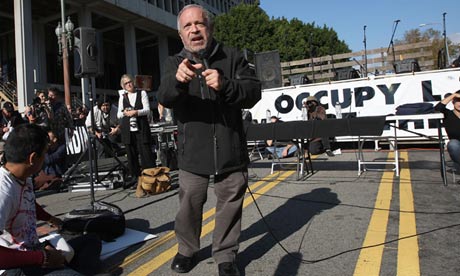
Robert Reich addresses Occupy rally
 Former US labour secretary Robert Reich at an Occupy Los Angeles rally in 2011. Photograph: David Mcnew/Getty Images

In one sense, Inequality for All is absolutely the film of the moment. We are living through tumultuous times. The economy has tanked. Austerity has cut a swath through the country. We're on the verge of a triple-dip recession. And, in another, parallel universe, a small cohort of alien beings – or as we know them, bankers – are currently engaged in trying to figure out what to spend their multimillion-pound bonuses on. Who wouldn't want to know what's going on? Or how it happened? Or why? Or if it is really true that the next generation down is well and truly shafted?

Any synopsis of the film runs the risk of making it seem dry again, but essentially it describes how the middle classes have come to have a smaller and smaller portion of the economic pie. And how, since 70% of the economy is based on the middle classes buying stuff, if they don't have any money to buy this stuff, it cannot grow. Meanwhile, the government has allowed the super-rich, the "one per cent", to take more of the nation's wealth. Half of the US's total assets are now owned by just 400 people – 400! – and, Reich contests that this is not just a threat to the economy, but also to democracy.

And what the film tries to do is thread together evidence that many people know about – the increasing struggle of the middle classes to just get by, the way that the top 1% of society has unshackled itself from the rest of us and has seen its income increase exponentially, and the ever-increasing cost of the traditional avenues of improvement, such as higher education – and weave it into a cohesive and convincing narrative. It is, in some respects, a theory of everything. Reich charts the three decades of increasing median income after the second world war, a period he calls "the great prosperity" and then examines what happened in the late 1970s to put an end to it. The economy didn't falter. It kept on growing. But wages didn't.
The figures that Reich supplies are simply gobsmacking. In 1978, the typical male US worker was making $48,000 a year (adjusted for inflation). Meanwhile the average person in the top 1% was making $390, 000. By 2010, the median wage had plummeted to $33,000, but at the top it had nearly trebled, to $1,100,000.
"Something happened in the late 1970s," we hear him tell his Berkeley class. And much of the rest of the film is working out what happened.
Some inequality is inevitable, he says. Even desirable. It's what makes capitalism tick. But at what point does it become a problem? When the middle classes (in its American sense of the 25% above and below the median wage) have so little of the economic pie that it affects not just their lives but the economy as a whole.
Reich's thesis is that since the 1970s a combination of anti-union legislation and deregulation of the markets contrived to create a situation in which the economy boomed but less of the wealth trickled down. Though for a while, nobody noticed. There were "coping mechanisms". More women entered the workforce, creating dual-income families. Working hours rose. And increasing house prices enabled people to borrow.
And then, in 2007, this all came crashing to a halt. "We have exhausted all the options," he says. There's nowhere else left to go. It's crunch time.
It's crunch time that so many working families understand too well. They may not be familiar with the theory of income inequality but they haven't been able to avoid noticing that they've got less money in their pockets. "I've always thought that kitchen-table economics is the most important topic to most people," says Reich. "Their wages, their jobs, getting by. I've always tried to relate economics to where people live. That's why I was so excited about the film."
… In the UK, Royal Bank of Scotland, having covered itself in glory in the Libor interest-rate fixing scandal, is currently contemplating bonuses for its investment banking division of £250m, according to reports last week. This, to put it another way, is the annual wage bill for at least 12,500 of its call-centre workers. Because this isn't just an American problem. It's a British one too.
"If there was upward mobility it would be OK," says Reich in the film. "But 42% of children born in poverty in the USA will stay there. In Denmark it's 24%. Even in Great Britain, where they still have an aristocracy, it's 30%."
It's probably a shocking statistic for Americans to hear. The problem is that by every index you can measure, inequality is worsening in Britain. There are fewer opportunities to overcome the barriers of your birth in the UK than in any other country in Europe. One of the most chilling moments in Inequality for All for a British audience is that how, faced with the same choices that America had in the 70s, we have, in the last year or so, taken the same path.

One of the key moments for Reich was the underinvestment in education, particularly higher education in the 70s. This was when America introduced tuition fees and its workforce started to fall behind the rest of the world's. When opportunities for those from low- and middle-income backgrounds began shrinking: precisely where the UK is today.
It's not just that wages have remained flat in America – as they have in the UK – it's that the expenses of everyday life have soared, in particular education and healthcare.
Last October, an independent commission in the UK led by the Resolution Foundation predicted that in 2020 wages for low- to middle-income families would be the same as they were in 2000. And yet everything else will have gone up. We too are facing the crunch.
In December, the Office for National Statistics found that richest 10% of people in Britain own 40% of the national wealth. In London and the south-east, one in eight households has almost £1m of assets. The bottom half of the country has no net property wealth and only £4,000 in pensions savings. For them, there is just rising prices. And the ever diminishing possibility of things ever being different for them or their children.

Thursday, January 31, 2013

Charity raised £176m, good causes got £55,000


From The Times - http://www.thetimes.co.uk/tto/money/tax/article3673519.ece


One of Britain’s biggest charities is a front for tax avoidance, The Times can reveal.
Wealthy donors used the Cup Trust to avoid £46 million in tax in an extensive abuse of Gift Aid incentives designed to encourage charitable donations.
The registered charity raised £176 million between 2010 and 2011. In 2010 it attracted more donations than the Royal Society for the Protection of Birds, the British Heart Foundation or the Salvation Army.
But instead of using the money for its stated objective, to “improve the lives of young children and adults”, it carried out trades that artificially generated Gift Aid for donors to reduce their tax bills. Investors who “donated” £1 million to the Cup Trust, for example, would receive most of their money back — but still be entitled to claim Gift Aid worth between £250,000 and £375,000.
“Of all the tax avoidance schemes I have come across, this is perhaps the worst,” Margaret Hodge, chairwoman of the Public Accounts Committee, said. “I thought I was past being shocked, but this genuinely has shocked me.
“To exploit a mechanism designed to encourage charitable giving in order to avoid tax is just disgusting. The Charity Commission certainly has questions to answer about how such flagrant abuse was allowed to occur.”
The Cup Trust is only one of several tax schemes on the market that manipulate charity law, The Times has learnt. George Osborne, the Chancellor, introduced a cap of £50,000 on charitable tax relief last year after identifying widespread abuse. But an outcry from philanthropists persuaded the Government to change its mind.
“A lot of people thought Osborne was excessive, but this case just proves that something needs to be done,” John Hemming, chairman of the Charity Tax Group, said. “The public will mistrust charities when this sort of activity is undertaken. It’s up to the authorities to stop this.”
Charity experts questioned yesterday how the Charity Commissiongave the Cup Trust a clean bill of health, despite a two-year investigation into its “governance and activities.”
The regulator, which has had its budget cut by a third, failed to take action despite the charity’s accounts disclosing that it was controlled by Matthew Jenner, the boss of NT Advisors, a well-known tax avoidance firm whose initials stand for “No Tax”.
“The commission were and are wholly unable to tackle this huge abuse of the charitable sector,” one former Charity Commission employee said. “Usually they have one accountant spread across many, many cases with limited investigative time or ability to obtain documents.”
The Revenue admits it is “well aware” that many tax avoidance schemes involve Gift Aid, introduced in 1990 to allow charities to claim tax relief on all donations. Donors paying the higher 40 or 50 per cent rates of tax can also claim Gift Aid to reduce their tax bill to the basic rate of 20 per cent.
Mr Jenner exploited these rules by arranging for the Cup Trust to purchase huge yearly quantities of gilts, or government bonds. It is understood that the gilts were sold for a minimal sum via third parties to investors, who then sold them at market value and “donated” the proceeds to the Cup Trust.
The end result of the complex transaction was that investors could generate large Gift Aid claims that could shelter other income simply by paying fees to NT Advisors and making a nominal donation to charitable causes.
The Cup Trust made sure that it donated this nominal amount to other charities to fulfil its “charitable objective”. In 2010, a payment of £55,000, representing 0.03 per cent of the total donations, was transferred to six unnamed “UK registered charities”.
Other NT Advisors schemes have attracted hundreds of high-net worth investors including the BBC presenter Chris Moyles and the comedian Jimmy Carr, who was exposed by The Times last year for investing millions of pounds in an aggressive tax avoidance scheme called K2. There is no suggestion, however, that these individuals invested in the Cup Trust, “The Cup Trust is a scheme which appears to function simply as a mechanism for deriving tax relief based on the Gift Aid legislation,” Alastair McEwan, of Rebus Investment Solutions, said.
“The scheme itself is designed to generate significant Gift Aid, in the region of £46.4 million, despite the fact that very little of the money is actually being used for any charitable benefit.”
Another person, with knowledge of the scheme, said: “It was a tax planning strategy to mitigate higher-rate income with no economic loss to the individual.
“There is a ‘donation’ per client. But obviously there is a mismatch between the amount the individual claims and the amount the charity gets in its hands.”
It is understood that legal changes will now prevent the Cup Trust from raising future funds, but will not affect claims already made for tax relief. It is not known whether HMRC has disputed these.

Monday, November 26, 2012

If only most wealthy people are like Warren Buffet


From -  Reuters  - http://www.reuters.com/article/2012/11/26/us-buffett-tax-idUSBRE8AP0LY20121126?feedType=RSS&feedName=topNews&utm_source=feedburner&utm_medium=feed&utm_campaign=Feed%3A+reuters%2FtopNews+%28News+%2F+US+%2F+Top+News%29&utm_content=Google+Feedfetcher

"Warren Buffett, the legendary investor who changed the debate about U.S. tax reform in 2011 with a call for the rich to pay more, is now calling for minimum tax rates for millionaires.
Investor Warren Buffet arrives for the premiere of the film ''Wall Street: Money Never Sleeps'' in New York September 20, 2010. REUTERS/Lucas Jackson
In a New York Times editorial printed on Monday, Buffett suggested Congress move immediately to implement minimum taxes of 30 percent on incomes of $1 million to $10 million and 35 percent above that.
"A plain and simple rule like that will block the efforts of lobbyists, lawyers and contribution-hungry legislators to keep the ultra rich paying rates well below those incurred by people with income just a tiny fraction of ours," Buffett wrote.
"Only a minimum tax on very high incomes will prevent the stated tax rate from being eviscerated by these warriors for the wealthy," he added.
The new push is in keeping with the one he made in the same newspaper in August 2011, in which he decried the "coddling" of the super-rich. He used himself and his secretary as an example, noting that her tax rate was much higher than his even though her income was just a tiny fraction of what he made.
"Warren Buffett's secretary" became a political meme following that editorial, and the said secretary, Debbie Bosanek, was ultimately a guest of President Barack Obama at this year's State of the Union address.
The 2011 editorial spurred Obama to seek the implementation of what he called the "Buffett Rule," which set a 30 percent tax rate on millionaires. Opponents said it would stifle spending by the job-creating well-to-do, a notion Buffett ridiculed in the new editorial.
"So let's forget about the rich and ultra rich going on strike and stuffing their ample funds under their mattresses if — gasp — capital gains rates and ordinary income rates are increased," he said. "The ultra rich, including me, will forever pursue investment opportunities."
Buffett, whom Forbes ranks as the world's third-richest person, is the chief executive officer of Berkshire Hathaway Inc, the ice-cream-to-insurance conglomerate that employs more than a quarter-million people around the world.
He acknowledged in Monday's editorial that some people like him might stop investing as they wait for Congress to act.
"In the meantime, maybe you'll run into someone with a terrific investment idea, who won't go forward with it because of the tax he would owe when it succeeds," Buffett said. "Send him my way. Let me unburden him.""

Monday, November 12, 2012

Starbucks, Amazon and Google to face UK lawmakers over tax


As you see in the last para, we've been advocating tax based on revenue rather than on profit for some time: http://what-is-wrong-with-world-economy.blogspot.co.uk/2012/10/starbucks-doesnt-pay-bean-in-uk-tax.html
                                                 
St Paul's Cathedral is pictured behind signage for a Starbucks coffee shop in London October 8, 2012. Picture taken October 8, 2012. REUTERS-Luke MacgregorFrom Reuters: http://www.reuters.com/article/2012/11/12/us-britain-tax-idUSBRE8AB0B520121112?feedType=RSS&feedName=topNews&utm_source=feedburner&utm_medium=feed&utm_campaign=Feed%3A+reuters%2FtopNews+%28News+%2F+US+%2F+Top+News%29&utm_content=Google+Feedfetcher

"UK lawmakers will quiz executives of Starbucks, Google and Amazon on Monday about how they have managed to pay only small amounts of tax in Britain while racking up billions of dollars worth of sales here.
The Public Accounts Committee (PAC), which is charged with monitoring government financial affairs, has invited the companies to give evidence amid mounting public and political concern about tax avoidance by big international companies.
"It is hard for the ordinary person to believe it's fair," said Margaret Hodge, a member of parliament for the opposition Labour party and chairman of PAC.
"It makes people incredibly angry in the current fiscal climate," she added, in reference to the austerity measures which large budget deficits have forced on the UK, and other countries.
Britain and Germany last week announced plans to push the Group of 20 economic powers to make multinational companies pay their "fair share" of taxes following reports of large firms exploiting loopholes to avoid taxes.
A Reuters report last month showed that Starbucks had paid no corporation, or income, tax in the UK in the past three years.
The world's biggest coffee chain paid only 8.6 million pounds ($13.74 million) in total UK tax over 13 years during which it recorded sales of 3.1 billion pounds.
Campaign group UK Uncut, which is opposed to government austerity measures, and which has organized protests against British telecoms operator Vodafone and pharmacist Boots over their tax practices, said in a statement on Monday that they planned to target Starbucks.
Starbucks said it followed the tax rules in every country where it operates and sought to pay its fair share of taxes.
"We are committed to being transparent on this issue and look forward to appearing before this committee," a spokeswoman said.
Starbucks Chief Financial Officer Troy Alstead will give evidence to the committee, as will Matt Brittin, Chief Executive Officer of Google UK, and Andrew Cecil, Brussels-based Director of Public Policy for Amazon, a PAC spokesman said.
Google's filings show it had $4 billion of sales in the UK last year, but despite having a group-wide profit margin of 33 percent, its main UK unit had a tax charge of just 3.4 million pounds in 2011.
The company avoids UK tax by channeling non-U.S. sales via an Irish unit, an arrangement that allowed it to pay taxes at a rate of 3.2 percent on non-U.S. profits. Amazon's main UK unit paid less than 1 million pounds in income tax last year. The company had UK sales worth $5.3-7.2 billion, filings show.
Amazon avoids UK taxes by reporting European sales through a Luxembourg-based unit. This structure allowed it to pay a tax rate of 11 percent on foreign profits last year - less than half the average corporate income tax rate in its major markets.
Google declined to comment. Amazon did not respond to requests for comment.
Hodge and former financial services minister Paul Myners told the Sunday Telegraph newspaper that the government should consider a new revenue-based tax to ensure profits from UK sales didn't go offshore."

Tuesday, November 6, 2012

G20 leaders call for clampdown on multinational tax avoidance


HM Revenue & Customs tax documents are pictured in London

It's about time that the major nations got on top of the so-far all-powerful multinational corporations who seem to behave as if they do not owe taxes to anyone and can pay as much (or as little) as they feel like.  Hopefully, these days will be ending and the world will be better for it.


From - The Times - http://www.thetimes.co.uk/tto/money/tax/article3591278.ece


George Osborne has recruited the world’s largest economies in a drive for tighter global rules to prevent multinational companies avoiding tax.
Finance ministers from the G20 countries called last night for proposals on how to stop big corporations shifting their profits around the world to minimise their tax bills.
They have asked the OECD to accelerate plans to strengthen tax standards and to report in February. The call came after Mr Osborne and his German counterpart, Wolfgang Schäuble, used the G20 summit in Mexico to call for tougher international tax standards and:
• A Tory MP used parliamentary privilege to reveal that Google, Amazon, Starbucks and Pfizer pay between 0 and 2.5 per cent tax in the UK;
• It emerged that more than 1,000 tax evaders who hid millions of pounds in Swiss bank accounts struck deals with Revenue & Customs to avoid prosecution and to stay anonymous;
• MPs accused the Revenue of failing to target multinationals while harassing ordinary taxpayers for small amounts.
The G20 intervention also comes amid mounting anger at the comparatively low rates of tax paid to the Treasury by US multinationals.

Monday, October 1, 2012

A new competition for companies and for individuals?


The article below makes me wonder why governments don't set up two annual awards; one for corporations and the other for individuals. The criteria for such awards will be either the amount of tax paid or the percentage of income that was paid in tax or a combination of the two. The winners will be the company or individual who paid the most tax.

In the UK, the former can be an extension of the existing Excellence in Industry awards and the latter can be part of the 'honours' system, where worthy citizens are given post-nominals like MBE or even knighthoods.

From - http://www.independent.co.uk/news/uk/home-news/rich-must-pass-smell-test-says-top-taxpayer-8191494.html - 


"Britain's highest earner has said the rich need to pass "the smell test" when it comes to paying tax – a week after The Independent revealed him as the country's biggest individual taxpayer.

David Harding, the founder of hedge fund Winton Capital Management, paid £34m tax on his £87m income last year, an overall rate of 39 per cent.

"I think if you want to be accepted by society you have to be seen to be paying your share," he said. "I think the resentment and anger is felt among the middle class – the civil servants, the soldiers, the public-sector workers, the professional classes, the backbone of the British nation.""