 |
Showing posts with label bank. Show all posts
Showing posts with label bank. Show all posts
Sunday, April 7, 2013
Small, micro firms in China are hungry for long-term loans
From - http://www.chinadaily.com.cn/china/2013-04/07/content_16379110.htm
China 's small and micro enterprises are still struggling with lackluster business , and most badly need long-term rather than short-term loans , said a report based on a survey released on Saturday at the Boao Forum for Asia .Of the 1,000 small and micro enterprises surveyed across China , 56.7 percent said their order numbers declined or stayed flat last year compared with 2011, and 57.7 percent said profit dropped or kept flat in 2012. In addition , 49.9 percent complained about an unstable workforce .One-third of SMEs need medium - and long-term loans to upgrade their equipment or invest in new products , the survey found , yet 63.3 percent of loans they got were short-term , less than a year .
"This stands in conflict with the fact that driven by fiercer competition , 39.3 percent of SME s have considered improving their product quality , 43.9 percent of SMEs have considered extending their product chain and 27.7 percent have considered upgrading their technology ,"said Ba Shusong , a banking expert with the Development Research Center under the State Council , who led the research .
A revelation of the report is that though 66.7 percent of SMEs regard bank loans as a primary financing measure , 62.1 percent of them do not now have them .Yao Wang , executive president of the Research Institute of the Boao Forum for Asia , said SMEs have little expectation of getting bank loans ."The survey showed most SMEs don 't have bank loans . They don 't expect to get a loan from big banks . This is pathetic ," Yao said .
In consequence , SMEs sought financing from family members and friends - 24.3 percent of micro enterprises and 7.5 percent of small enterprises . They are much less aware of the multiple new financing methods : 38.8 percent of SMEs , for example , do not know about intangible assets mortgages .==============================================================================
So it's not only British banks who are shy of lending to SMEs!

Wednesday, March 20, 2013
Documentary: Inside Job
Charles Ferguson’s film – Inside Job – won the Academy Award for Best Documentary in 2011. It narrates the conflicts of interest between the finance industry, politicians, academics and regulators, which eventually led to the trillion-dollar collapse of 2008. Narrated by Matt Damon. From: http://www.theotherschoolofeconomics.org/?p=2499 - which screens the film on-line.
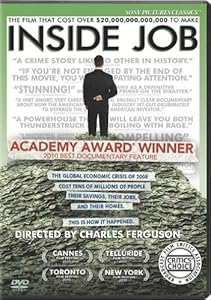
It is fascinating viewing, but deeply disturbing as many of the key personalities are still in play in various companies and governments and regulatory bodies today.
For a write up see - http://en.wikipedia.org/wiki/Inside_Job_(film)
Sunday, February 10, 2013
Barclays to close tax unit
From The Sunday Telegraph - http://www.telegraph.co.uk/finance/newsbysector/banksandfinance/9859934/Barclays-to-close-tax-unit.html
Barclays is to close its controversial tax avoidance unit as one of the landmark measures of Antony Jenkins’ much anticipated strategy review designed to show that “Barclays is changing”.

"The Sunday Telegraph can reveal that Mr Jenkins, who will deliver the outcome of the review on Tuesday, will say the bank will shut its structured capital markets (SCM) business.
In the mid-2000s the unit made profits of as much as £1bn in a single year and became synonymous with Barclays’ aggressive investment banking culture under the stewardship of Bob Diamond, Mr Jenkins’ predecessor as chief executive.
The unit, previously run by Barclays’ highest-paid banker, Roger Jenkins, who was paid as much as £40m a year as a result of SCM’s success, gave advice to large companies on how to avoid tax. SCM was responsible for building a network of almost 300 offshore tax-haven subsidiaries which meant Barclays itself paid only £113m of UK corporation tax in 2009, despite profits of £4.6bn.
The strategy review will be delivered at London’s Royal Horticultural Halls just hours after the bank’s full-year results for 2012, which are expected to show that Barclays will have made adjusted profits of £7.18bn, up from £5.88bn in 2011.
The review has seen Barclays split into 75 business units, each of which has been measured on the returns generated and the reputational impact of the specific activities."
Maybe other big banks and consultancies offering Tax Avoidance services will also close. Maybe pigs will fly!
Tuesday, February 5, 2013
RBS bankers must pay Libor fine, says George Osborne
From - http://www.guardian.co.uk/business/2013/feb/04/royal-bank-scotland-libor-fine-osborne

George Osborne is forcing Royal Bank of Scotland to cut its bankers' pay to ensure that taxpayers are not left to pick up the cost of the upcoming multimillion-pound fine for Libor rigging.
The chancellor said his views had been made clear to the management of the bailed-out bank in an attempt to defuse public anger about the portion of the fine – which could amount to between £400m to £500m in total – that will be paid to the US authorities.
"When it comes to RBS, I am clear that the bill for any US fine related to this investigation should on this occasion be paid for by the bankers, and not the taxpayer," Osborne said.
Speaking in Bournemouth where he unveiled plans to reform the banking system, Osborne appeared to back the RBS chief executive, Stephen Hester, but indicated he expects heads to roll as a result of the fine for rigging Libor – a key interest rate. It was "well known" that RBS was considering management changes, Osborne said.
The fine from the UK's Financial Services Authority is thought to be just under £90m with US regulators levying fines of around four times that amount. In the furore that followed the £290m Libor fine paid by Barclays last year, £59.5m of which was levied by the FSA, the law was changed to ensure that fines went to the government.
"Those who were doing the supervising must also bear their share of the responsibility," Osborne said. "The RBS board and the RBS senior management are well aware of that and decisions are in hand."
He added that Hester is "taking the action to ensure those responsible are held to account".
It is expected that the departure of John Hourican, the head of the investment bank, will be announced once the Libor fine is revealed, possibly later this week, although he is not thought to be personally implicated in the rigging of Libor. The size of the bonus pool for 2012 at RBS has yet to be disclosed. It was £390m for 2011 and is expected to fall by as much as £150m. But the call by the chancellor to ensure bankers pay for the Libor fine does not preclude bonuses being paid for 2012.
Responding to questions about why senior bankers should receive bonuses after a year of scandal, Osborne acknowledged that Hester and Barclays boss Antony Jenkins have waived their bonuses.
He said there could have been "enormous public anger" if fines levied on RBS by US regulators were paid by the taxpayer, not the bankers.
"That is not on," said Osborne, who has told the bank's management that a fine imposed by international regulators should be paid out of bankers' pay. If the fine is paid by shareholders, led by taxpayers who own 83%of the bank, "that could have been a very great source of public anger this spring," said Osborne.
The chancellor confirmed remarks by Treasury sources over the weekend which had suggested he was concerned about how the Libor fine would be paid. In his speech, Osborne insisted that "everyone should exercise restraint and responsibility" over bonuses.
Osborne was accused of "rhetoric" and a "partial climbdown" by Ed Balls, the shadow chancellor, after he said he would use legislation to threaten banks with being broken up if they attempted to flout rules requiring them to ringfence their high street and investment banking operations.
Andrew Tyrie, the Conservative MP whose banking standards commission helped create the idea of "electrifying" the ringfence, said the chancellor had taken an "important step in the right direction". The ringfence was a key plank in proposals by Sir John Vickers' independent commission but the banking standards commission had been concerned banks would try to "game" the ringfence. "They will always try to do so unless strong disincentives are put in place," said Tyrie.
Chancellor insists Royal Bank of Scotland, not UK taxpayers, must take up estimated £500m fine for Libor rigging
Sunday, February 3, 2013
Inequality for All – another Inconvenient Truth?
From The Guardian - http://www.guardian.co.uk/film/2013/feb/02/inequality-for-all-us-economy-robert-reich

The powerful documentary Inequality for All was an unexpected
hit at the recent Sundance film festival, arguing that US capitalism has
fatally abandoned the middle classes while making the super-rich richer. Can
its star, economist Robert Reich, do for economics what Al Gore did for the
environment?
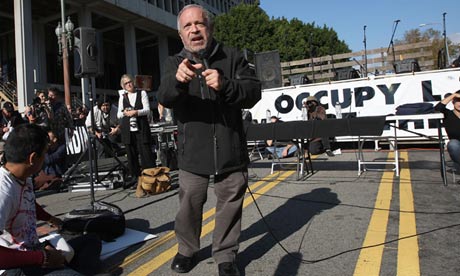
Former US labour secretary Robert Reich at an Occupy Los Angeles rally in 2011. Photograph: David Mcnew/Getty Images
In one sense, Inequality
for All is absolutely the film of the moment.
We are living through tumultuous times. The economy has tanked. Austerity has
cut a swath through the country. We're on the verge of a triple-dip recession.
And, in another, parallel universe, a small cohort of alien beings – or as we
know them, bankers – are currently engaged in trying to figure out what to
spend their multimillion-pound bonuses on. Who wouldn't want to know what's
going on? Or how it happened? Or why? Or if it is really true that the next
generation down is well and truly shafted?
…
Any synopsis of the film runs the risk of making it seem dry again, but
essentially it describes how the middle classes have come to have a smaller and
smaller portion of the economic pie. And how, since 70% of the economy is based
on the middle classes buying stuff, if they don't have any money to buy this
stuff, it cannot grow. Meanwhile, the government has allowed the super-rich,
the "one per cent", to take more of the nation's wealth. Half of the
US's total assets are now owned by just 400 people – 400! – and, Reich contests
that this is not just a threat to the economy, but also to democracy.
…
And what the film tries to do is thread together evidence that many
people know about – the increasing struggle of the middle classes to just get
by, the way that the top 1% of society has unshackled itself from the rest of
us and has seen its income increase exponentially, and the ever-increasing cost
of the traditional avenues of improvement, such as higher education – and weave
it into a cohesive and convincing narrative. It is, in some respects, a theory
of everything. Reich charts the three decades of increasing median income after
the second world war, a period he calls "the great prosperity" and
then examines what happened in the late 1970s to put an end to it. The economy
didn't falter. It kept on growing. But wages didn't.
The figures that Reich supplies are simply gobsmacking. In 1978, the
typical male US worker was making $48,000 a year (adjusted for inflation).
Meanwhile the average person in the top 1% was making $390, 000. By 2010, the
median wage had plummeted to $33,000, but at the top it had nearly trebled, to
$1,100,000.
"Something happened in the late 1970s," we hear him tell his
Berkeley class. And much of the rest of the film is working out what happened.
Some inequality is inevitable, he says. Even desirable. It's what makes
capitalism tick. But at what point does it become a problem? When the middle
classes (in its American sense of the 25% above and below the median wage) have
so little of the economic pie that it affects not just their lives but the
economy as a whole.
Reich's thesis is that since the 1970s a combination of anti-union
legislation and deregulation of the markets contrived to create a situation in
which the economy boomed but less of the wealth trickled down. Though for a
while, nobody noticed. There were "coping mechanisms". More women
entered the workforce, creating dual-income families. Working hours rose. And
increasing house prices enabled people to borrow.
And then, in 2007, this all came crashing to a halt. "We have
exhausted all the options," he says. There's nowhere else left to go. It's
crunch time.
It's crunch time that so many working families understand too well. They
may not be familiar with the theory of income inequality but they haven't been
able to avoid noticing that they've got less money in their pockets. "I've
always thought that kitchen-table economics is the most important topic to most
people," says Reich. "Their wages, their jobs, getting by. I've
always tried to relate economics to where people live. That's why I was so
excited about the film."
…
… In the UK, Royal Bank of Scotland, having covered itself in glory in
the Libor interest-rate fixing scandal, is currently contemplating bonuses for
its investment banking division of £250m, according to reports last week. This,
to put it another way, is the annual wage bill for at least 12,500 of its
call-centre workers. Because this isn't just an American problem. It's a
British one too.
"If there was upward mobility it would be OK," says Reich in
the film. "But 42% of children born in poverty in the USA will stay there.
In Denmark it's 24%. Even in Great Britain, where they still have an
aristocracy, it's 30%."
It's probably a shocking statistic for Americans to hear. The problem is
that by every index you can measure, inequality is worsening in Britain. There
are fewer opportunities to overcome the barriers of your birth in the UK than
in any other country in Europe. One of the most chilling moments in Inequality for All for a British audience is that how,
faced with the same choices that America had in the 70s, we have, in the last
year or so, taken the same path.
One of the key moments for Reich was the underinvestment in education,
particularly higher education in the 70s. This was when America introduced
tuition fees and its workforce started to fall behind the rest of the world's.
When opportunities for those from low- and middle-income backgrounds began
shrinking: precisely where the UK is today.
It's not just that wages have remained flat in America – as they have in
the UK – it's that the expenses of everyday life have soared, in particular
education and healthcare.
Last October, an independent
commission in the UK led by the Resolution Foundation predicted that in 2020 wages for low- to middle-income families would be
the same as they were in 2000. And yet everything else will have gone up. We
too are facing the crunch.
In December, the Office for National Statistics found that richest 10% of
people in Britain own 40% of the national wealth. In London and the
south-east, one in eight households has almost £1m of assets. The bottom half
of the country has no net property wealth and only £4,000 in pensions savings.
For them, there is just rising prices. And the ever diminishing possibility of
things ever being different for them or their children.
Sunday, January 27, 2013


Wednesday, October 10, 2012
What's wrong with Capitalism?
In this - http://www.thersa.org/events/video/animate/rsa-animate-crisis-of-capitalism -

RSA Animate video - Crisis of Capitalism
28 Jun 2010
Radical sociologist David Harvey asks if it is time to look beyond capitalism, towards a new social order that would allow us to live within a responsible, just and humane system.
Radical sociologist David Harvey asks if it is time to look beyond capitalism, towards a new social order that would allow us to live within a responsible, just and humane system.
Thursday, August 9, 2012
The evolution of inequality
In the 28 July 2012 issue of New Scientist, there is an excellent article on why anthropologists believe the human race, after 50,000 years of relative equality, became very unequal in the last 5,000 years; resulting in today's 1% owning up to 20% of the total wealth.
The reason they believe was the root cause of this trend is the surplus that started to build up once mankind changed from nomadic hunter-gatherers to settled farmers. Those who accumulated most were able to lord it over their less fortunate village mates. Soon hierarchies of chiefs and super-chiefs and kings and emperors evolved.
Later, in the European middle ages, religious and political power gradually changed hands and the merchant classes started to rule the roost - at least as far as wealth is concerned. Fighting wars was and is not cheap and the one constant beneficiaries were and are the banks and bankers. So today's top 1% includes not only land and other asset owners of the past, but also builders and manufacturers and, surprise, surprise, bankers and other financiers.

For more information on inequality, read: http://en.wikipedia.org/wiki/List_of_countries_by_income_equality
The reason they believe was the root cause of this trend is the surplus that started to build up once mankind changed from nomadic hunter-gatherers to settled farmers. Those who accumulated most were able to lord it over their less fortunate village mates. Soon hierarchies of chiefs and super-chiefs and kings and emperors evolved.
Later, in the European middle ages, religious and political power gradually changed hands and the merchant classes started to rule the roost - at least as far as wealth is concerned. Fighting wars was and is not cheap and the one constant beneficiaries were and are the banks and bankers. So today's top 1% includes not only land and other asset owners of the past, but also builders and manufacturers and, surprise, surprise, bankers and other financiers.
For more information on inequality, read: http://en.wikipedia.org/wiki/List_of_countries_by_income_equality
Tuesday, August 7, 2012
Another week, another bank!
From BBC News: http://www.bbc.co.uk/news/business-19159286

Shares of Standard Chartered bank have tumbled despite the bank denying allegations that it illegally "schemed" with Iran to launder money.

Shares fell 15% in early London trade, after falling 16% in Hong Kong.
The New York State Department of Financial Services said the UK-based bank laundered as much as $250bn (£161bn) over nearly a decade.
It said the bank hid transactions for "Iranian financial institutions" that were subject to US economic sanctions.
The regulator said that Standard Chartered had hidden 60,000 such secret transactions.
However, the bank denied the allegations, saying that it "strongly rejects the position or portrayal of facts as set out in the order" issued by the regulator.
Tuesday, July 31, 2012
Libor Euribor Fixing Scandal: Banks Cooperate for Lower Fines
From International Business Times - http://www.ibtimes.co.uk/articles/368304/20120730/libor-euribor-fixing-barclays-deutsche-bank-hsbc.htm:
Several unidentified banks under investigation for the suspected manipulation of Euro Interbank Offered Rate (Euribor) are reportedly cooperating with European Union antitrust regulators in the hope of lower fines, said two unnamed sources cited by Reuters.

When Barclays settled with US and UK regulators for a record fine of £290m for rigging Libor and Euribor, the bank received a 30 percent discount under the UK's Financial Services Authority's (FSA) settlement discount scheme. It paid the FSA £59.5m; without the discount, this would have been £85m.
The names of the banks under investigation have not been revealed. A total of 43 banks sit on the Euribor panel, which is hosted by the European Banking Federation.
Under the European Commission's leniency policy, the "whistle-blower" firm does not incur any penalty as part of an immunity deal and fines can be reduced by 30-50 percent for the next company to provide evidence of wrongdoing.
Fines can also be reduced by 20-30 percent for the next applicant and all subsequent applicants can get a reduction in any penalty of up to 20 percent.
First the LIBOR scandal, now Euribor. Is there a US and Asian equivalent? if so, when will their scandals emerge?
Monday, July 30, 2012
Why Capitalism Has an Image Problem
From WSJ - Charles Murray:
Mitt Romney's résumé at Bain should be a slam dunk. He has been a successful capitalist, and capitalism is the best thing that has ever happened to the material condition of the human race. From the dawn of history until the 18th century, every society in the world was impoverished, with only the thinnest film of wealth on top. Then came capitalism and the Industrial Revolution. Everywhere that capitalism subsequently took hold, national wealth began to increase and poverty began to fall. Everywhere that capitalism didn't take hold, people remained impoverished. Everywhere that capitalism has been rejected since then, poverty has increased.
Getty Images


Henry Ford with his Model T


Corbis


A dry-cleaning store


Yet it hasn't worked out that way for Mr. Romney. "Capitalist" has become an accusation. The creative destruction that is at the heart of a growing economy is now seen as evil. Americans increasingly appear to accept the mind-set that kept the world in poverty for millennia: If you've gotten rich, it is because you made someone else poorer.The Saturday Essay
![[image]](http://si.wsj.net/public/resources/images/RV-AH663_CAPITA_DV_20120727172640.jpg)
Capitalism has lifted the world out of poverty because it gives people a chance to get rich by creating value and reaping the rewards. Who better to be president of the greatest of all capitalist nations than a man who got rich by being a brilliant capitalist?
What happened to turn the mood of the country so far from our historic celebration of economic success?
Two important changes in objective conditions have contributed to this change in mood. One is the rise of collusive capitalism. Part of that phenomenon involves crony capitalism, whereby the people on top take care of each other at shareholder expense (search on "golden parachutes").
But the problem of crony capitalism is trivial compared with the collusion engendered by government. In today's world, every business's operations and bottom line are affected by rules set by legislators and bureaucrats. The result has been corruption on a massive scale. Sometimes the corruption is retail, whereby a single corporation creates a competitive advantage through the cooperation of regulators or politicians (search on "earmarks"). Sometimes the corruption is wholesale, creating an industrywide potential for profit that would not exist in the absence of government subsidies or regulations (like ethanol used to fuel cars and low-interest mortgages for people who are unlikely to pay them back). Collusive capitalism has become visible to the public and increasingly defines capitalism in the public mind.
Another change in objective conditions has been the emergence of great fortunes made quickly in the financial markets. It has always been easy for Americans to applaud people who get rich by creating products and services that people want to buy. That is why Thomas Edison and Henry Ford were American heroes a century ago, and Steve Jobs was one when he died last year.
When great wealth is generated instead by making smart buy and sell decisions in the markets, it smacks of inside knowledge, arcane financial instruments, opportunities that aren't accessible to ordinary people, and hocus-pocus. The good that these rich people have done in the process of getting rich is obscure. The benefits of more efficient allocation of capital are huge, but they are really, really hard to explain simply and persuasively. It looks to a large proportion of the public as if we've got some fabulously wealthy people who haven't done anything to deserve their wealth.
Subscribe to:
Posts (Atom)