Wednesday, April 16, 2014

Capitalism simply isn't working and here are the reasons why

From: http://www.theguardian.com/commentisfree/2014/apr/12/capitalism-isnt-working-thomas-piketty

thomas-piketty-economist-will-hutton
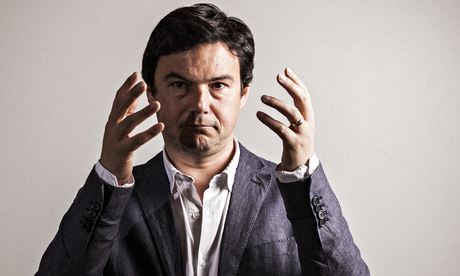
Thomas Piketty has mined 200 years of data to support his theory that capitalism does not work. Photograph: Ed Alcock for the Observer
Suddenly, there is a new economist making waves – and he is not on the right. At the conference of the Institute of New Economic Thinking in Toronto last week, Thomas Piketty's book Capital in the Twenty-First Century got at least one mention at every session I attended. You have to go back to the 1970s and Milton Friedman for a single economist to have had such an impact.
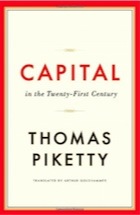
  1. Capital in the Twenty-First Century
  2. by Thomas Piketty, Arthur Goldhammer
  1. Tell us what you think:Star-rate and review this book
Like Friedman, Piketty is a man for the times. For 1970s anxieties about inflation substitute today's concerns about the emergence of the plutocratic rich and their impact on economy and society. Piketty is in no doubt, as he indicates in an interview in today's Observer New Review, that the current level of rising wealth inequality, set to grow still further, now imperils the very future of capitalism. He has proved it.
It is a startling thesis and one extraordinarily unwelcome to those who think capitalism and inequality need each other. Capitalism requires inequality of wealth, runs this right-of-centre argument, to stimulate risk-taking and effort; governments trying to stem it with taxes on wealth, capital, inheritance and property kill the goose that lays the golden egg. Thus Messrs Cameron and Osborne faithfully champion lower inheritance taxes, refuse to reshape the council tax and boast about the business-friendly low capital gains and corporation tax regime.
Piketty deploys 200 years of data to prove them wrong. Capital, he argues, is blind. Once its returns – investing in anything from buy-to-let property to a new car factory – exceed the real growth of wages and output, as historically they always have done (excepting a few periods such as 1910 to 1950), then inevitably the stock of capital will rise disproportionately faster within the overall pattern of output. Wealth inequality rises exponentially.
The process is made worse by inheritance and, in the US and UK, by the rise of extravagantly paid "super managers". High executive pay has nothing to do with real merit, writes Piketty – it is much lower, for example, in mainland Europe and Japan. Rather, it has become an Anglo-Saxon social norm permitted by the ideology of "meritocratic extremism", in essence, self-serving greed to keep up with the other rich. This is an important element in Piketty's thinking: rising inequality of wealth is not immutable. Societies can indulge it or they can challenge it.
Inequality of wealth in Europe and US is broadly twice the inequality of income – the top 10% have between 60% and 70% of all wealth but merely 25% to 35% of all income. But this concentration of wealth is already at pre-First World War levels, and heading back to those of the late 19th century, when the luck of who might expect to inherit what was the dominant element in economic and social life. There is an iterative interaction between wealth and income: ultimately, great wealth adds unearned rentier income to earned income, further ratcheting up the inequality process.
The extravagances and incredible social tensions of Edwardian England, belle epoque France and robber baron America seemed for ever left behind, but Piketty shows how the period between 1910 and 1950, when that inequality was reduced, was aberrant. It took war and depression to arrest the inequality dynamic, along with the need to introduce high taxes on high incomes, especially unearned incomes, to sustain social peace. Now the ineluctable process of blind capital multiplying faster in fewer hands is under way again and on a global scale. The consequences, writes Piketty, are "potentially terrifying".
For a start, almost no new entrepreneurs, except one or two spectacular Silicon Valley start-ups, can ever make sufficient new money to challenge the incredibly powerful concentrations of existing wealth. In this sense, the "past devours the future". It is telling that the Duke of Westminster and the Earl of Cadogan are two of the richest men in Britain. This is entirely by virtue of the fields in Mayfair and Chelsea their families owned centuries ago and the unwillingness to clamp down on the loopholes that allow the family estates to grow.
Anyone with the capacity to own in an era when the returns exceed those of wages and output will quickly become disproportionately and progressively richer. The incentive is to be a rentier rather than a risk-taker: witness the explosion of buy-to-let. Our companies and our rich don't need to back frontier innovation or even invest to produce: they just need to harvest their returns and tax breaks, tax shelters and compound interest will do the rest.
Capitalist dynamism is undermined, but other forces join to wreck the system. Piketty notes that the rich are effective at protecting their wealth from taxation and that progressively the proportion of the total tax burden shouldered by those on middle incomes has risen. In Britain, it may be true that the top 1% pays a third of all income tax, but income tax constitutes only 25% of all tax revenue: 45% comes from VAT, excise duties and national insurance paid by the mass of the population.
As a result, the burden of paying for public goods such as education, health and housing is increasingly shouldered by average taxpayers, who don't have the wherewithal to sustain them. Wealth inequality thus becomes a recipe for slowing, innovation-averse, rentier economies, tougher working conditions and degraded public services. Meanwhile, the rich get ever richer and more detached from the societies of which they are part: not by merit or hard work, but simply because they are lucky enough to be in command of capital receiving higher returns than wages over time. Our collective sense of justice is outraged.
The lesson of the past is that societies try to protect themselves: they close their borders or have revolutions – or end up going to war. Piketty fears a repeat. His critics argue that with higher living standards resentment of the ultra-rich may no longer be as great – and his data is under intense scrutiny for mistakes. So far it has all held up.
Enhanced by Zemanta

Google Agrees to Pay More Tax in UK

From: http://www.ibtimes.co.uk/google-agrees-pay-more-tax-uk-1431068

Internet giant Google has put aside £24m to pay corporation tax in the UK following a review of the way the company pays its employees in shares that are billed through its Irish subsidiary. Google has some 2,000 UK employees; in 2011 they received £50m in US shares and they received a similar amount in 2012.
Although this share-payment scheme was legal, HMRC scrutinised the arrangements because the company claims the payments as tax-deductible but under new guidelines share payments must be counted as revenue. As a result, Google said in its 2012 accounts, the company had "made a provision of £24m for potential corporation tax for the years under review".
Google has faced persistent criticism over its tax arrangements. Last June the Public Accounts Committee (PAC) of MPs called on the company to be investigated when former employee turned whistle-blower Barney Jones claimed the UK branch engaged in advertising sales, despite Google's insistence that sales took place in Ireland – a practice he described as immoral.
The company's highly contrived tax arrangement has no purpose other than to enable the company to avoid UK corporation tax.
Speaking about that arrangement, chairwoman of the PAC Margaret Hodge said: "Google brazenly argued before this committee that its tax arrangements in the UK are defensible and lawful. The company's highly contrived tax arrangement has no purpose other than to enable the company to avoid UK corporation tax."
Similar schemes have been adopted by other technology giants including Apple, Facebook and Amazon. In 2012, Apple's UK revenue was estimated at £9.5bn and Facebook's at £307m, yet neither paid any corporation tax. Amazon, which had revenue of an estimated £3.7bn, paid just £2.4m in corporation tax.
Whereas Amazon channels its financial transactions through Luxembourg, Google, Facebook and Apple base their European operations in Ireland, which has lower corporation taxes than in the UK. However, a spokesman for Google pointed out that the company pays much of its corporation tax in the US and it remains a significant contributor to the UK, paying around £150m in tax.
Enhanced by Zemanta

Starbucks to move Europe base to London, pay more UK tax

From: http://uk.reuters.com/article/2014/04/16/uk-starbucks-unitedkingdom-idUKBREA3F03820140416

 A paper cup is seen in Starbucks' Vigo Street branch in Mayfair, central London January 11, 2013. REUTERS/Stefan WermuthStarbucks Corp said on Wednesday it would move its European headquarters to London from the Netherlands and pay more tax in the UK as a result.
The world's largest coffee chain has endured widespread criticism over low tax contributions in Britain, since Reuters reported in 2012 that the company had told the UK tax authority it was lossmaking while informing investors that the British subsidiary was profitable.
Following the Reuters report, Starbucks was called to testify before a parliamentary hearing about its tax affairs, where it revealed it had agreed a deal with the Dutch tax authorities that allowed it pay "a very low tax rate" there.
"This move will mean we pay more tax in the UK," the company said in a statement, without giving further details.

Starbucks regional president Kris Engskov said London was "the perfect place to grow our European business".
Enhanced by Zemanta

Wednesday, March 26, 2014

The 67 People As Wealthy As The World's Poorest 3.5 Billion

From: http://www.forbes.com/sites/forbesinsights/2014/03/25/the-67-people-as-wealthy-as-the-worlds-poorest-3-5-billion/

Oxfam International, a poverty fighting organization, made news at the World Economic Forum in Davos earlier this year with its report that the world’s 85 richest people own assets with the same value as those owned by the poorer half of the world’s population, or 3.5 billion people (including children). Both groups have  $US 1.7 trillion. That’s $20 billion on average if you are in the first group, and $486 if you are in the second group.
Oxfam’s calculations of the richest individuals are based on the 2013 Forbes Billionaires list. I decided to take a closer look at this group of 85 in search of trends. That’s when I realized that they are by now a much wealthier group. The rich got richer.  And it was quite fast and dramatic. For example, while last year it took $23 billion to be in the top 20 of the world’s billionaires, this year it took $31 billion, according to Luisa Kroll, Forbes wealth editor, writing on Forbes.com.
As a result, by the time Forbes published its 2014 Billionaires List in early March, it took only 67 of the richest peoples’ wealth to match the poorer half of the world. (For the purpose of this blog, I will put aside the conversation about the importance of income inequality versus impoverishment. This has recently been skewing strongly toward recognition of the importance of income distribution and its inequality, most recently with the publication of Capital in the Twenty-First Century by Thomas Piketty.)


Each of the 67 is on average worth the same as 52 million people from the bottom of the world’s wealth  pyramid. Bill Gates, the world’s richest man, with a net worth of $76 billion, is worth the same as 156 million people from the bottom.
Who are the 67? The biggest group—28 billionaires, or 42% of them—is from the United States. No other country comes close. Germany and Russia have the second-highest number, with six each. The rest are sprinkled among 13 countries in Western Europe, APAC and the Americas.
That the biggest group of the super rich comes from the U.S. should not be a surprise, as the country holds almost a third of the world’s wealth (30%), significantly more than any other country, according to the Global Wealth Databook, from Credit Suisse Research Institute. However, Europe, with a slightly bigger chunk of the world’s wealth (32%), produced substantially fewer of the richest. That is due to less dynamic economies, which do not equal the U.S. in how they foster innovation, on which many of the newest U.S. fortunes are based.
When comparing the ratio of the richest to the percentage of the world’s wealth held by each country, it is Russia that comes out the most lopsided, with its holdings skewed to the super rich. As a country, Russia holds only half a percent of the world’s wealth, and yet it has 9% of the 67 richest.
The 67 fortunes come from three main industries: technology (12), retail (12) and natural resources-based sectors such as oil and gas, mining and steel. The geographical split by industry illustrates the state and progression of the various economies. Almost all technology fortunes are recent and from the U.S. (Microsoft MSFT -0.4%, Oracle, Facebook). Retail is dominated by second- or third-generation Western Europeans. The majority of the rich whose money comes from natural resources are from emerging markets, with most of them from Russia.
The majority of the 67—40, or 60%, to be precise—are self-made.
Enhanced by Zemanta

Sunday, February 23, 2014

Robert Mugabe's lavish 90th birthday plans decried as Zimbabwe struggles

Costly celebration, criticised as cultism and hero worship, comes at a time of heavy job losses and slowing economic growth

Robert Mugabe
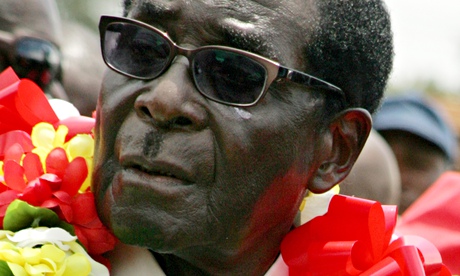
Robert Mugabe is expected to celebrate with thousands of supporters at the Rudhaka stadium in Marondera. Photograph: Jekesai Njikizana/AFP/Getty Images
Plans for a lavish $1m (£600,000) celebration of Zimbabwean presidentRobert Mugabe's 90th birthday have been condemned as the country lurches towards another financial crisis.
The tribute to Africa's oldest head of state – and second oldest in the world after Israel's Shimon Peres – is expected to surpass last year's party, when special gold coins were minted and Mugabe was presented with a cake said to weigh 89kg.
But the costly event will come amid heavy job losses, slowing economic growth and what the central bank describes as a "severe and persistent liquidity crunch", reviving memories of the disastrous meltdown five years ago.
Mugabe, who continues to defy the march of time and constant health speculation, travelled to Singapore this week for cataract surgery on his left eye, according to his spokesman.
But he is expected back in time for the birthday celebration with thousands of supporters at the Rudhaka stadium in the town of Marondera on Sunday, two days after he turns 90.
Absalom Sikhosana, secretary for youth affairs in Mugabe's Zanu-PF party, told reporters recently: "This is a very special celebration. Turning 90 is no mean feat. You cannot turn 90 years when you are a womaniser, a drunkard or a chain smoker. We will be celebrating the life of a very special person on a very special occasion."
It is a milestone in the history of the country, which has known no other leader since gaining independence from Britain in 1980, but activists and opposition politicians described the event as an extravagant waste of money when many citizens are going hungry.
"It would be inappropriate for a country's head of state to have such a lavish and costly celebration at a time when the country is faced with the disaster of flooding and a crumbling economy," said Dewa Mavhinga, a Zimbabwe researcher at Human Rights Watch. "It's about cultism, hero worship, institutionalising Mugabe, with sycophants around him trying to oil the wheels of patronage. There's an entire system behind this corruption."
Reflecting on Mugabe's 34 years in power, Mavhinga added: "His human rights record is one that no one can honestly admire. There is nothing to celebrate about his birthday or his legacy – and there are concerns that, if something should happen to him, the country might be plunged into chaos if there is no clear mechanism for transition."
Enhanced by Zemanta

Friday, October 4, 2013

U.S. government shutdown: Obama blames Boehner

Partial closure of U.S. government in third day

The Associated Press Posted: Oct 03, 2013 11:22 AM ET Last Updated: Oct 03, 2013 10:43 PM ET
  • The U.S. government shutdown entered its third day on Thursday. Here's a photographic look at some parts of American life that are closed or severely affected by Washington shutting down.
  •  The U.S. government shutdown entered its third day on Thursday. Here's a photographic look at some parts of American life that are closed or severely affected by Washington shutting down. (Larry Downing/Reuters)
1 of 14

Related Stories

President Barack Obama laid the blame for the U.S. government's partial shutdown at the feet of House of Representatives Speaker John Boehner on Thursday, escalating a confrontation that is running the risk of a potentially damaging clash over the country's borrowing authority.

The Treasury Department warned that a deadlock over raising the nation's debt limit could touch off a new recession even worse than the last one that Americans are still recovering from. Worry about prospects for resolving the debt question within the next two weeks deepened as the shutdown standoff dragged into a third day.

House Republicans adamant about cancelling, delaying or watering down President Barack Obama's signature health-care reform legislation have refused to pass spending measures without anti-Obamacare provisions. Senate Democrats insist that the Affordable Care Act, as it's formally known, was passed into law long ago and isn't up for reconsideration.

With 800,000 federal government employees forced into taking leave, some agencies have almost entirely shuttered, including NASA, the Commerce Department and the Environmental Protection Agency. The partial closure is also disrupting everyone from farmers who can't cash their paycheques to Statue of Liberty tourists.

Late Thursday, the White House announced that Obama was abandoning an already abbreviated trip to Indonesia and Brunei next week in the face of the shutdown. White House spokesman Jay Carney said Secretary of State John Kerry would travel instead.

The Republican-controlled House has tried to push piecemeal legislation to fund individual departments and programs, but most Democrats, including Obama, want a comprehensive resolution that would reopen the whole government, not just bits of it.

The shutdown showdown grew more personal Thursday.

Speaking at a construction company in Washington's Maryland suburbs, Obama cast the House speaker as a captive of a small band of conservative Republicans who want to extract concessions in exchange for passing a short term spending bill that would restart the partially shuttered government.

"The only thing preventing people from going back to work and basic research starting back up and farmers and small business owners getting their loans, the only thing that is preventing all that from happening right now, today, in the next five minutes is that Speaker John Boehner won't even let the bill get a yes or no vote because he doesn't want to anger the extremists in his party," Obama said.

Boehner answered by batting blame back toward Obama and his "my-way-or-the-highway approach." Boehner said that if the president would negotiate to fix flaws in "Obamacare," the shutdown could end.

"The president's insistence on steamrolling ahead with this flawed program is irresponsible," said Boehner, a Republican from Ohio.

Eric Cantor, the Republican majority leader in the House of Representatives, said the House would continue on its course of passing separate bills to remedy "situations that are in critical stages" because of the partial government shutdown that began Tuesday.

The House was expected to vote to for more money for National Guard and Reserves and for veterans programs during the day, and officials said legislation to help some social programs could soon be drafted, as well.

Monday, July 29, 2013

Capability building in China

All too often in the UK we hear senior business leaders and politicians bemoaning the lack of skilled labour.  But China 30 or so years ago had very few skilled staff.  So how did they progress to be the world's leading manufacturer and exporter?


Article|McKinsey Quarterly

Capability building in China

Skill building must be rewards-based, rooted in real work, and tailored to local conditions.


July 2013 | byKarel Eloot, Gernot Strube, and Arthur Wang
Capability building—leadership, managerial, and team-based skills rather than technical ones—has become an urgent imperative for many companies in China. As the country loses its extreme low-cost-labor advantage, businesses must look for ways to increase productivity and internal collaboration, to better understand consumers, and to develop a more sophisticated appetite for risk.
Companies in China face many of the same challenges—a lack of up-front planning and inadequate resources—that bedevil capability-building exercises everywhere. But certain “China factors” stand out. For starters, the demand for managers with strong leadership skills and international experience is growing significantly faster than the supply of qualified candidates. That imbalance makes it more difficult to pull off successful skill-building efforts, even for multinationals that typically invest more in training than Chinese companies do. (Indeed, one implication of China’s white-hot war for talent is that outside trainers brought in by multinational companies to set up and run new programs often move on before relevant tools and internal processes are in place.) Another perennial challenge for multinationals: the Chinese context and culture, which may require local tailoring of global approaches.
Then, of course, there are China’s state-owned enterprises. Many of them only recently converted from government departments into commercial entities and are still working to adapt to a competitive environment and adopt a true business mind-set. These companies generally lack a systematic approach to nurturing employees moving up the organizational ladder. They misconstrue capability building as a classroom activity, missing the impact of linking it to actual business. And they are too inflexible either to fire underperformers or to reward and promote employees, including managers, who change their behavior and adopt the necessary mind-sets.
While the challenges facing multinationals and state-owned enterprises differ, our experience with leaders at both kinds of organizations (as well as with private-sector Chinese companies) has highlighted the importance of some common, broadly applicable principles. In this article, we describe three that should help companies overcome many of the obstacles that have frustrated capability-building efforts in the past.

1. Relate capability building to real activities

...

2. Instill incentives and create opportunities for promotion

...

3. Don’t forget China’s unique culture

...
The solutions may sound obvious: developing Chinese teaching materials to help solve problems, building day-to-day business problems around products that participants would find in the Chinese market, and localizing global training materials through culturally appropriate metaphors and examples. But we know from experience how easy it is to overlook these issues. In our own work, we routinely use a case involving a coffee machine to teach managers about the seven types of waste and how a “lean” perspective can address them. When we recently used this case at a Chinese state-owned enterprise, however, the managers couldn’t make sense of the story, because they had never used a coffee machine. We have now adapted the context to tea making.
About the authors
Karel Eloot is a director in McKinsey’s Shanghai office; Gernot Strube is a director in the Hong Kong office, where Arthur Wang is a principal.