Monday, July 29, 2013

Capability building in China

All too often in the UK we hear senior business leaders and politicians bemoaning the lack of skilled labour.  But China 30 or so years ago had very few skilled staff.  So how did they progress to be the world's leading manufacturer and exporter?


Article|McKinsey Quarterly

Capability building in China

Skill building must be rewards-based, rooted in real work, and tailored to local conditions.


July 2013 | byKarel Eloot, Gernot Strube, and Arthur Wang
Capability building—leadership, managerial, and team-based skills rather than technical ones—has become an urgent imperative for many companies in China. As the country loses its extreme low-cost-labor advantage, businesses must look for ways to increase productivity and internal collaboration, to better understand consumers, and to develop a more sophisticated appetite for risk.
Companies in China face many of the same challenges—a lack of up-front planning and inadequate resources—that bedevil capability-building exercises everywhere. But certain “China factors” stand out. For starters, the demand for managers with strong leadership skills and international experience is growing significantly faster than the supply of qualified candidates. That imbalance makes it more difficult to pull off successful skill-building efforts, even for multinationals that typically invest more in training than Chinese companies do. (Indeed, one implication of China’s white-hot war for talent is that outside trainers brought in by multinational companies to set up and run new programs often move on before relevant tools and internal processes are in place.) Another perennial challenge for multinationals: the Chinese context and culture, which may require local tailoring of global approaches.
Then, of course, there are China’s state-owned enterprises. Many of them only recently converted from government departments into commercial entities and are still working to adapt to a competitive environment and adopt a true business mind-set. These companies generally lack a systematic approach to nurturing employees moving up the organizational ladder. They misconstrue capability building as a classroom activity, missing the impact of linking it to actual business. And they are too inflexible either to fire underperformers or to reward and promote employees, including managers, who change their behavior and adopt the necessary mind-sets.
While the challenges facing multinationals and state-owned enterprises differ, our experience with leaders at both kinds of organizations (as well as with private-sector Chinese companies) has highlighted the importance of some common, broadly applicable principles. In this article, we describe three that should help companies overcome many of the obstacles that have frustrated capability-building efforts in the past.

1. Relate capability building to real activities

...

2. Instill incentives and create opportunities for promotion

...

3. Don’t forget China’s unique culture

...
The solutions may sound obvious: developing Chinese teaching materials to help solve problems, building day-to-day business problems around products that participants would find in the Chinese market, and localizing global training materials through culturally appropriate metaphors and examples. But we know from experience how easy it is to overlook these issues. In our own work, we routinely use a case involving a coffee machine to teach managers about the seven types of waste and how a “lean” perspective can address them. When we recently used this case at a Chinese state-owned enterprise, however, the managers couldn’t make sense of the story, because they had never used a coffee machine. We have now adapted the context to tea making.
About the authors
Karel Eloot is a director in McKinsey’s Shanghai office; Gernot Strube is a director in the Hong Kong office, where Arthur Wang is a principal.

Monday, July 15, 2013

Hello 3D printing, goodbye China

If the following article's predictions do come true, then the world economy as we know it today will be destroyed as the unintended consequence. No trucks, freight trains, container ships, no major manufacturing facilities, no major hub warehouses. No truck and freight train drivers, no container ship crews, no depot warehousemen. No truck, freight train, container ship manufacturers; less construction workers and companies. I wonder ...

From: http://www.thesundaytimes.co.uk/sto/business/Tech_and_Media/article1287518.ece?CMP=OTH-gnws-standard-2013_07_14


A SPECTRE is haunting the great container ship ports of China, with their highways jammed by lorries and the vast factory estates stretching from the coast of the South China Sea to the mountainous inland provinces.

It is the spectre of a revolution led by a quiet, software-driven 3D printer, a machine that can laser up layers of liquid or granular resin — or even cell tissue — into a finished product.
Some 3D printers are huge devices that make complete components such as aircraft parts. Others are small units that could stand next to a desk and create a small plastic prototype.
Maplin, the British electronics retailer, said last week it would start selling one for just £700. The Velleman K8200 will allow those who are so inclined to make simple objects — mobile phone covers, perhaps, or toys.
“The only restriction is your imagination. You can make whatever you want,” said Pieter Nartus, export manager at Velleman.
To visionaries in the West, the digital 3D printer promises to disrupt conventional manufacturing and supply chains so radically that advocates compare its impact to the advent of the production line, or the internet.
In China, whose big factories are thinking of using giant 3D printers for manufacturing, the technology does not seem to pose an immediate threat.
“It is on their horizon but it is not a factor right now,” says a British buying agent who sources plastics in China.
However, as Chinese leaders ought to know from their compulsory classes in Karl Marx, control of the means of production is everything. And if 3D printing takes off, production will come back to a place near you.
The implications, economists say, are limitless. No huge factories. No fleets of trucks. No ships. No supply chain. No tariffs. Few middlemen. Orders tailored exactly to demand, so no need for stock and warehouses. Just a printer, raw materials, software and a design.
The advantages do not end there. Because the item is “sintered” — created from a powdered material — to precise settings using a laser, there is no waste such as metal shavings. To customise a product, the user simply changes the software. An operator presses a button and the printer spits out the item.
“The first implication is that more goods will be manufactured at or closer to their point of purchase or consumption,” said Richard D’Aveni, a professor at Dartmouth College in America.
Writing in the Harvard Business Review, D’Aveni predicted the elimination of the long supply chain linked to a huge factory staffed by cheap workers and sited on the other side of the world.
It may be the most significant, if underplayed, article in that distinguished publication in decades.
Not surprisingly, 3D manufacturing has been dismissed by the boss of the biggest factories of them all, Terry Gou of Foxconn, which employs more than 1m Chinese workers making consumer electronics for Apple, Sony, Samsung, Nintendo and other household names in technology.
Foxconn has used some elements of industrial 3D printing for three decades but Gou says it is commercially impractical for mass production.
“3D printing is a gimmick,” he told reporters in Taiwan, where Foxconn is based. “If it really is that good, then I’ll write my name backwards from now on.”
Foxconn and its clients are still smarting from publicity over a chain of suicides at the company’s vast plants, where young employees live under heavy security and work to a strict management regimen on the production line.
Conditions on Chinese assembly lines, as in Bangladeshi garment workshops, have long concerned advocates of workers’ rights.
But it may not be the workers who ultimately overthrow the system. The use of 3D printing implies a transformation that persuades hard-headed economists such as D’Aveni that companies like Foxconn might just become obsolete.
“China has grabbed outsourced manufacturing contracts from every mature economy by pushing the mass-manufacturing model to its limit,” he wrote. “It not only aggregates enough demand to create unprecedented efficiencies of scale but also minimises a key cost: labour.

Watch a demonstration of the £700 Velleman K8200 printer, on sale at Maplin
“Under a model of widely distributed, highly flexible small-scale manufacturing, these daunting advantages become liabilities. No workforce can be paid little enough to make up for the costs of shipping across oceans.”
According to the British buyer, who provided a cost breakdown on a commercially confidential basis, a Chinese factory typically gets between 6p and 7p from a plastic product sold in Britain for £1. That includes its labour costs and profit.
Raw materials, shipping and ground transport add 24p to bring the landed price at a port in southern England to 31p.
The product will sell to the retailer for about 45p, handing the wholesaler a profit of 14p. The retailer marks the product up to £1 but the Treasury helps itself to 20p VAT, leaving the retailer a profit of 35p.
In the brutal war for margin amid volatile commodities and currencies at the bottom end of the market — where China has carved its niche — the numbers tell their own ominous story. In a world of 3D manufacturing, the classic supply chain makes no commercial sense.
“China won’t be a loser in the new era,” D’Aveni argued in the Harvard Business Review. “It will have a domestic market to serve . . . and its domestic market is huge. But China will have to give up on being the mass-manufacturing powerhouse of the world.”
China, of course, is not sitting still. It is eagerly buying western 3D printing technology and making its own lightweight machines to sell to consumers. The ministry of industry and information technology has already allocated £20m to fund 10 research centres and set up a group of 40 participating companies.
In May, Beijing hosted the World 3D Printing Technology Industry Conference. Luo Jun, head of a Chinese trade body, told the state media that the domestic 3D industry will generate about £1.1bn in revenues within three years.
Luo Zheng, sales manager of Renishaw, a Shanghai company, said Chinese firms were at present forced to buy large industrial printers made in Britain at a cost, he said, of about £650,000 each.
Nor has China yet mastered the complex chemistry of 3D inks and resins, so it is dependent on imports.
However, observers who have spent many years watching how China operates in world markets don’t expect such dependence to last.
Caixin, a business magazine, reports that a mechanical engineering professor at Tsinghua University, Yan Yongnian, first brought American 3D technology to China in the 1980s.
This year a research team at Beijing University, led by Wang Huaming, a professor of materials science and engineering, won an award for 3D innovation in aviation components from the State Council, China’s cabinet. The country’s military aviation industry is already using the technology. It is employed in making the J-16 fighter and the next-generation J-31, according to Huanqiu, a website linked to the Global Times. Scientists have used it to make critical load-bearing titanium components, including strengthened landing gear for planes that will be operating from aircraft carriers.
In June, Dalian University of Technology in northeast China unveiled the world’s largest 3D printer. According to Professor Yao Shan of the university, the industrial-grade machine also uses a cheaper form of print material that can cut operating costs by 40%.
In the medical field, researchers at Shining 3D Tech, a company based in Zhejiang province, showed off an artificial disc implant that can fuse with human cell tissue to avoid rejection. The company predicts that one day the technology could be used to manufacture human skeletons from cell tissue and biomaterial.
So there is no doubt about China’s scientific, engineering and intellectual commitment to 3D manufacturing.
However, it is a fundamentally different concept in China. To the Chinese, it is an industrial tool to be used in making more things to sell.
To western economies that are hooked on cheap imports with a huge carbon footprint, it could be a means of transformation — perhaps even an agent of de- industrialisation.
That conceptual divergence has led to a tone of complacency in some quarters in China. “Some western media said 3D technology will benefit the West, help American industry recover and attack China’s position as the factory of the world,” said Jia Jinjing, a management researcher, before adding: “I do not support this view.”
In an interview with a Chinese magazine, Environment and Livelihood, Jia said: “3D can make only a single-material product and it cannot print electronic components. Therefore 3D technology will not have a big impact on Chinese manufacturing.”
In the West, one very important person disagrees. In February, President Barack Obama declared that 3D technology could “guarantee that the next revolution in manufacturing is made in America”.
The fate of thousands of companies and millions of employees in the two biggest economies will depend on who is right.

Sunday, June 30, 2013

Prince Charles aide to be quizzed by MPs over Duchy of Cornwall tax affairs

Private secretary to defend tax status of estate from which prince received record personal income of £19m last year
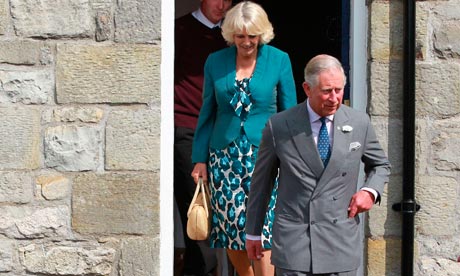
Prince Charles
The Prince of Wales's most senior official is to defend the tax status of his £763m Duchy of Cornwall hereditary estate before the Commons public accounts committee, which has already scrutinised the tax affairs of Starbucks, Google and Amazon.
As Clarence House revealed Prince Charles received a record private income of £19m from the duchy last year – a 4.1% increase on the previous year – his principal private secretary, William Nye, said: "Naturally we are happy to appear before the PAC if they would like to see us."
Nye and the estate's finance director, Keith Willis, have been summoned before the committee on 15 July. MPs on the committee have questioned whether the tax status of the hereditary duchy – which saw its capital value increase by 4.9% last year – "remains defensible". It pays no corporation or capital gains tax.
The duchy, which has a portfolio of land, property and investments and published its annual accounts late on Thursday evening, provides income for the heir to the throne.
Nye stressed that the prince "voluntarily" paid income tax on the surplus of his duchy income after official expenses had been deducted. His tax bill fell sightly last year by £70,000 to £4.26m, a drop of 1.5%.
But it is not income tax that interests the PAC who have noted public concern over the duchy's exemption from corporation and capital gains tax. Any change to the duchy's tax status threatens to reduce the annual surplus paid to the prince for his private and official spending.
Charles's annual accounts show that he spent more than half – £10,952,000 – on official expenditure. He is also believed to have spent at least £1m on official activities carried out by the Duke and Duchess of Cambridge and Prince Harry, including covering their office staff costs, though their official travel, security and refurbishment of the Cambridges' Kensington Palace apartment are met by the taxpayer. A breakdown of the young royals' costs was not revealed, but they are said to be "a significant element" of the £2,088,000 Charles paid out on "other expenditure."
His funding from the British taxpayer fell by 47% from £2.1m to £1.1m, but officials admitted this was due in large part to his travel costs visiting the realms of Australia, Canada and New Zealand where the Queen is also head of state, being met by the host countries.
Charles's expenditure includes the costs of 125.4 full-time official positions plus eight personal staff, including secretaries, chefs and valets, and 15 estate, farm, garden and stable staff. He also funds the 10.5 full-time staff employed for the Duke and Duchess of Cambridge and Prince Harry.
At a briefing on the prince's finances, Nye said that "special rules" applied to the duchy. "The Prince of Wales gets the income from the duchy but he doesn't have access to the capital. That has always been the case," he said.
"The duchy is a unique organisation. And, because it is unique, it isn't completely straightforward. We can explain it but it takes a little bit of explanation and we're happy to provide that explanation."
The duchy, founded in 1337, was not a corporation, so did not pay corporation tax. And to pay capital gains tax would undermine the reason behind it being set up, he said.
"The whole point about the duchy is that it is set up specifically, and indeed is required by law, to maintain its capital, to roll over and maintain its capital and to invest in the future so as to generate income for the future.
"Indeed, the only reason why accounts are put before parliament in the first place is because there is an obligation to the treasury to produce those accounts to demonstrate that the treasury is doing its job of checking that the duchy is maintaining its capital . So whatever the duchy sells, any asset, it has to put the money back in to maintain the capital.
"Of course, parliament could legislate to require the duchy to pay capital gains tax if they wish to, but that would completely undermine the point of why it evolved in the first place."

Monday, June 3, 2013

Why do we have to trawl for the facts about Britain and the EU?

Finally, the absurd fishing quota policy that sometimes results in 50% of the catch being discarded is going to change.
With fishing policy, as with Italy's attempt to ban plastic bags, our government is terrified of appearing to allow the EU to undermine British 'interests'
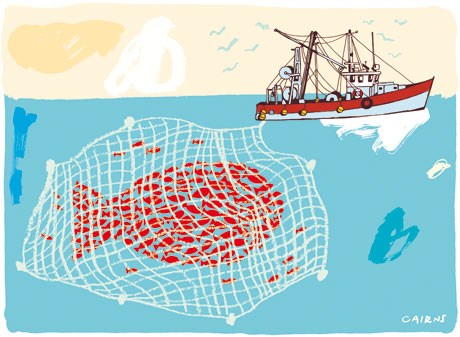
Brian Cairns illustration
For years, campaigners have been fighting against industrial fishing in European waters and last week, at long last, they had something to celebrate. Their target has been the huge factory ships that hoover up everything in their wake, discarding the dead fish they don't want – often half the catch – and returning to port with their quotas met the most profitable way. The result has not just been dwindling fish stocks – the entire marine ecosystem is under assault, including the coastal fishing communities that depend on it for their livelihood.
No one European country can make a difference by itself: fish do not respect borders. In any case, the danger for any one country acting unilaterally to husband fish stocks and ban the practice of discarding dead fish is that if others do not follow suit it will be the sucker. It will have hurt its own fishing interests just to benefit others. This is a problem that can only be solved by European countries acting together.
Last Thursday at 3am, EU members states finally agreed the outlines of a tough Common Fisheries Policy. First, there was a commitment for the first time to set quotas – based on hard scientific advice – that aim to go beyond stabilising fish stocks to achieving growth. Crucially, from 2015, boats will be forbidden from discarding unwanted dead fish, starting with species such as mackerel that live in the upper oceans, and extended to all fish types by 2020. Every country will have to submit a detailed plan for how it intends to meet its quota, but making its own decision about which types of fishing it will favour. But with discards effectively banned – inevitably, under British pressure, boats will still be allowed to discard 5% of their catch after 2020 – there will be an inbuilt bias against industrial fishing. This is a major move to help stocks.
Battle-hardened campaigners could only blink in semi-disbelief. Hugh Fearnley-Whittingstall, the leader of Fish Fight, who has signed up more than 860,000 supporters to work for tougher quotas and a ban on discards, hailed the deal as a "tremendous achievement". Even Greenpeace managed a grudging congratulation: "For all its loopholes and sluggish timelines the policy has the potential to turn Europe's destructive and oversized fishing industry into a sustainable, low-impact sector." The fishing industry acknowledged a corner had been turned.
It was a great example of an increasingly democratic EU beginning to work rather well. For the policy to become law, the European parliament will have to give its assent – and on this question it is very radical. EU fisheries ministers, managed cleverly by EU Commissioner Maria Damanaki, knew they had to come up with something strong, or parliament's endorsement would be impossible. But equally, the deal is only sellable domestically if governments accountable to national parliaments and electorates work out exactly which parts of their domestic fishing industry are going to shoulder the pain. Here is a policy that is democratically legitimate at EU and national levels, respects national sovereignty and solves a problem that no one country could solve itself.
However, this will be news to almost every reader of this column. No national newspaper printed it. It did break at 3am, but apart from the FTthere was not even online coverage and no follow-up the following day. Intriguingly, even the BBC's Today programme felt the story could be ignored; the juicy European news of the day was a BBC scoop that the EU Commission is going to take Britain to court over the government's alleged discriminatory withdrawal of welfare benefits from EU nationals. It was a good story, but listeners might also have been interested in hearing the fishing deal discussed – or even that it had happened. After all, the news was only hours old. Fish Fight does have 860,000 supporters: the effective ending of discards was hardly marginal news.
But the story did not fit the narrative. The British view, hardwired into the political and media class's DNA, is that the EU is a mess about to disintegrate under the weight of its absurd, anti-democratic ambitions to become a superstate, with its even more absurd single currency. It does nothing worthwhile, harms all British interests and we must stay disengaged or, at best, leave altogether. Every editor knows that no positive stories emanate from Brussels, and even if they do, there are no penalties for ignoring them.
It is utterly disabling. The technical reason why Britain fought so hard to continue to allow boats to discard 5% of their catch after 2020 is that allegedly in British waters, shoals of fish are more intertwined than in other waters, so catching fish that have to be discarded is more likely. Really? My hunch is that without the concession officials and ministers were terrified of Nigel Farage and Eurosceptic Tory MPs lining up with some disgruntled fishermen to claim the big bad EU had undermined British "interests".
Certainly, that was why Britain last week blocked Italy from implementing a ban on single-use plastic bags as discriminatory under EU law against British plastic bag manufacturers. Now no EU country can adopt what is clearly a sane environmental move – at one time supported by the prime minister – because of a reflex terror of a complaint by "wealth-creating" business that EU regulation is undermining British interests. (Both Wales and Northern Ireland have introduced a plastic bag levy.)
Nor will anybody have juxtaposed the richly comic spectacle of the British government prosecuting Italy for being discriminatory under EU law even as it protests against the injustice of being called discriminatory itself over welfare. Instead, there is synthetic outrage about Britain being singled out by a mutton-headed and politically insensitive European Commission. Yet the entire EU is based on the principle that there are common European interests, extending from how we fish our seas to how we explore space, that are underpinned by the notion that member states do not discriminate against each other. The rule of European law is universal, as it should be in rule-of-law societies. The Commission has no option but to uphold it.
This is a club worth staying in. It is much better for Britain's fishing industry – along with every other industry – that we are in the EU as it makes its rules. If the British are to make an informed choice about their destiny in any future referendum, then at least they deserve to know the facts. Judging by last week they will not be able to rely on their media for those or on their terrified politicians.

Friday, May 24, 2013

Tesco bonus cuts: Profit fall dents rewards for supermarket workers

That's the way it should be: workers get some bonus, execs get none with falling profit.

From - http://www.mirror.co.uk/money/city-news/tesco-bonus-cuts-profit-fall-1907685


Tesco workers paid the price for the biggest profit slump in its history after their bonus pot was halved.
Trolleys are stacked outside a Tesco store in Hammersmith, west London October 3, 2012. REUTERS/Paul HackettThe supermarket giant’s 280,000 UK staff will share a payout worth £56million, down from £110m a year earlier, and worth a maximum of £1,625 per employee.
Tesco’s 5,000 top managers and its board will also lose out after their annual bonus and long-term share awards were axed.
The clampdown came after annual profits crashed 51% to £1.96billion.
It was left facing a £1.2bn hit from pulling out of the US by axing its Fresh & Easy business.
Philip Clarke, who has begun a £1bn ­fightback in the UK, missed out on an annual bonus for the second year running after waiving last year’s award. But he has just got £830,000 worth of shares, granted in 2010, on top of his £1.1m salary.
Tesco’s top execs still shared nearly £9m in pay and perks. Finance director Laurie McIlwee saw his total pay fall almost 20% to £917,000.
Tesco’s annual report also showed the firm paid two ousted directors £3m.
Tim Mason, who ran the troubled US arm, got £1.6m, while former UK chief Richard Brasher received a £1.3m pay-off.
Senior managers will only get an annual bonus if they manage to turn things around, the report said.
Under a new plan, annual payouts will be “less heavily weighted towards short-term profits”.
If maximum targets are met, Clarke could earn as much as £7m.
The £56m staff shares award is equivalent to 1.5% of an employee’s earnings, and is payable to workers who joined the group before February 25.
Shares are held in trust and can be sold after three years. A company spokeswoman said: “It’s not been a secret it’s been a challenging year for the business.”
The retailer also unveiled a new campaign to cut food waste from both its ­operations and supply chain, and among customers as part of its Tesco and Society report.
It aims to tackle the £680 worth of food that is thrown away by ­households every year, and includes selling food in smaller sizes at its convenience stores and tailoring ­promotions away from goods with shorter shelf lives.

Tuesday, May 21, 2013

Apple 'among largest tax avoiders in US' - Senate committee

A few days ago Google claimed that the reason it seems to be paying low taxes outside of its home country is because the buklk of its taxes are paid in the US.  Apple obviously does not have the same excuse.

From - http://www.bbc.co.uk/news/business-22600984

Apple has been accused of being "among America's largest tax avoiders".
Apple chief executive Tim Cook


A Senate committee said Apple had used "a complex web of offshore entities" to avoid paying billions of dollars in US income taxes. But it said there was no indication the firm acted illegally.
Apple chief Tim Cook will go before the panel on Tuesday. In prepared testimony Apple said it did not use tax gimmicks.
The Irish Republic, home to three Apple subsidiaries, says it is not to blame for the firm's low tax payments.
The US Senate had said that Apple paid little or nothing on billions of dollars in profits placed in Irish subsidiaries.
"They are not issues that arise from the Irish taxation system," Deputy Prime Minister Eamon Gilmore told national broadcaster RTE when asked about the Senate committee report.
"They are issues that arise from the taxation systems in other jurisdictions and that is an issue that has to be addressed first of all in those jurisdictions."
Apple has a cash stockpile of $145bn (£95bn), but the Senate committee said $102bn of this was held offshore.
The company says it is one of the largest taxpayers in the US, having paid $6bn in federal corporate income tax in the 2012 fiscal year.
The Senate Permanent Subcommittee on Investigations has been examining "methods employed by multinational corporations to shift profits offshore".
Some large firms in the US have come under fire for their reluctance to repatriate their foreign earnings as they could face a top tax rate of 35%.
US corporation tax is one of the highest in the world at 35%. However, companies typically pay far less, thanks to numerous deductions and exemptions.


Sunday, May 19, 2013

'Google is cheating British taxpayers out of millions... what they are doing is just immoral': Web giant accused of running 'scandalous' tax avoidance scheme by whistleblower Read more: http://www.dailymail.co.uk/news/article-2326897/Google-tax-avoidance-row-Internet-giant-accused-scandalous-tax-avoidance-scheme-whistleblower.html#ixzz2TkN0odzA Follow us: @MailOnline on Twitter | DailyMail on Facebook

From - http://www.dailymail.co.uk/news/article-2326897/Google-tax-avoidance-row-Internet-giant-accused-scandalous-tax-avoidance-scheme-whistleblower.html

* Barney Jones said Google diverts British profits through Ireland to Bermuda 
* Former executive said company 'pulled the wool over the eyes' of HMRC
* Adds to mounting pressure on Google over its tax affairs 
* Company says all sales contracts go through its low-tax Ireland office 
* Last year, paid just £7.3million in corporation tax on UK turnover of £3billion

A former Google executive turned whistleblower says he has 100,000 emails that expose the 'immoral' tax avoidance scheme used by his former employer.
Barney Jones said the company has 'pulled the wool over the eyes of HMRC and the British population'
Barney Jones, who worked for Google from 2002 until 2006, said the company has 'pulled the wool over the eyes of HMRC and the British population'.

He claims Google has a system in place which diverts British profits through Ireland to the Bermuda tax haven and accused the company of 'cheating' the British taxpayer. 

The internet giant has been under increasing pressure about allegations of tax avoidance.
Prime Minister David Cameron will lead efforts at next month's G8 summit of world leaders to find ways of preventing multinational firms from exploiting tax loopholes.

He is due to meet Google's executive chairman Eric Schmidt tomorrow at the quarterly meeting of the prime minister's Business Advisory Group. 

Last week, Matt Brittin, a vice-president of Google, was aggressively questioned by MPs, who accused the company of 'doing evil' by using 'devious, calculated and unethical' tricks to minimise its liabilities.

It paid just £7.3million in corporation tax last year despite having a UK turnover of £3billion.

Yet, Google assert that all its sales are made in low-tax Ireland, rather than the UK, where corporation tax is just 12.5 per cent compared to 23 per cent in Britain. 

Mr Jones's earlier testimony to the PAC gave MPs such as chair Margaret Hodge further ammunition for the questioning of Mr Brittin last week.