This blog is a layman's view of what's wrong with the world economy and, perhaps, how to correct them. Included in this blog will be renewables, green, sustainability and other such topics.
I hope some of these will be "good news".
Internet giant Google has put aside £24m to pay corporation tax in the UK following a review of the way the company pays its employees in shares that are billed through its Irish subsidiary. Google has some 2,000 UK employees; in 2011 they received £50m in US shares and they received a similar amount in 2012.
Although this share-payment scheme was legal, HMRC scrutinised the arrangements because the company claims the payments as tax-deductible but under new guidelines share payments must be counted as revenue. As a result, Google said in its 2012 accounts, the company had "made a provision of £24m for potential corporation tax for the years under review".
Google has faced persistent criticism over its tax arrangements. Last June the Public Accounts Committee (PAC) of MPs called on the company to be investigated when former employee turned whistle-blower Barney Jones claimed the UK branch engaged in advertising sales, despite Google's insistence that sales took place in Ireland – a practice he described as immoral.
“The company's highly contrived tax arrangement has no purpose other than to enable the company to avoid UK corporation tax.”
Speaking about that arrangement, chairwoman of the PAC Margaret Hodge said: "Google brazenly argued before this committee that its tax arrangements in the UK are defensible and lawful. The company's highly contrived tax arrangement has no purpose other than to enable the company to avoid UK corporation tax."
Similar schemes have been adopted by other technology giants including Apple, Facebook and Amazon. In 2012, Apple's UK revenue was estimated at £9.5bn and Facebook's at £307m, yet neither paid any corporation tax. Amazon, which had revenue of an estimated £3.7bn, paid just £2.4m in corporation tax.
Whereas Amazon channels its financial transactions through Luxembourg, Google, Facebook and Apple base their European operations in Ireland, which has lower corporation taxes than in the UK. However, a spokesman for Google pointed out that the company pays much of its corporation tax in the US and it remains a significant contributor to the UK, paying around £150m in tax.
The world's largest coffee chain has endured widespread criticism over low tax contributions in Britain, since Reuters reported in 2012 that the company had told the UK tax authority it was lossmaking while informing investors that the British subsidiary was profitable.
Following the Reuters report, Starbucks was called to testify before a parliamentary hearing about its tax affairs, where it revealed it had agreed a deal with the Dutch tax authorities that allowed it pay "a very low tax rate" there.
"This move will mean we pay more tax in the UK," the company said in a statement, without giving further details.
Starbucks regional president Kris Engskov said London was "the perfect place to grow our European business".
Oxfam International, a poverty fighting organization, made news at the World Economic Forum in Davos earlier this year with its report that the world’s 85 richest people own assets with the same value as those owned by the poorer half of the world’s population, or 3.5 billion people (including children). Both groups have $US 1.7 trillion. That’s $20 billion on average if you are in the first group, and $486 if you are in the second group.
Oxfam’s calculations of the richest individuals are based on the 2013 Forbes Billionaires list. I decided to take a closer look at this group of 85 in search of trends. That’s when I realized that they are by now a much wealthier group. The rich got richer. And it was quite fast and dramatic. For example, while last year it took $23 billion to be in the top 20 of the world’s billionaires, this year it took $31 billion, according to Luisa Kroll, Forbes wealth editor, writing on Forbes.com.
As a result, by the time Forbes published its 2014 Billionaires List in early March, it took only 67 of the richest peoples’ wealth to match the poorer half of the world. (For the purpose of this blog, I will put aside the conversation about the importance of income inequality versus impoverishment. This has recently been skewing strongly toward recognition of the importance of income distribution and its inequality, most recently with the publication of Capital in the Twenty-First Century by Thomas Piketty.)
Each of the 67 is on average worth the same as 52 million people from the bottom of the world’s wealth pyramid. Bill Gates, the world’s richest man, with a net worth of $76 billion, is worth the same as 156 million people from the bottom.
Who are the 67? The biggest group—28 billionaires, or 42% of them—is from the United States. No other country comes close. Germany and Russia have the second-highest number, with six each. The rest are sprinkled among 13 countries in Western Europe, APAC and the Americas.
That the biggest group of the super rich comes from the U.S. should not be a surprise, as the country holds almost a third of the world’s wealth (30%), significantly more than any other country, according to the Global Wealth Databook, from Credit Suisse Research Institute. However, Europe, with a slightly bigger chunk of the world’s wealth (32%), produced substantially fewer of the richest. That is due to less dynamic economies, which do not equal the U.S. in how they foster innovation, on which many of the newest U.S. fortunes are based.
When comparing the ratio of the richest to the percentage of the world’s wealth held by each country, it is Russia that comes out the most lopsided, with its holdings skewed to the super rich. As a country, Russia holds only half a percent of the world’s wealth, and yet it has 9% of the 67 richest.
The 67 fortunes come from three main industries: technology (12), retail (12) and natural resources-based sectors such as oil and gas, mining and steel. The geographical split by industry illustrates the state and progression of the various economies. Almost all technology fortunes are recent and from the U.S. (MicrosoftMSFT-0.4%, Oracle, Facebook). Retail is dominated by second- or third-generation Western Europeans. The majority of the rich whose money comes from natural resources are from emerging markets, with most of them from Russia.
The majority of the 67—40, or 60%, to be precise—are self-made.
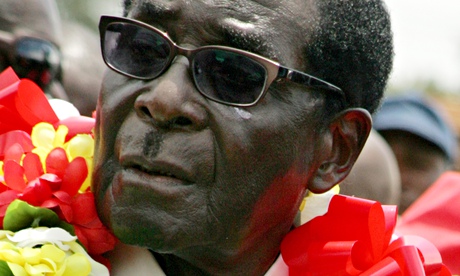
Robert Mugabe is expected to celebrate with thousands of supporters at the Rudhaka stadium in Marondera. Photograph: Jekesai Njikizana/AFP/Getty Images
Plans for a lavish $1m (£600,000) celebration of Zimbabwean presidentRobert Mugabe's 90th birthday have been condemned as the country lurches towards another financial crisis.
The tribute to Africa's oldest head of state – and second oldest in the world after Israel's Shimon Peres – is expected to surpass last year's party, when special gold coins were minted and Mugabe was presented with a cake said to weigh 89kg.
But the costly event will come amid heavy job losses, slowing economic growth and what the central bank describes as a "severe and persistent liquidity crunch", reviving memories of the disastrous meltdown five years ago.
But he is expected back in time for the birthday celebration with thousands of supporters at the Rudhaka stadium in the town of Marondera on Sunday, two days after he turns 90.
Absalom Sikhosana, secretary for youth affairs in Mugabe's Zanu-PF party, told reporters recently: "This is a very special celebration. Turning 90 is no mean feat. You cannot turn 90 years when you are a womaniser, a drunkard or a chain smoker. We will be celebrating the life of a very special person on a very special occasion."
It is a milestone in the history of the country, which has known no other leader since gaining independence from Britain in 1980, but activists and opposition politicians described the event as an extravagant waste of money when many citizens are going hungry.
"It would be inappropriate for a country's head of state to have such a lavish and costly celebration at a time when the country is faced with the disaster of flooding and a crumbling economy," said Dewa Mavhinga, a Zimbabwe researcher at Human Rights Watch. "It's about cultism, hero worship, institutionalising Mugabe, with sycophants around him trying to oil the wheels of patronage. There's an entire system behind this corruption."
Reflecting on Mugabe's 34 years in power, Mavhinga added: "His human rights record is one that no one can honestly admire. There is nothing to celebrate about his birthday or his legacy – and there are concerns that, if something should happen to him, the country might be plunged into chaos if there is no clear mechanism for transition."
The Associated PressPosted: Oct 03, 2013 11:22 AM ET Last Updated: Oct 03, 2013 10:43 PM ET
The U.S. government shutdown entered its third day on Thursday. Here's a photographic look at some parts of American life that are closed or severely affected by Washington shutting down. (Larry Downing/Reuters)
1 of 14
Related Stories
President Barack Obama laid the blame for the U.S. government's partial shutdown at the feet of House of Representatives Speaker John Boehner on Thursday, escalating a confrontation that is running the risk of a potentially damaging clash over the country's borrowing authority.
The Treasury Department warned that a deadlock over raising the nation's debt limit could touch off a new recession even worse than the last one that Americans are still recovering from. Worry about prospects for resolving the debt question within the next two weeks deepened as the shutdown standoff dragged into a third day.
House Republicans adamant about cancelling, delaying or watering down President Barack Obama's signature health-care reform legislation have refused to pass spending measures without anti-Obamacare provisions. Senate Democrats insist that the Affordable Care Act, as it's formally known, was passed into law long ago and isn't up for reconsideration.
Late Thursday, the White House announced that Obama was abandoning an already abbreviated trip to Indonesia and Brunei next week in the face of the shutdown. White House spokesman Jay Carney said Secretary of State John Kerry would travel instead.
The Republican-controlled House has tried to push piecemeal legislation to fund individual departments and programs, but most Democrats, including Obama, want a comprehensive resolution that would reopen the whole government, not just bits of it.
The shutdown showdown grew more personal Thursday.
Speaking at a construction company in Washington's Maryland suburbs, Obama cast the House speaker as a captive of a small band of conservative Republicans who want to extract concessions in exchange for passing a short term spending bill that would restart the partially shuttered government.
"The only thing preventing people from going back to work and basic research starting back up and farmers and small business owners getting their loans, the only thing that is preventing all that from happening right now, today, in the next five minutes is that Speaker John Boehner won't even let the bill get a yes or no vote because he doesn't want to anger the extremists in his party," Obama said.
Boehner answered by batting blame back toward Obama and his "my-way-or-the-highway approach." Boehner said that if the president would negotiate to fix flaws in "Obamacare," the shutdown could end.
"The president's insistence on steamrolling ahead with this flawed program is irresponsible," said Boehner, a Republican from Ohio.
Eric Cantor, the Republican majority leader in the House of Representatives, said the House would continue on its course of passing separate bills to remedy "situations that are in critical stages" because of the partial government shutdown that began Tuesday.
The House was expected to vote to for more money for National Guard and Reserves and for veterans programs during the day, and officials said legislation to help some social programs could soon be drafted, as well.
All too often in the UK we hear senior business leaders and politicians bemoaning the lack of skilled labour. But China 30 or so years ago had very few skilled staff. So how did they progress to be the world's leading manufacturer and exporter?
Skill building must be rewards-based, rooted in real work, and tailored to local conditions.
July 2013 | byKarel Eloot, Gernot Strube, and Arthur Wang
Capability building—leadership, managerial, and team-based skills rather than technical ones—has become an urgent imperative for many companies in China. As the country loses its extreme low-cost-labor advantage, businesses must look for ways to increase productivity and internal collaboration, to better understand consumers, and to develop a more sophisticated appetite for risk.
Companies in China face many of the same challenges—a lack of up-front planning and inadequate resources—that bedevil capability-building exercises everywhere. But certain “China factors” stand out. For starters, the demand for managers with strong leadership skills and international experience is growing significantly faster than the supply of qualified candidates. That imbalance makes it more difficult to pull off successful skill-building efforts, even for multinationals that typically invest more in training than Chinese companies do. (Indeed, one implication of China’s white-hot war for talent is that outside trainers brought in by multinational companies to set up and run new programs often move on before relevant tools and internal processes are in place.) Another perennial challenge for multinationals: the Chinese context and culture, which may require local tailoring of global approaches.
Then, of course, there are China’s state-owned enterprises. Many of them only recently converted from government departments into commercial entities and are still working to adapt to a competitive environment and adopt a true business mind-set. These companies generally lack a systematic approach to nurturing employees moving up the organizational ladder. They misconstrue capability building as a classroom activity, missing the impact of linking it to actual business. And they are too inflexible either to fire underperformers or to reward and promote employees, including managers, who change their behavior and adopt the necessary mind-sets.
While the challenges facing multinationals and state-owned enterprises differ, our experience with leaders at both kinds of organizations (as well as with private-sector Chinese companies) has highlighted the importance of some common, broadly applicable principles. In this article, we describe three that should help companies overcome many of the obstacles that have frustrated capability-building efforts in the past.
1. Relate capability building to real activities
...
2. Instill incentives and create opportunities for promotion
...
3. Don’t forget China’s unique culture
...
The solutions may sound obvious: developing Chinese teaching materials to help solve problems, building day-to-day business problems around products that participants would find in the Chinese market, and localizing global training materials through culturally appropriate metaphors and examples. But we know from experience how easy it is to overlook these issues. In our own work, we routinely use a case involving a coffee machine to teach managers about the seven types of waste and how a “lean” perspective can address them. When we recently used this case at a Chinese state-owned enterprise, however, the managers couldn’t make sense of the story, because they had never used a coffee machine. We have now adapted the context to tea making.
About the authors
Karel Eloot is a director in McKinsey’s Shanghai office; Gernot Strube is a director in the Hong Kong office, where Arthur Wang is a principal.
If the following article's predictions do come true, then the world economy as we know it today will be destroyed as the unintended consequence. No trucks, freight trains, container ships, no major manufacturing facilities, no major hub warehouses. No truck and freight train drivers, no container ship crews, no depot warehousemen. No truck, freight train, container ship manufacturers; less construction workers and companies. I wonder ...
A SPECTRE is haunting the great container ship ports of China, with their highways jammed by lorries and the vast factory estates stretching from the coast of the South China Sea to the mountainous inland provinces.
It is the spectre of a revolution led by a quiet, software-driven 3D printer, a machine that can laser up layers of liquid or granular resin — or even cell tissue — into a finished product.
Some 3D printers are huge devices that make complete components such as aircraft parts. Others are small units that could stand next to a desk and create a small plastic prototype.
Maplin, the British electronics retailer, said last week it would start selling one for just £700. The Velleman K8200 will allow those who are so inclined to make simple objects — mobile phone covers, perhaps, or toys.
“The only restriction is your imagination. You can make whatever you want,” said Pieter Nartus, export manager at Velleman.
To visionaries in the West, the digital 3D printer promises to disrupt conventional manufacturing and supply chains so radically that advocates compare its impact to the advent of the production line, or the internet.
In China, whose big factories are thinking of using giant 3D printers for manufacturing, the technology does not seem to pose an immediate threat.
“It is on their horizon but it is not a factor right now,” says a British buying agent who sources plastics in China.
However, as Chinese leaders ought to know from their compulsory classes in Karl Marx, control of the means of production is everything. And if 3D printing takes off, production will come back to a place near you.
The implications, economists say, are limitless. No huge factories. No fleets of trucks. No ships. No supply chain. No tariffs. Few middlemen. Orders tailored exactly to demand, so no need for stock and warehouses. Just a printer, raw materials, software and a design.
The advantages do not end there. Because the item is “sintered” — created from a powdered material — to precise settings using a laser, there is no waste such as metal shavings. To customise a product, the user simply changes the software. An operator presses a button and the printer spits out the item.
“The first implication is that more goods will be manufactured at or closer to their point of purchase or consumption,” said Richard D’Aveni, a professor at Dartmouth College in America.
Writing in the Harvard Business Review, D’Aveni predicted the elimination of the long supply chain linked to a huge factory staffed by cheap workers and sited on the other side of the world.
It may be the most significant, if underplayed, article in that distinguished publication in decades.
Not surprisingly, 3D manufacturing has been dismissed by the boss of the biggest factories of them all, Terry Gou of Foxconn, which employs more than 1m Chinese workers making consumer electronics for Apple, Sony, Samsung, Nintendo and other household names in technology.
Foxconn has used some elements of industrial 3D printing for three decades but Gou says it is commercially impractical for mass production.
“3D printing is a gimmick,” he told reporters in Taiwan, where Foxconn is based. “If it really is that good, then I’ll write my name backwards from now on.”
Foxconn and its clients are still smarting from publicity over a chain of suicides at the company’s vast plants, where young employees live under heavy security and work to a strict management regimen on the production line.
Conditions on Chinese assembly lines, as in Bangladeshi garment workshops, have long concerned advocates of workers’ rights.
But it may not be the workers who ultimately overthrow the system. The use of 3D printing implies a transformation that persuades hard-headed economists such as D’Aveni that companies like Foxconn might just become obsolete.
“China has grabbed outsourced manufacturing contracts from every mature economy by pushing the mass-manufacturing model to its limit,” he wrote. “It not only aggregates enough demand to create unprecedented efficiencies of scale but also minimises a key cost: labour.
Watch a demonstration of the £700 Velleman K8200 printer, on sale at Maplin
“Under a model of widely distributed, highly flexible small-scale manufacturing, these daunting advantages become liabilities. No workforce can be paid little enough to make up for the costs of shipping across oceans.”
According to the British buyer, who provided a cost breakdown on a commercially confidential basis, a Chinese factory typically gets between 6p and 7p from a plastic product sold in Britain for £1. That includes its labour costs and profit.
Raw materials, shipping and ground transport add 24p to bring the landed price at a port in southern England to 31p.
The product will sell to the retailer for about 45p, handing the wholesaler a profit of 14p. The retailer marks the product up to £1 but the Treasury helps itself to 20p VAT, leaving the retailer a profit of 35p.
In the brutal war for margin amid volatile commodities and currencies at the bottom end of the market — where China has carved its niche — the numbers tell their own ominous story. In a world of 3D manufacturing, the classic supply chain makes no commercial sense.
“China won’t be a loser in the new era,” D’Aveni argued in the Harvard Business Review. “It will have a domestic market to serve . . . and its domestic market is huge. But China will have to give up on being the mass-manufacturing powerhouse of the world.”
China, of course, is not sitting still. It is eagerly buying western 3D printing technology and making its own lightweight machines to sell to consumers. The ministry of industry and information technology has already allocated £20m to fund 10 research centres and set up a group of 40 participating companies.
In May, Beijing hosted the World 3D Printing Technology Industry Conference. Luo Jun, head of a Chinese trade body, told the state media that the domestic 3D industry will generate about £1.1bn in revenues within three years.
Luo Zheng, sales manager of Renishaw, a Shanghai company, said Chinese firms were at present forced to buy large industrial printers made in Britain at a cost, he said, of about £650,000 each.
Nor has China yet mastered the complex chemistry of 3D inks and resins, so it is dependent on imports.
However, observers who have spent many years watching how China operates in world markets don’t expect such dependence to last.
Caixin, a business magazine, reports that a mechanical engineering professor at Tsinghua University, Yan Yongnian, first brought American 3D technology to China in the 1980s.
This year a research team at Beijing University, led by Wang Huaming, a professor of materials science and engineering, won an award for 3D innovation in aviation components from the State Council, China’s cabinet. The country’s military aviation industry is already using the technology. It is employed in making the J-16 fighter and the next-generation J-31, according to Huanqiu, a website linked to the Global Times. Scientists have used it to make critical load-bearing titanium components, including strengthened landing gear for planes that will be operating from aircraft carriers.
In June, Dalian University of Technology in northeast China unveiled the world’s largest 3D printer. According to Professor Yao Shan of the university, the industrial-grade machine also uses a cheaper form of print material that can cut operating costs by 40%.
In the medical field, researchers at Shining 3D Tech, a company based in Zhejiang province, showed off an artificial disc implant that can fuse with human cell tissue to avoid rejection. The company predicts that one day the technology could be used to manufacture human skeletons from cell tissue and biomaterial.
So there is no doubt about China’s scientific, engineering and intellectual commitment to 3D manufacturing.
However, it is a fundamentally different concept in China. To the Chinese, it is an industrial tool to be used in making more things to sell.
To western economies that are hooked on cheap imports with a huge carbon footprint, it could be a means of transformation — perhaps even an agent of de- industrialisation.
That conceptual divergence has led to a tone of complacency in some quarters in China. “Some western media said 3D technology will benefit the West, help American industry recover and attack China’s position as the factory of the world,” said Jia Jinjing, a management researcher, before adding: “I do not support this view.”
In an interview with a Chinese magazine, Environment and Livelihood, Jia said: “3D can make only a single-material product and it cannot print electronic components. Therefore 3D technology will not have a big impact on Chinese manufacturing.”
In the West, one very important person disagrees. In February, President Barack Obama declared that 3D technology could “guarantee that the next revolution in manufacturing is made in America”.
The fate of thousands of companies and millions of employees in the two biggest economies will depend on who is right.


 Email